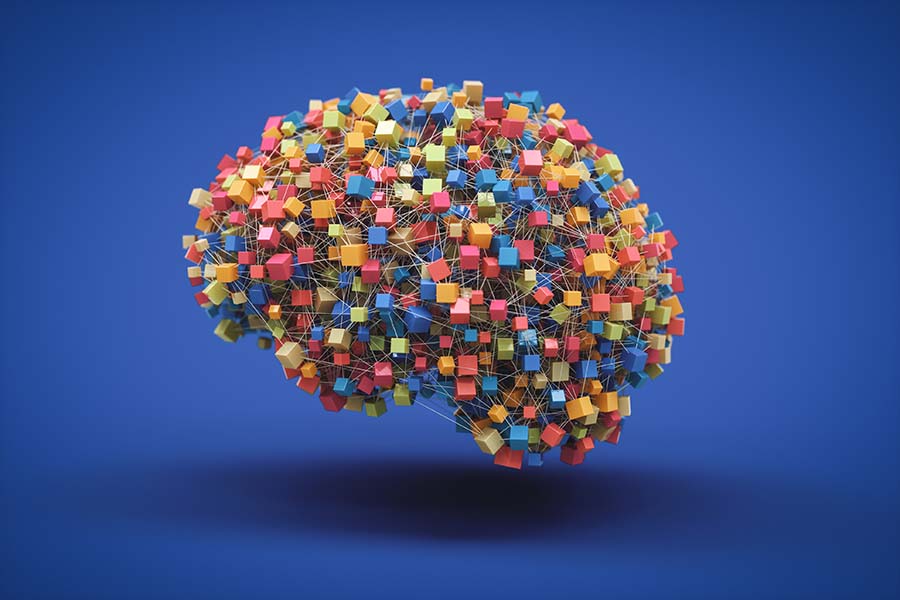
3 Questions: Neural transparency and the future of AI design
Assistant Professor Pat Pataranutaporn describes a new interface that lets everyday users glimpse inside an AI's neural network before their chatbot ever says a word.
More from the blog
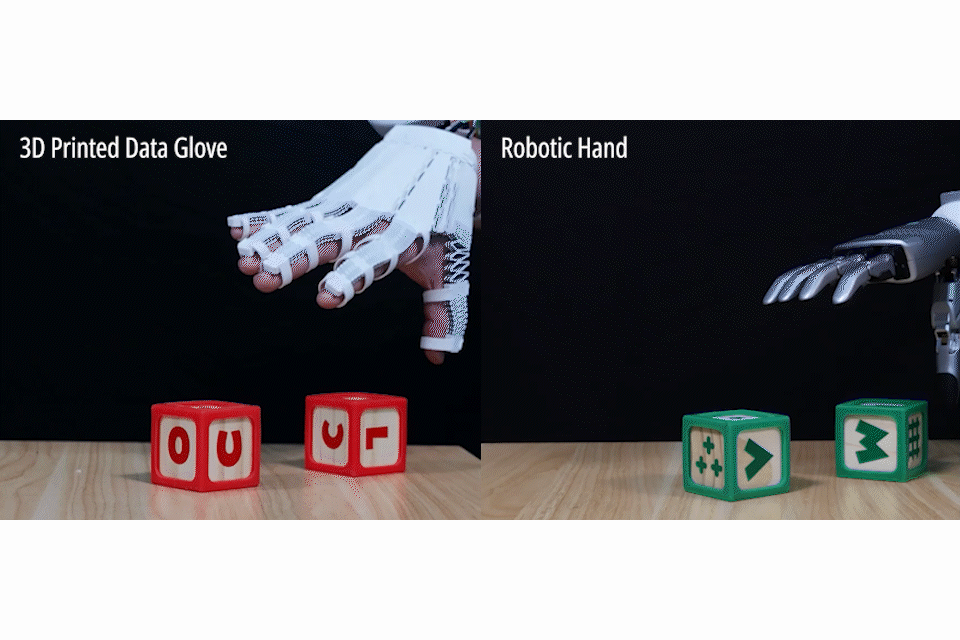
How an MIT research project became a global programming language
With millions of users across the world, Julia has been used to conduct cutting-edge research and to design new drugs, jet engines, heat pumps, and more.
Looking beyond natural sequences
A new machine-learning framework aims to improve the success rate of computational protein design while moving away from results that reproduce sequences found in nature.
AI helps design new materials that work in the real world
The “CrysVCD” tool developed at MIT could cut the huge amounts of time and money spent on screening out chemically unstable designs.
Following the questions where they lead
Assistant Professor Bailey Flanigan has arrived at complex computational methods for helping democracy thrive.
Related papers
Unified and explainable molecular representation learning for imperfectly annotated data from the hypergraph view
Molecular representation learning (MRL) has shown promise in accelerating drug development by predicting chemical properties. However, imperfectly annotation among datasets pose challenges in model design and explainability. In this work, we formulate molecules and corresponding properties as a hypergraph, extracting three key relationships: among properties, molecule-to-property, and among molecules, and developed a unified and explainable multi-task MRL framework, OmniMol. It integrates a task-related meta-information encoder and a task-routed mixture of experts (t-MoE) backbone to capture correlations among properties and produce task-adaptive outputs. To capture underlying physical principles among molecules, we implement an innovative SE(3)-encoder for physical symmetry, applying equilibrium conformation supervision, recursive geometry updates, and scale-invariant message passing to facilitate learning-based conformational relaxation. OmniMol achieves state-of-the-art performance in properties prediction, reaches top performance in chirality-aware tasks, demonstrates explainability for all three relations, and shows effective performance in practical applications. Our code is available in our https://github.com/bowenwang77/OmniMol public repository. AI models for drug discovery often struggle with real-world, incomplete data. Here, the authors present OmniMol, a framework using hypergraphs to improve predictions of molecular properties, addressing challenges of imperfect data annotation and enhancing model explainability.
Anomaly detection in smart power grids with graph-regularized MS-SVDD: a multimodal subspace learning approach
Anomaly detection in smart power grids is a critical challenge due to the complexity, heterogeneity, and dynamic nature of sensor data streams. Existing one-class classification methods, particularly Subspace Support Vector Data Description (SVDD), have been extended to multimodal scenarios but often fail to fully exploit the structural dependencies across modalities, limiting their robustness in real-world applications. In this paper, we address this gap by proposing a generalized Multimodal Subspace Support Vector Data Description (MS-SVDD) model with graph-embedded regularization. The method projects data from multiple modalities into a shared low-dimensional subspace while preserving modality-specific structure through Laplacian regularizers. Our approach is evaluated on a three-modality dataset derived from smart grid event time series, using a dedicated preprocessing pipeline for constructing one-class classification training samples. The results demonstrate that our graph-embedded MS-SVDD improves robustness of event detection compared to conventional approaches, highlighting the potential of integrating graph priors with multimodal subspace learning for advancing anomaly detection in critical infrastructure. More broadly, this work contributes to the wider field of AI by illustrating how relational and structural information can be systematically embedded into one-class models, enabling robust learning under complex, high-dimensional, and multimodal conditions.
HiCLR: Knowledge-Induced Hierarchical Contrastive Learning with Retrosynthesis Prediction Yields a Reaction Foundation Model
Reaction representation learning is of paramount importance for adopting deep-learning-based chemistry modeling to solve real-world tasks such as synthesis planning. Most prevailing models are prestrained by self-supervised objectives that rely solely on the chemical structure information. Since structurally similar reactions could possess entirely distinct properties (e.g., reaction yields) and the synthesis-related tasks are highly heterogeneous, there are inherent limitations in constructing a foundational reaction model within the existing approaches. To tackle this limitation, we propose HiCLR, a knowledge-induced hierarchical contrastive learning framework for chemical reactions, by introducing relational inductive bias to forge chemically meaningful and generally applicable reaction fingerprints. Critically, the pretraining scheme combining both retrosynthesis prediction and contrastive loss enables HiCLR to tackle generation-based and understanding-based tasks simultaneously. Comprehensive experiments demonstrate that HiCLR successfully organizes the reaction space into hierarchical global semantic clusters, aligned well with prior knowledge. Consequently, HiCLR is the first foundation model that can be broadly applied to various synthesis-related tasks, and it achieves state-of-the-art performance in reaction classification, reaction condition recommendation, reaction yield prediction, synthesis planning, and even molecular property prediction. HiCLR demonstrates clear benefits in incorporating domain knowledge to guide the learning of neural networks, expediting AI-driven advancements in chemistry.