Concatenating quantum error correction codes scales error correction capability by driving logical error rates down double-exponentially across levels. However, the noise structure shifts under concatenation, making it hard to choose an optimal code sequence. We automate this choice by estimating the effective noise channel after each level and selecting the next code accordingly. In particular, we use learning-based methods to tailor small, non-additive encoders when the noise exhibits sufficient structure, then switch to standard codes once the noise is nearly uniform. In simulations, this level-wise adaptation achieves a target logical error rate with far fewer qubits than concatenating stabilizer codes alone--reducing qubit counts by up to two orders of magnitude for strongly structured noise. Therefore, this hybrid, learning-based strategy offers a promising tool for early fault-tolerant quantum computing.
Nico Meyer, Christopher Mutschler, Dominik Seu{\ss} et al.· 0 citations
Parameterised graph theory studies how the complexity of graph-theoretic problems depends on structural parameters of the input graph. This perspective has proved useful in analysing tensor-network simulation (Markov and Shi, 2008). Its implications for tensor-network representations and tomography are less well understood. In particular, which graph parameters determine whether a tensor-network state (TNS) admits a tractable matrix product state (MPS) or tree tensor network (TTN) representation, and which control the complexity of learning the state?
We address these questions using parameterised graph theory. First, we show that cutwidth and tree-cutwidth bound the bond dimension overhead required to represent a TNS as an MPS or TTN. In the TTN case, tree-cutwidth also bounds the local dimension of the grouped subsystems. The proofs are based on entanglement rerouting, a tensor-network analogue of rerouting information in a classical network. Second, we derive graph-dependent upper bounds on the sample and computational complexity of realisable TNS tomography, with exponents that depend on cutwidth, tree-cutwidth, and a new graph parameter, learning complexity, which we bound in terms of degree and treewidth. We obtain these results by extending the disentangling MPS learner of (Cramer et al., 2010), as analysed further in (Bakshi et al., 2025; Lin et al., 2025), to TTNs and to tensor networks on arbitrary known graphs. Finally, we extend the framework beyond the realisable setting. For an arbitrary input state, our agnostic learner outputs a pure state whose fidelity is within additive error $\epsilon$ of the optimum over tensor-network states on the given graph with a given bond dimension, with explicit graph-dependent bounds on sample and computational complexity.
Matthias C. Caro, Natalie McHugh, Sergii Strelchuk· 0 citations
The computation of the Bures-Wasserstein (BW) barycenter of an ensemble of positive definite matrices arises throughout machine learning, optimal transport, and quantum information. Riemannian gradient descent (RGD) at unit step size -- the fixed-point iteration used in practice -- converges rapidly, yet existing analyses present a dichotomy: unit-step guarantees carry worst-case exponential dependence on the dimension, while dimension-independent guarantees require small step sizes that forfeit the empirical speed. We resolve this dichotomy, not by improving the guarantees for unit-step RGD, but by proposing a Projected RGD algorithm that achieves dimension-independent linear convergence at unit step size. The achieved rate, $(1 - \kappa^{-3/2})$, where $\kappa$ is the condition number of the ensemble, also polynomially improves on the best small-step guarantee ($\kappa^{3/2}$ versus $\kappa^{5/2}$ iteration complexity). The crux is a novel Projection Lemma: clipping the eigenvalues of a positive matrix to an interval $[\alpha, \beta]$ is the closed-form, non-expansive (1-Lipschitz) BW-metric projection onto the set $\{S : \alpha I \leq S \leq \beta I\}$ -- a statement which, unlike its known one-sided counterpart, does not follow from convexity. The projection is moreover free: it reuses an eigendecomposition the next iteration must perform in any case, so the projected and unprojected iterations cost the same per step. The same analysis covers the invariant matrix projection problem of Brahmachari et al. (2025), whose fixed-point algorithm we identify as unit-step RGD on a totally geodesic submanifold, thereby extending the dimension-independent guarantee to that setting verbatim.
Maximum likelihood prediction (MLP) is a core task at the heart of modern large language models. Here, we study a quantum version of this task for a simplified data model consisting of independent and identically distributed samples, as a first step. The quantum maximum likelihood predictor (QMLP) is obtained by embedding of empirical probability distributions into quantum states and performing a minimization of quantum relative entropy over a given class of states. We derive non-asymptotic performance guarantees for QMLP in terms of convergence rates and concentration inequalities, both in trace norm and quantum relative entropy. Our approach provides a unified framework to handle MLP within both classical and quantum LLMs. We also consider the related problem of quantum information projection and generalize the quantum Pythagorean theorem to mixture families specified by possibly non-self-adjoint linear constraints. We further show that the Pythagorean inequality continues to hold in the infinite-dimensional setting whenever the convex information-projection problem attains a finite minimum.
Sreejith Sreekumar, Nir Weinberger· 0 citations
Reach audiences
Advertise in front of researchers, engineers, and readers.
Quantum error correction (QEC) is essential for scalable quantum computing, yet decoding errors via conventional algorithms result in limited accuracy (i.e., suppression of logical errors) and high overheads, both of which can be alleviated by inference-based decoders. To date, such machine-learning (ML) decoders lack two key properties crucial for practical fault tolerance: reliable uncertainty quantification and robust generalization to previously unseen QEC codes. To address this gap, we propose a Quantum Bayesian graph Attention decoder \textbf{(QuBA)} that enables expressive error-pattern recognition alongside calibrated uncertainty estimates. Building on QuBA, we further develop a multi-phase training framework with enhanced cross-domain robustness enabling decoding beyond the training set called Sequential Aggregate Generalization under Uncertainty \textbf{(SAGU)}. Experiments on bivariate bicycle (BB) codes and their coprime variants demonstrate that (i) both QuBA and SAGU consistently outperform the classical baseline belief propagation (BP), achieving up to a \emph{two orders of magnitude} reduction in logical error rate (LER) under confident-decision bounds on the coprime BB code $[[154,6,16]]$; (ii) SAGU achieves decoding performance comparable to or even outperforming QuBA's domain-specific training approach.
Quantum error correction is crucial for protecting quantum information against decoherence. Traditional codes like the surface code require substantial overhead, making them impractical for near-term, early fault-tolerant devices. We propose a novel objective function for tailoring error correction codes to specific noise structures by maximizing the distinguishability between quantum states after a noise channel, ensuring efficient recovery operations. We formalize this concept with the distinguishability loss function, serving as a machine learning objective to discover resource-efficient encoding circuits optimized for given noise characteristics. We implement this methodology using variational techniques, termed variational quantum error correction (VarQEC). Our approach yields codes with desirable theoretical and practical properties and outperforms standard codes in various scenarios. We also provide proof-of-concept demonstrations on IBM and IQM hardware devices, highlighting the practical relevance of our procedure.
Nico Meyer, Christopher Mutschler, Andreas Maier et al.· 0 citations
We present quantum speedups for sampling from distributions of the form $\pi\propto e^{-f}$ on $\mathbb{R}^d$. We consider two stochastic oracle models: a stochastic gradient oracle, where $f=\frac{1}{n}\sum_{i=1}^n f_i $ and component gradients $\{\nabla f_i\}_{i \in [n]}$ are available, and a stochastic evaluation oracle, where only noisy values of $f$ are available. Our framework accelerates classical stochastic Langevin Monte Carlo (LMC) and Hamiltonian Monte Carlo (HMC) algorithms by replacing stochastic gradient estimators with variance-controlled quantum mean estimation and gradient estimation subroutines. Unlike quantum walk based approaches, our algorithms do not require reversibility or exact gradients, and they preserve the structure of the underlying Markov chain. In the finite-sum setting, quantum mean estimation combined with classical variance-reduction techniques improves the stochastic gradient-query complexity for the approximate sampling task. In the stochastic zeroth-order setting, we develop gradient estimators robust to noisy function evaluations, yielding improved evaluation complexity for LMC and HMC. These results apply to strongly log-concave and/or non-log-concave distributions satisfying a log-Sobolev inequality, with convergence guarantees in Wasserstein distance and Kullback--Leibler divergence. We also show that faster sampling methods lead to quantum speedups for optimization, including for non-smooth and approximately convex objectives.
Guneykan Ozgul, Xiantao Li, Mehrdad Mahdavi et al.· 0 citations
Quantum generative models offer a promising framework for exploring whether quantum computation can enhance generative machine learning. Flow matching is a generative method in which samples are generated by transporting a simple, known distribution to the target data distribution with a learned velocity field. Its quantum counterpart, known as quantum flow matching (QFM), was introduced recently, and, like its classical counterpart, requires integrating an ordinary differential equation over many time steps during inference. As each step requires the output from the previous step, the circuit submission is sequential and a drawback on quantum computers as they have high input/output costs. To alleviate this problem, we introduce Quantum MeanFlow (QMF), the quantum analogue of the MeanFlow formulation, which allows single-step sample generation. While the QFM learns an instantaneous velocity field at each time step, QMF learns the average velocity over a time interval. We use a parameterized quantum circuit to learn these velocity fields and benchmark the two methods on the MNIST dataset. We show that while single-step QMF has lower image quality compared to multi-step QFM, it performs better than the single-step QFM sampling at every shot count. Both of our models are executed on IBM quantum computers and best-of-N rejection sampling recovers most of the accuracy lost to device noise without modifying the circuit. This is especially advantageous for QMF which has only one circuit evaluation per image. Here, We establish QMF as a viable method for single-step quantum generative sampling, saving on quantum circuit evaluations per generated sample.
Angle-encoded quantum kernels on tabular data collapse when the feature map is wider than the intrinsic dimension of the data. We propose the correlation fractal dimension D2 as an a priori qubit budget: encode D2 coordinates chosen by FD-ASE instead of the PCA-95% width or all E attributes. On nine data sets and a statevector simulator (n= 32), a one-layer ZZ fidelity kernel at q=D2 stays geometrically alive while the same kernel at the PCA-95% width has already collapsed. The budget is map-dependent: product-state and IQP maps overshoot it; a second ZZ layer undershoots it. Packed dense-angle and re-uploading encodings still live at the fractal q, but not when PCA-95% features are stacked onto those qubits. Shrinking the angle bandwidth moves the ZZ knee later; stretching it kills the kernel earlier. On IBM Quantum (ibm_fez, 256 shots, n=8) the one-layer ZZ kernel at the fractal width matches the exact kernel (MAE 0.021); past that width both hardware and simulator have collapsed. The ceiling is a property of the map-data pair at a stated bandwidth, not of the classical table alone.
With quantum sensors, simulators and networks emerging, a future of quantum technology may produce quantum states as data---that is, coherently rather than as classical measurement records---thus motivating the study of suitable quantum generalisations of modern machine learning, including the automated, unsupervised extraction of useful representations. Two ingredients are central to the latter: inference, mapping observations to latent representations, and generation, mapping latent states back to synthetic data. Both are related to each other and to joint distributions for training models by the chain-rule of classical probability theory. The fact that quantum states however lack such universal, standard factorisation property thus poses a challenge. Here we develop a conceptual and mathematical framework for unsupervised representation learning from quantum data. Models are joint quantum states over visible and latent systems; state-over-time maps provide a notion of factorisation into a marginal state and inference (generation) channel; models with inference (generation) are ambiguous states---states for which such factorisation obtains---subject to a further consistency condition on extended inference maps as data extension. These stipulations are restrictive: we show that non-trivial models must feature non-linear such maps to the extended space. For three representative state-over-time maps, we completely characterise the ambiguous states, uncovering a hierarchy tied to the positive-partial-transpose (PPT) criterion from entanglement theory. Notably, the Leifer-Spekkens construction supports inference and generation exactly for model classes of PPT states, thus allowing genuinely quantum visible-latent correlations. We also formulate quantum counterparts of exact and approximate inference training, explore weaker notions of data extension and sketch a future research programme.
Robin Lorenz, Eric Brunner, Marcello Benedetti· 0 citations
This work studies hybrid quantum-classical neural networks for learning routing heuristics. Specifically, this paper asks whether small quantum neural networks can replace parameter-heavy modules inside a competitive attention-based routing model while maintaining solution quality. For the capacitated vehicle routing problem, encoder feed-forward replacement emerges as the most promising design: it reduces the number of model parameters by 56.6% while keeping the hybrid model close to the classical neural baseline at small and medium instance sizes, although the gap grows for larger instances. This work also compares to classical routing algorithms, which remain highly competitive and often superior on the fixed Euclidean test sets. Our results therefore do not indicate quantum advantage or solver dominance, but identify encoder feed-forward replacement as a viable hybrid-module compression strategy for neural combinatorial optimization.
Marcus Rolf Peter Ritt, Alexsandro Santos da Rosa J\'unior, Marcos Vinicius Reballo et al.· 0 citations
This paper introduces QXymb, a general framework for constructing observational declarative twins of quantum circuits, and develops QILP-0, its first complete order-0 specialization. QILP-0 constructs a finite multi-valued propositional logic program from observed circuit behaviour within a declared observational scope.
The pipeline traverses a declared family of quantum observables incrementally according to a reproducible structural grading and a declared observational reference horizon. Progress is quantified through reference-relative coverage against a fixed target-independent reference. Observable responses are organized through target-independent geometry, while retained latent structure is mapped deterministically back to original observable columns before symbolic processing, preserving observational semantics and provenance.
Selected observable profiles are converted into a finite relation through admissible target-independent discretization. The target is used only afterwards to audit twin-admissibility and induce the declarative theory. A theory is certified as an exact observational declarative twin when it completely and correctly reconstructs the resulting finite task-conditioned discrete relation. Logical exactness is therefore separated from numerical, backend, provider, and discretization uncertainty, which is retained as audit metadata.
Validation uses two complementary QML settings. Exhaustive Bars & Stripes experiments compare product and grid-CZ embeddings from 16 to 100 qubits and exercise the native-discrete branch. Low-Depth MNIST analyses all 14,708 digit-0/1 instances before and after a trained variational quantum transformation and exercises continuous discretization. In every reported relation, the induced QILP-0 theory achieves complete, conflict-free reconstruction with strict accuracy equal to one.
Marina de la Cruz Echeand\'ia, C\'esar Luis Alonso, Tony Ribeiro et al.· 0 citations
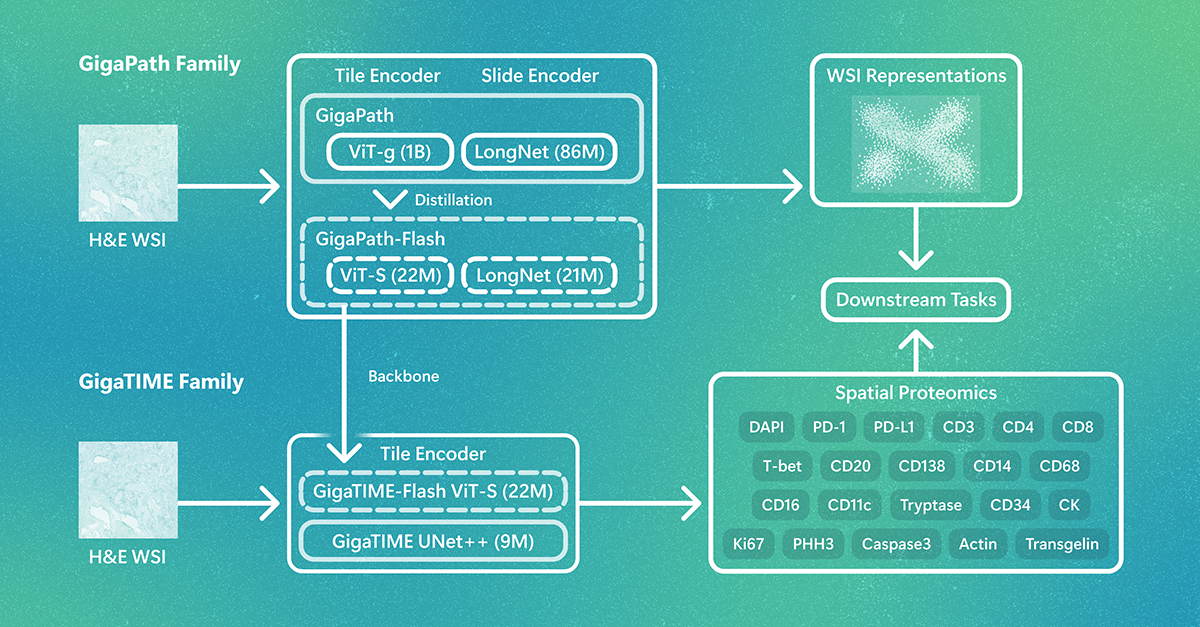
What if pathology foundation models could do more with less? GigaPath-Flash and GigaTIME-Flash cut computational demands while maintaining strong performance, opening the door to larger studies and broader exploration. The post GigaPath-Flash and GigaTIME-Flash: Toward population-scale discovery with efficient pathology foundation models appeared first on Microsoft Research.
MIT News · Artificial Intelligence· news.mit.eduAug 27, 2026
A new machine-learning framework aims to improve the success rate of computational protein design while moving away from results that reproduce sequences found in nature.