Skip to content

Quantum MeanFlow: single-shot generative sampling on NISQ hardware

Sep 2026 · 0 citations · 38 references
Physics Computer Science

TL;DR

Quantum MeanFlow (QMF), the quantum analogue of the MeanFlow formulation, is established as a viable method for single-step quantum generative sampling, saving on quantum circuit evaluations per generated sample.

Abstract

Quantum generative models offer a promising framework for exploring whether quantum computation can enhance generative machine learning. Flow matching is a generative method in which samples are generated by transporting a simple, known distribution to the target data distribution with a learned velocity field. Its quantum counterpart, known as quantum flow matching (QFM), was introduced recently, and, like its classical counterpart, requires integrating an ordinary differential equation over many time steps during inference. As each step requires the output from the previous step, the circuit submission is sequential and a drawback on quantum computers as they have high input/output costs. To alleviate this problem, we introduce Quantum MeanFlow (QMF), the quantum analogue of the MeanFlow formulation, which allows single-step sample generation. While the QFM learns an instantaneous velocity field at each time step, QMF learns the average velocity over a time interval. We use a parameterized quantum circuit to learn these velocity fields and benchmark the two methods on the MNIST dataset. We show that while single-step QMF has lower image quality compared to multi-step QFM, it performs better than the single-step QFM sampling at every shot count. Both of our models are executed on IBM quantum computers and best-of-N rejection sampling recovers most of the accuracy lost to device noise without modifying the circuit. This is especially advantageous for QMF which has only one circuit evaluation per image. Here, We establish QMF as a viable method for single-step quantum generative sampling, saving on quantum circuit evaluations per generated sample.

View source

Similar papers

Preprint Sep 2026

Distilling Datasets into Shallow Circuits for Quantum Machine Learning

In quantum machine learning, training a quantum model requires each sample to be prepared as a quantum state by a loading circuit that must be re-executed for every shot at every training step. The total burden therefore scales with both the number of samples and the cost of preparation. Existing approaches reduce the...

Guang Lin, Qianchuan Zhao · 0 citations
Preprint Sep 2026

Quantum Fidelity Landscape-Guided Prior Calibration for Single-Circuit QGAN Image Generation

Quantum Generative Adversarial Networks (QGANs) have emerged as representative generative models in the Noisy Intermediate-Scale Quantum (NISQ) era and have attracted increasing attention in quantum machine learning. However, most existing QGAN methods rely on patch-based decomposition strategies, which weaken the glob...

Xue Yang, Rigui Zhou, Dax Enshan Koh et al. · 0 citations
Preprint Aug 2026

Qkabrine: A Joint Architecture, Encoding, and Hyperparameter Search Framework for Quantum Machine Learning

Building a quantum machine learning (QML) model competitive with a classical baseline currently requires a practitioner to separately choose a circuit architecture, a data-encoding scheme, a model paradigm (kernel versus variational), and a set of training hyperparameters, then verify after the fact that the chosen cir...

Eric Jagwara · 0 citations
#machine learning Preprint Aug 2026

"Train classical, deploy quantum"requires rethinking generalization

The results indicate that a converged moment-matching loss is not a reliable measure of generalization, and that train-classical, deploy-quantum workflows will need approaches that target generalization directly, leaving open whether better training objectives suffice or whether the model architectures themselves must...

S. Raj, Natansh Mathur, A. Perdomo-Ortiz · 0 citations
Preprint Oct 2026

QPI-DeepONet-MAC: A Scalable and Stable Hybrid Classical-Quantum Architecture for Physics-Informed Deep Operator Networks

General operator learning for parametric partial differential equations (PDEs) is a fundamental challenge at the intersection of artificial intelligence and physics-based modeling. Physics-informed Deep Operator Networks (PI-DeepONets) incorporate governing equations into learning, but face optimization difficulties in...

Said Lantigua, José Valencia, G. Giraldi et al. · 0 citations
#machine learning Preprint Sep 2026

GRPO-QPS: Target-Preserving Reinforcement Learning for Quantum Posterior Sampling

GRPO-QPS is introduced, a target-preserving framework in which GRPO learns proposal behavior and an exact Metropolis correction preserves the posterior after training, which combines target-preserving Bayesian inference with broad gains over learned transport baselines and a sampling advantage when efficient exploratio...

Yu-Feng Wang, Parivesh Priye, Lu Wei et al. · 0 citations

Related blog posts

MIT News · Artificial Intelligence Aug 27, 2026

Looking beyond natural sequences

A new machine-learning framework aims to improve the success rate of computational protein design while moving away from results that reproduce sequences found in nature.

Microsoft Research Blog Aug 20, 2026

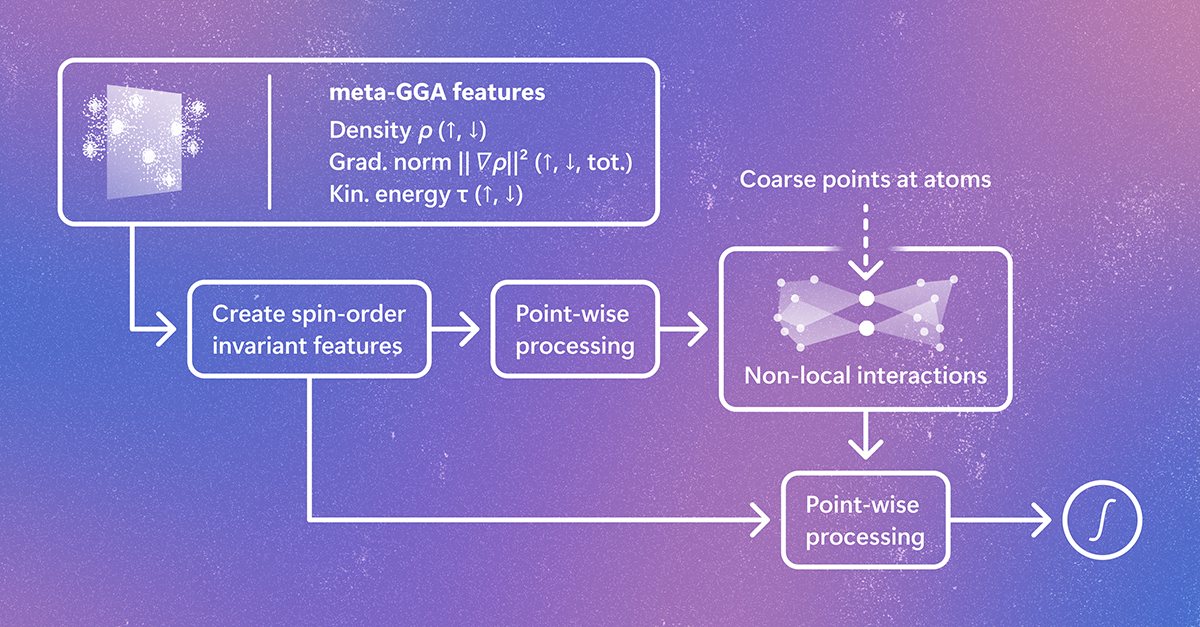
Broadening access to Skala creates a faster path to predictive DFT 

Skala 1.1, the updated deep-learning exchange-correlation functional from Microsoft Research, provides greater accuracy, expanded accessibility across the computational chemistry ecosystem, and a living benchmark to track computational performance. The post Broadening access to Skala creates a faster path to predictive DFT  appeared first on Microsoft Research.

We use cookies to run the site and, with your consent, for analytics and to show ads. See our Cookie Policy.