
Agent Lightning v1.0: A 3,500-Line Lightweight Agentic RL Framework for Training Agents with Real Harnesses
Training AI agents with reinforcement learning can be challenging because their tools, context, and decision-making are managed by complex frameworks. Agent Lightning connects existing agents to RL training, making it easier to improve them without rebuilding them. The post Agent Lightning v1.0: A 3,500-Line Lightweight Agentic RL Framework for Training Agents with Real Harnesses appeared first on Microsoft Research.
More from the blog
EmbeddingGemma 2: an open, lightweight multimodal embedding model
Open and Emergent Problems in Agentic Privacy and Security: A Contextual Angle
Education Innovation
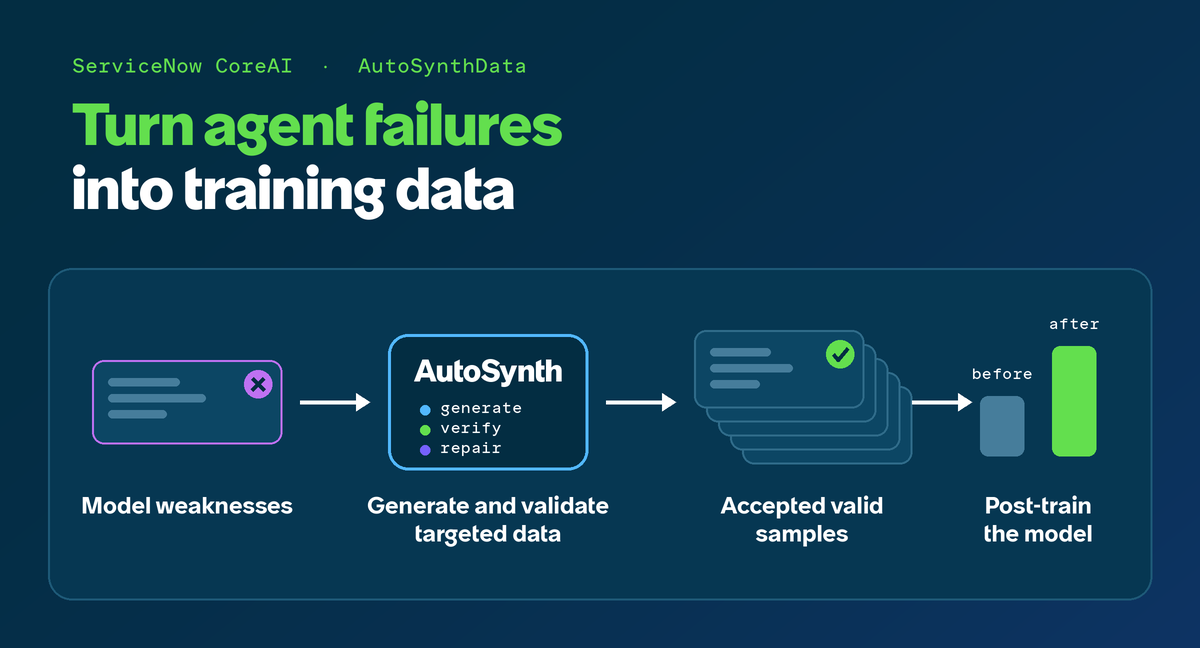
AutoSynthData: Generating Training Data for Enterprise Agents
A Blog post by ServiceNow-AI on Hugging Face
Related papers
Token-Mol 1.0: tokenized drug design with large language models
Token-Mol is presented, a token-only 3D drug design model that encodes both 2D and 3D structural information, along with molecular properties, into discrete tokens, which introduces a Gaussian cross-entropy loss function tailored for regression tasks, enabling superior performance across multiple downstream application...
mRNABERT: advancing mRNA sequence design with a universal language model and comprehensive dataset
The authors develop mRNABERT, a foundational AI model that designs entire mRNA sequences and demonstrates superior performance across comprehensive benchmarks, which signifies a substantial leap forward in mRNA research and therapeutic development.
Time for AI (Ethics) Maturity Model Is Now
It is argued that AI software is still software and needs to be approached from the software development perspective, and whether the focus should be on AI ethics or the quality of an AI system, called a maturity model for the development of AI systems is discussed.
Unified and explainable molecular representation learning for imperfectly annotated data from the hypergraph view
OmniMol is presented, a framework using hypergraphs to improve predictions of molecular properties, addressing challenges of imperfect data annotation and enhancing model explainability, and achieves state-of-the-art performance in properties prediction.