Skip to content
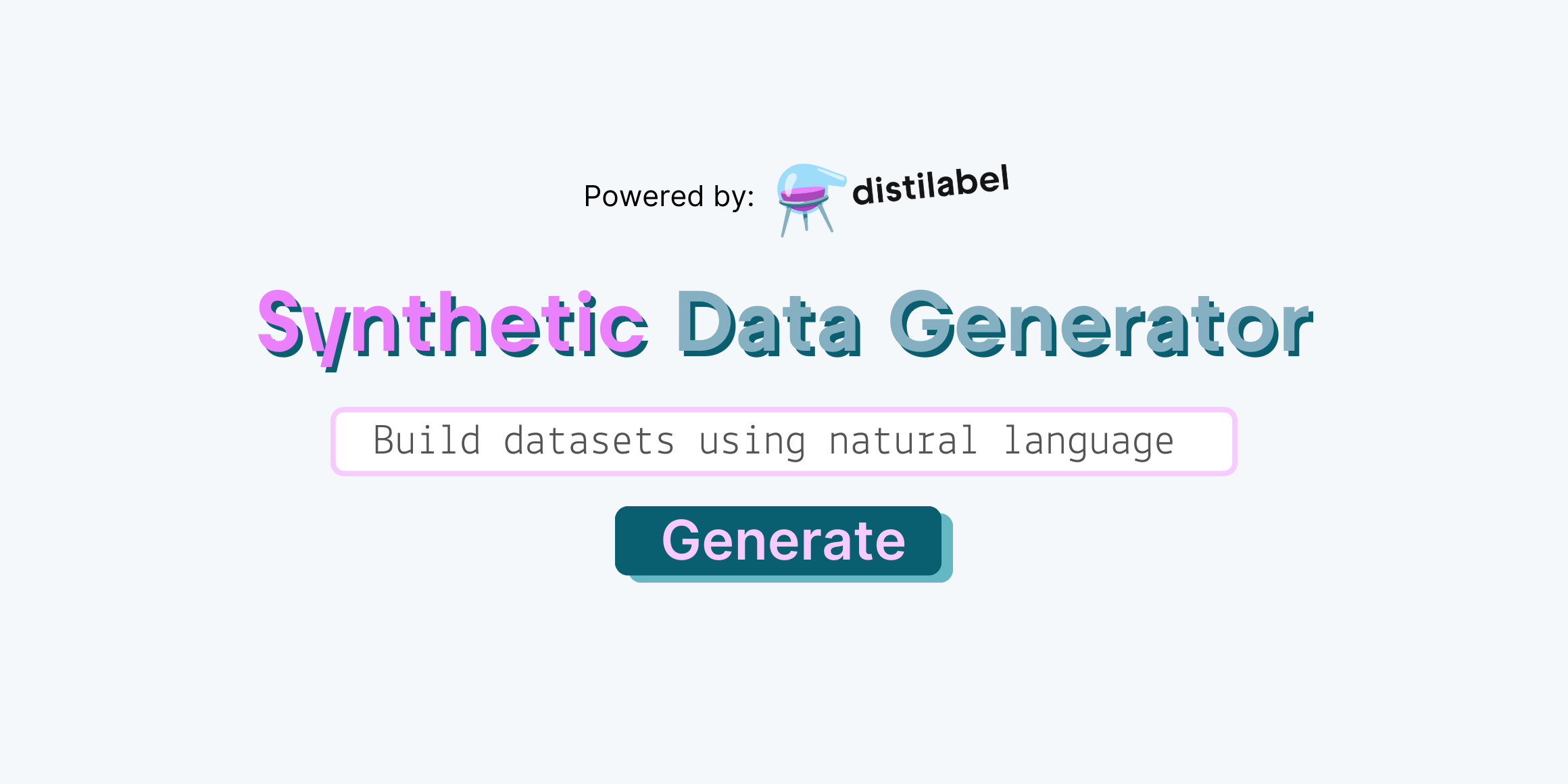
← All posts Introducing the Synthetic Data Generator - Build Datasets with Natural Language

Introducing the Synthetic Data Generator - Build Datasets with Natural Language

Hugging Face Blog · huggingface.co · December 16, 2024

We’re on a journey to advance and democratize artificial intelligence through open source and open science.

Read on Hugging Face Blog → Opens the original article in a new tab.

More from the blog

Related papers

Experimenting with Multi-Agent Software Development: Towards a Unified Platform

Large language models are redefining software engineering by implementing AI-powered techniques throughout the whole software development process, including requirement gathering, software architecture, code generation, testing, and deployment. However, it is still difficult to develop a cohesive platform that consistently produces the best outcomes across all stages. The objective of this study is to develop a unified platform that utilizes multiple artificial intelligence agents to automate the process of transforming user requirements into well-organized deliverables. These deliverables include user stories, prioritization, and UML sequence diagrams, along with the modular approach to APIs, unit tests, and end-to-end tests. Additionally, the platform will organize tasks, perform security and compliance, and suggest design patterns and improvements for non-functional requirements. We allow users to control and manage each phase according to their preferences. In addition, the platform provides security and compliance checks following European standards and proposes design optimizations. We use multiple models, such as GPT-3.5, GPT-4, and Llama3 to enable to generation of modular code as per user choice. The research also highlights the limitations and future research discussions to overall improve the software development life cycle. The source code for our uniform platform is hosted on GitHub, enabling additional experimentation and supporting both research and practical uses. \end

Malik Abdul Sami, Muhammad Waseem, Z. Rasheed et al. · 14 citations · ⚡1
#artificial intelligence Open access 2026

Bridging Humans and LLMs: Investigating Human-AI Collaboration in Multi-agent Requirements Analysis for Organizational AI Adoption

Context: Organizations adopting Artificial Intelligence (AI) face challenges in eliciting and analyzing requirements that align with strategic objectives, especially when human oversight and iterative refinement are needed. Large Language Models (LLMs)-based Multi-agent systems provide a potential solution by supporting structured and collaborative Requirements Engineering (RE) processes for AI adoption planning. Objective: The objective of this study is to investigate whether a multi-agent system, built on LLMs and supported by human input, can assist in requirements analysis for AI adoption. Method: We used a mixed-method approach: (i) designed and developed a multi-agent system to support the generation and prioritization of requirements for AI adoption, (ii) conducted multiple case studies with four companies to evaluate the system, and (iii) collected data through post-session questionnaires from nine participants and follow-up interviews, one per company. Results: Questionnaire and interview findings together indicate that the system may assist in identifying relevant and goal-aligned requirements. Seven participants considered the generated requirements relevant, and six found them aligned with organizational goals. Participants noted that iterative feedback improved completeness and feasibility, often within two feedback rounds. Both data sources show that human input was essential to clarify technical details, ensure contextual accuracy, and validate prioritization results. Participants from all companies also identified usability, transparency, and scalability as areas requiring further refinement for broader organizational use. Conclusions: LLM-based multi-agent systems can support strategic AI planning by enabling iterative refinement with human experts. Future work will include more interviews with stakeholders and adjustments to system features to improve transparency, usability, and scalability.

Malik Abdul Sami, Zheying Zhang, Muhammad Waseem et al. · 6 citations
#artificial intelligence Preprint Jul 2026

Constitutional Midtraining: Content Presence Drives Alignment Gains

Post-training alignment is often shallow, eroding under fine-tuning. It remains untested as to whether constitutional midtraining interventions can produce durable alignment when cleanly isolated from post-training. We build a 394M-token constitutional corpus from Anthropic's Constitution and apply constitutional midtraining at 120B scale, where principled, values-based content is inserted into midtraining. A 2x2 design (curriculum ordering x deliberative reasoning) was used to produce four constitutionally midtrained conditions, plus a control, which were evaluated on self-generated and established benchmarks including alignment under pressure, value conflict resolution, blackmail, and emergent misalignment. All models were evaluated across three stages: post-midtraining, post-SFT, and post-benign fine-tuning. Constitutionally midtrained models outperformed the control on alignment generalization and durability, notably on blackmail: SFT instilled a blackmail propensity in all models, but constitutional midtraining blunted it, with the advantage surviving benign fine-tuning (-17.5pp). This durability did not extend to settings that required active resistance to in-context pressure or conflict, where the advantage attenuates after SFT. The presence of constitutional content at midtraining also mattered more than its structure, and constitutional midtraining incurred no capability cost, on average, at any stage (MMLU, ARC-Easy, piqa, GSM8K). A modest amount of constitutional content at midtraining could therefore yield broad, persistent alignment gains, offering a cheap, complementary addition to SFT-centered pipelines. Code, data, and models are available.

Desiree Cho, Cameron Tice, Bernie Hogan et al. · 0 citations
#computer vision Open access Feb 2018

Lean Internal Startups for Software Product Innovation in Large Companies: Enablers and Inhibitors

To compete in this age of disruption, large companies cannot rely on cost efficiency, lead time reduction and quality improvement. They are now looking for ways to innovate like startups. Meanwhile, the awareness and use of the Lean startup approach have grown rapidly amongst the software startup community in recent years. This study investigates how Lean internal startup facilitates software product innovation in large companies and identifies its enablers and inhibitors. A multiple case study approach is followed in the investigation. Two software product innovation projects from two large companies are examined, using a conceptual framework that is based on the method-in-action framework and extended with the previously developed Lean-Internal Corporate Venture model. Seven face-to-face in-depth interviews of the employees with different roles are conducted. Within-case analysis and cross-case comparison are applied to draw the findings from the cases. A generic process flow summarises the common key processes of Lean internal startups. The findings suggest that an internal startup that is initiated management or employees faces different challenges. A list of enablers of applying Lean startup in large companies are identified, including top management support and cross-functional team. Both cases face different inhibitors due to the different process of inception, objective of the team and type of the product. Our contributions are threefold. First, this study is one of the first attempt to investigate the use of Lean startup approach in large companies empirically. Second, the study shows the potential of the method-in-action framework to investigate the Lean startup approach in non-startup context. The third is a general process of Lean internal startup and the evidence of the enablers and inhibitors of implementing it, which are both theory-informed and empirically grounded.

Henry Edison, Nina M. Smørsgård, Xiaofeng Wang et al. · 78 citations · ⚡6