
Learning the language of machine learning
By studying the computational foundations of language learning, Associate Professor Jacob Andreas builds intelligent systems that can communicate effectively with humans.
More from the blog
Rumble-2-Flash: an open 0.5B speech model for 40+ languages
Q&A: Why building math muscles remains important in the AI era
Assistant Professor John Urschel explains why learning the fundamental skills of mathematics is still essential despite the evolution of AI tools.
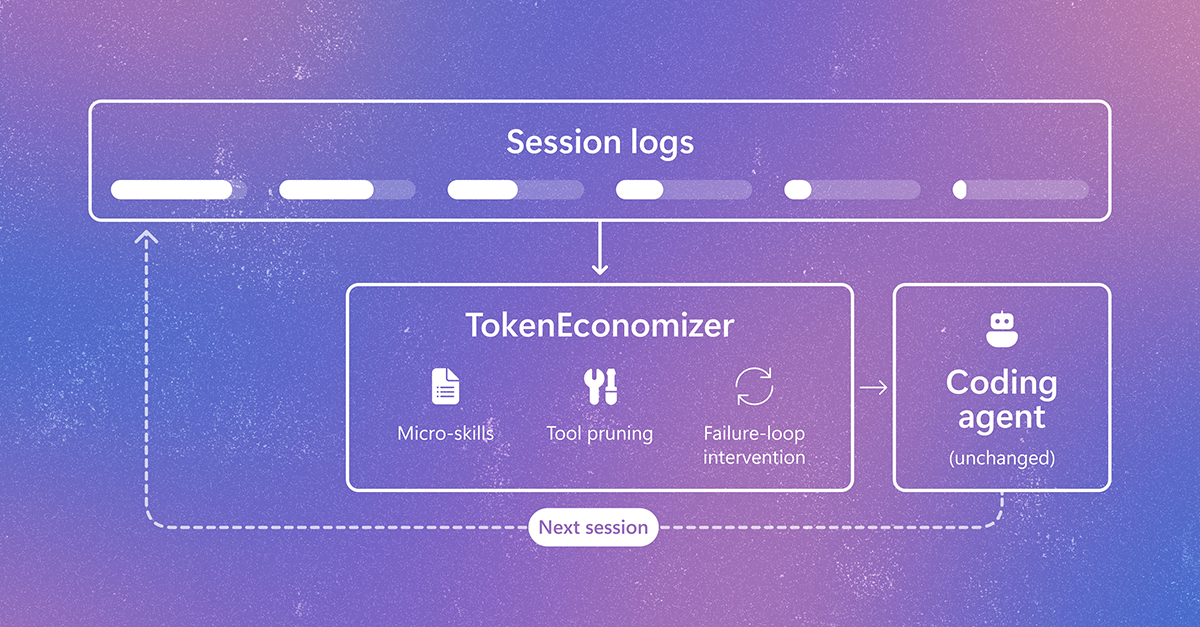
TokenEconomizer: Learning from Experience to Make AI Coding Agents More Efficient
AI coding agents are increasingly help developers fix bugs and build features largely on their own, but every interaction with their models consumes tokens. In each session, an agent sends instructions, tool descriptions, and session history to its model. Most efforts to reduce this cost focus on individual tasks. Yet developers return to the same […] The post TokenEconomizer: Learning from Experience to Make AI Coding Agents More Efficient appeared first on Microsoft Research.

New AI “copilot” helps engineers design better structures
The system asks humans for feedback to increase trust in machine-generated designs for buildings and bridges.
Related papers
“Failures” to be celebrated: an analysis of major pivots of software startups
This study conducts a case survey study based on the secondary data of the major pivots happened in 49 software startups, and demonstrates that customer need pivot is the most common among all pivot types.
What Influences the Speed of Prototyping? An Empirical Investigation of Twenty Software Startups
This study conducts a multiple case study on twenty European software startups and proposes a prototype-centric learning model in early stage software startups, and identifies factors that occur as barriers but also facilitators for prototyping in earlystage software startups.
RSGPT: a generative transformer model for retrosynthesis planning pre-trained on ten billion datapoints
RSGPT, a generative model pre-trained on ten billion data points, achieving state-of-the-art performance for synthesis planning, and introduces reinforcement learning to capture the relationships among products, reactants, and templates more accurately.
PepPCBench is a Comprehensive Benchmarking Framework for Protein-Peptide Complex Structure Prediction
PepPCBench enables a robust evaluation of PFNN-based methods and supports their continued development for peptide-protein structure prediction, and highlights the influence of peptide length, conformational flexibility, and training set similarity on prediction accuracy.