The complex environmental situation in industrial regions requires the development of applied methods to assess the impact of industrial emissions on the environment. Purpose: Development of numerical simulation methods of pollutant distribution in urban environment. Methodology: Steady-state numerical simulation is performed in Ansys Fluent using the Species Transport model, which simulates mixing and transport of chemical substances by solving equations of concentration transport under the gradient diffusion hypothesis. The model is validated against classic 2D and 3D cases of substances mixing in a pipe. Research findings: Numerical simulation methods for the pollutant distribution in urban environment is developed and applied to nitrogen dioxide (NO 2 ) and sulphur dioxide (SO 2 ) emissions from chimneys of a cement plant in five wind directions. Practical capabilities of the developed methods are demonstrated, including clear visualization of the nature of the pollutant distribution from the point of emission, the concentration level of each substance in a selected area, and areas with exceeded maximum permissible concentrations. In this study, the distribution of substances resembles bands, which widen with increasing distance from emission sources. For the given mass fractions and emission volumes, maximum permissible concentrations for NO 2 and SO 2 exceed 7.9 and 8.9 times, respectively. Conclusions: The developed numerical simulation method of the pollutant distribution used in Ansys Fluent, are effective and informative for analysing the environmental situation in urban environment. However, for greater reliability, accurate, officially verified data on the qualitative and quantitative composition of emissions from industrial facilities is required, as well as the consideration of a greater number of factors influencing the concentration of harmful substances in the atmosphere.
O. S. Goryachevsky, E. Yu. Lipovtseva· Vestnik Tomskogo gosudarstve...· 0 citations
This study aims to model the boronizing kinetics of Sverker 3 steel in the temperature range 1173 - 1273 K for treatment times between 1 and 7 h. The first used approach is the Taylor expansion (TE) model. It considers the diffusion of boron atoms under transient regime through the surface of the treated Sverker 3 steel. Whereas the second one is the dimensional analysis (DA) model based on the Buckingham’s Pi - theorem. It enables the reduction of the number of variables involved in complex physical phenomena. In formulating this second model, dimensionless groups were derived to simulate the thicknesses of the FeB and Fe2B layers. The predicted values were found to be in good agreement with the experimentally measured layers’ thicknesses. Furthermore, the boron activation energies determined for the FeB and Fe2B layers were 214.92 kJ mol-1 and 203.20 kJ mol-1, respectively, using Taylor Expansion (TE) model and were finally compared with values reported in the literature.
Katia Benyakoub, М. Кеддам, Brahim Boumaali· Journal of Chemical Technolo...· 0 citations
Reach audiences
Advertise in front of researchers, engineers, and readers.
Accurate simulation of convection-dominated pollutant transport remains a significant challenge due to the presence of steep concentration gradients and the numerical instabilities associated with standard finite element discretizations. This study presents an adaptive Streamline Upwind/Petrov–Galerkin (SUPG) finite element framework for solving two-dimensional advection–diffusion equations governing atmospheric pollutant dispersion. The proposed methodology combines SUPG stabilization with a residual-based a posteriori error estimator to automatically guide local mesh refinement, thereby improving solution accuracy while reducing unnecessary computational effort. The adaptive algorithm iteratively identifies regions with large discretization errors and selectively refines the mesh to accurately resolve localized pollutant plumes and sharp concentration fronts. The numerical performance of the proposed framework is evaluated through representative single-source and two-source pollutant transport problems. Convergence studies, computational efficiency analysis, and comparisons with uniform mesh refinement demonstrate that the adaptive approach achieves lower numerical errors and reduced computational cost for an equivalent number of degrees of freedom. The results further show that the adaptive strategy effectively captures the interaction of multiple pollutant plumes while maintaining numerical stability under convection-dominated conditions. These findings confirm that the proposed adaptive SUPG framework provides an accurate, robust, and computationally efficient numerical tool for atmospheric pollutant transport simulations and establishes a reliable foundation for extending the methodology to more complex environmental transport problems involving nonlinear processes, heterogeneous media, and time-dependent emission scenarios.
Hamid Ait Lhoussain, Younes Abouelhanoune, A. Boujraf· International Journal of Com...· 0 citations
Against global carbon neutrality targets, the carbon-intensive steel industry bears severe decarbonization stress, wherein advanced low-carbon smelting technologies dominate its green transition. Scrap preheating boosts scrap ratio and cuts steelmaking carbon emissions; optimized fuel-scrap matching and fuel grading by scrap type significantly improve thermal efficiency and reduce preheating energy demand. This work establishes a 3D numerical model for randomly stacked scrap within a 100-t hot metal ladle to compare natural gas, coke oven gas and converter gas regarding flow field, flame structure, thermal distribution, scrap heating performance and energy efficiency under equal total heat input. Numerical simulations with the k-ε turbulence, EDC combustion and P-1 radiation models are performed to couple flow, heat transfer and combustion. Fuel composition strongly governs flame morphology and thermal behaviors. Natural gas and converter gas form intact, stiff flames, while coke oven gas produces discontinuous unstable flames. Flow intensity decreases in the sequence converter gas, coke oven gas and natural gas, and high-speed turbulent fluctuation of converter gas facilitates heat diffusion. Under the same heating duration, the average surface temperatures of scrap are 695 K, 782 K and 411 K for natural gas, converter gas and coke oven gas, respectively. Converter gas achieves the highest preheating efficiency of 11.2 %, followed by natural gas (5.9 %), and coke oven gas is the lowest (2.4 %) due to its low calorific value. Moreover, fuel-scrap matching characteristics reveal that natural gas is suitable for light and thin scrap to avoid overheating, while converter gas is more favorable for medium and heavy scrap with improved heat penetration. This work reveals the influence mechanism of gas type on ladle scrap preheating and provides theoretical support for fuel selection and process optimization in high-efficiency and low-carbon scrap preheating applications.
Yi Fu, Guang Giang Liu, Lan Yue Xu· Archives of Foundry Engineer...· 0 citations
The criterion, measured. This version adds the experiment the programme lacked: Pollard's criterion applied directly to a real decay curve, without fitting, and it withdraws a way of reading every fitted exponent in the corpus — including our own. 72 pages, 27 sections in 7 parts, 8 appendices. Eloy René Becerra Daly What is measured 20 non-adjacent qubits of one superconducting device — one session, one fixed layout, 39 circuits, 958,452 shots. The criterion answers differently in two channels of the same qubit. Energy relaxation admits a positive rate density (non-negative least squares over 200 free rates, χ²/dof = 0.99, 19/20 replicates compatible); pure dephasing does not (χ²/dof = 12.43, 17/20 refuted). The cause needs no model: the echo curve rises, in 10 of 220 consecutive segments above 3σ and six above 5σ, peaking at z = +11.01, across 7 of 20 qubits, while the T1 control gives 0 of 220 and backflow exactly zero in all twenty. Three independent confirmations: the Breuer–Laine–Piilo witness on the same counts, the residual against a one-rate Lindblad twin (+10.6σ), and frev = 0.674 failing to correlate with that witness (ρ = −0.107). What is withdrawn Reading a fitted β without reporting its goodness of fit. At σ/C ≈ 0.011 the two-parameter Kohlrausch form is rejected in both dephasing arms (χ²/dof = 11.49 and 1598), so its exponent licenses nothing in either direction. A non-rejection at low statistical power is not evidence of adequacy. Every β-dependent quantity of the new run. The pre-registered positive control fired: the T1 arm returned β = 0.8664 ± 0.0285 where a single rate must give 1. Its premise proved false — T1 is not a single rate on real hardware — but a premise falsified after the fact does not annul the clause. The distance to the pole and the branch assignment are withdrawn for that run. The universal claim that no platform violates β < 1, which survived into the conclusion of v2.0.0 after being corrected elsewhere. What is falsified in the previous version §20 of v2.0.0 states that revivals are slowdowns and not reversals, and that no local operation can revert the decoherence arrow. Both are falsified by measurement: the echo rises with the control at zero, and a single X pulse — a local unitary — reverts 67 % of the free-induction dephasing. The backflow bound of §3, which admits recoherence and bounds it, is the section the data support; it receives its first experimental test and is not refuted. What is unchanged The exact identities, the no-go theorem, the transferable criteria and the dark-matter conjecture stand as in v2.0.0, with that version's errata intact. The decisive test the programme identifies — β = (1 + αdiff)/2 on a single sample, refutable against existing NMR and diffusion literature without new experiments — is still not performed here. Scope, stated because it is easy to overstate One device, one session, twenty qubits, and a single-qubit observable blind to entanglement by construction. The measurement establishes that the criterion is applicable to hardware and that it separates two channels of the same qubit. It establishes nothing about superconducting qubits in general, and the corrected pre-registration for a second device is published rather than attempted. Reproducibility Every number of the new section is regenerated from the raw counts by a single extractor that writes them with the SHA-256 of the counts file, and a verification mode fails if any has moved. The figures are produced by a script that refuses to write if its own numbers disagree with that file. The register documents 44 inconsistencies, of which 20 remain open, each with the observation that would close it; one was closed by returning to hardware and one was falsified there.
Eloy René Becerra Daly· Zenodo (CERN European Organi...· 0 citations
Pollutant dispersion in rivers is governed by advection, diffusion, and the physical characteristics of the channel. This paper models two-dimensional pollutant transport using the advection-diffusion equation and solves it numerically with the Finite Element Method (FEM) under five scenarios: constant flow with a single pollutant source, flow that follows a meandering channel, constant flow with two sources, the presence of a rock obstacle, and an irregular river domain. Simulations are implemented in Mathematica through domain construction, mesh generation, and a Finite Element-based numerical solution. The results show that flow velocity is the primary driver of plume movement, while diffusion smooths concentration gradients. Comparative analysis across the five scenarios demonstrates that obstacle-containing and irregular domains produce the widest plume spreading and the strongest concentration deformation compared to the straight-channel case. Peak concentrations also decrease more rapidly in multi-source and irregular-flow scenarios due to enhanced mixing and plume interaction. Physical obstacles and channel irregularities generate loacal recirculation zones and plume deviation, producing more realistic pollutant transport behavior than simplified channer models. These findings highlight the importance of geometry-aware flow representations for understanding river pollutant transport in numerical modelling studies.
Muhamad Adzka Rizkia, Rahma Alya Zahrani, Zelisha Pitriatuz Zahra Fauzi et al.· CAUCHY Jurnal Matematika Mur...· 0 citations
A three-compartment predator-prey model (prey, middle predator, top predator) is developed by integrating spatial diffusion, discrete time delays (gestation and biomass conversion), and proportional harvesting on the two lower trophic levels. The objectives are to formulate the model, analyze local stability dynamics and Hopf bifurcation due to time delay variations, and determine a sustainable harvesting strategy based on the Maximum Sustainable Yield (MSY) concept. Methods include equilibrium analysis, linearization using a variation matrix, Routh–Hurwitz criterion, and numerical simulations with GNU Octave in one- and two-dimensional spatial domains. The results show that a positive interior coexistence equilibrium exists and is locally asymptotically stable under certain conditions. Single or double time delays without harvesting trigger Hopf bifurcation when exceeding critical values, while pure diffusion does not produce instability on its own. Harvesting at safe rates increases the critical delay values and maintains coexistence, in contrast to the mathematical MSY harvesting that leads to species extinction. In conclusion, the integration of diffusion, time delays, and harvesting yields complex dynamics, with time delays as the main destabilizer and controlled harvesting as a stabilizing agent that delays the onset of Hopf bifurcation.
Abstract Cross-diffusion systems play a central role in mathematical modelling, in which density-dependent dispersal and multiscale mechanisms can lead to spatial segregation and diffusion-driven instabilities. In several relevant examples, including generalised SKT-type competition models, cross-diffusion terms can be rigorously derived as fast-reaction limits, thereby providing a clear biological interpretation while posing significant analytical challenges. In this work, we investigate the impact of biologically derived cross-diffusion on Turing instability. For a generalised SKT framework, we characterise instability conditions for a broad class of cross-diffusion functions arising from fast-reaction mechanisms. We then propose an alternative fast-reaction formulation leading to a different diffusion structure and show that, in this case, diffusion-driven pattern formation is prevented. We further discuss an example motivated by dietary diversity and starvation dynamics, and analyse how the sign structure of the reaction Jacobian interacts with cross-diffusion in determining the onset of patterns. Our results clarify structural features that promote or inhibit spatial self-organisation in competitive systems.
Elisabetta Brocchieri, Cinzia Soresina· Ricerche di Matematica· 0 citations
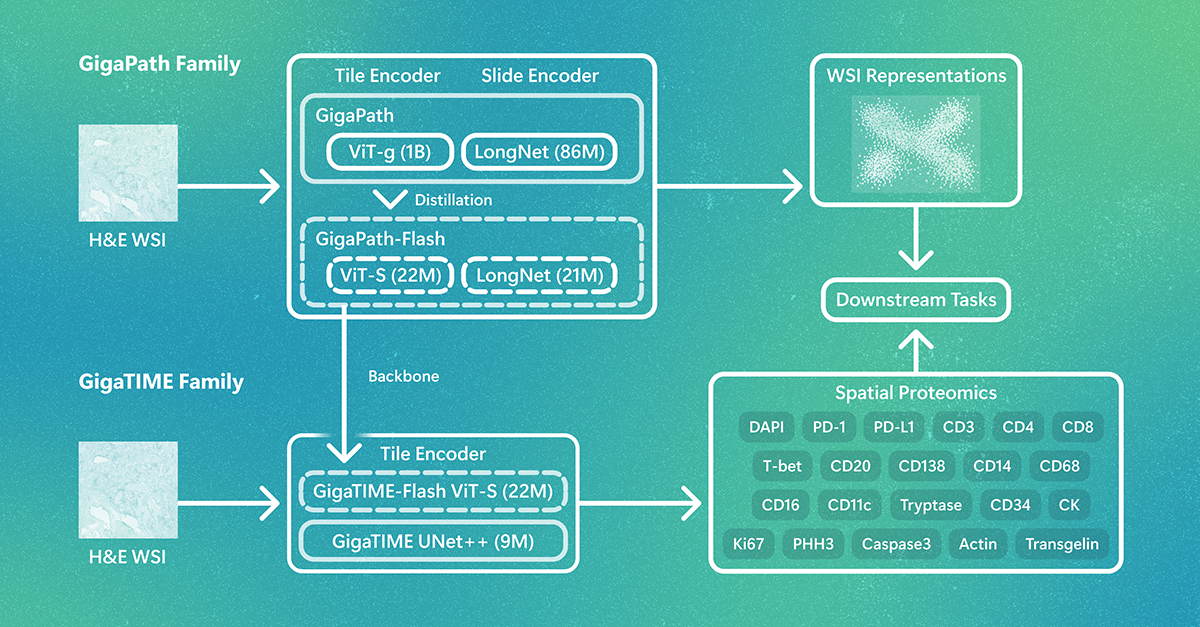
What if pathology foundation models could do more with less? GigaPath-Flash and GigaTIME-Flash cut computational demands while maintaining strong performance, opening the door to larger studies and broader exploration. The post GigaPath-Flash and GigaTIME-Flash: Toward population-scale discovery with efficient pathology foundation models appeared first on Microsoft Research.