Temporal graph embeddings aim to capture the evolving behavior of graphs over time, a crucial task in domains like social network analysis, knowledge graph reasoning, and anomaly detection. However, current graph embedding techniques often treat temporal relationships as simple sequential adjacency updates, neglecting the underlying causal structure that governs how nodes influence each other across time. This paper introduces a novel approach – Causality-Aware Propagation (CAP) – that explicitly models causal relationships within evolving graphs to generate more accurate and informative embeddings. CAP leverages event sequences and domain knowledge to define a causal graph, then employs a modified diffusion process where node representations are propagated based on the learned strength of these causal links. The core idea is to move beyond mere connection propagation to represent the *influence* of connections over time. We demonstrate the effectiveness of CAP through a theoretical analysis and explore its potential applications, establishing a foundational technique for temporal graph representation learning. The method's key contribution lies in its integration of causal inference with graph embedding, offering a more robust and interpretable representation of dynamic graph structures.
Jincheng Zhang· Zenodo (CERN European Organi...· 0 citations
This paper investigates the design and implementation of a novel information diffusion suppression mechanism tailored for topological networks. Traditional information diffusion models often assume uniform network structures, failing to account for the inherent advantages offered by networks with specific topologies. This research proposes a strategy leveraging the structural properties of topological networks – namely, node connectivity and network paths – to mitigate the spread of malicious information. The core mechanism involves employing techniques such as node isolation and path reconstruction to disrupt the propagation of information, effectively limiting its reach. The proposed approach provides a new defense layer against information attacks, offering a more robust and adaptable solution compared to methods reliant on network homogeneity. Mathematical formulations are presented to describe the key processes involved, including information diffusion probability and the effectiveness of suppression strategies. The analysis demonstrates the potential of topological network structure to significantly enhance information security.
Jincheng Zhang· Zenodo (CERN European Organi...· 0 citations
Computing transition states for heterogeneous catalyst surface reactions is computationally demanding due to the relatively high cost in precisely locating a saddle point using ab initio electronic structure calculations. In this work, we present a new generative score-based diffusion model—CatWalk—that predicts the initial structures for reaction pathways of heterogeneous catalysts with surface adsorbates. Given only the desired reaction type and reactant structure, CatWalk produces nine pathway structures by iteratively perturbing the coordinates of the previous output. CatWalk was trained on 731 nudged elastic band (NEB) calculations from the CatTSunami dataset, which contains diverse substrate elements with adsorbates undergoing three types of chemical reactions: desorption, dissociation, and atom transfer. The model can be directed to target one of these three reaction types during generation, and due to its stochastic nature can generate various products via multiple pathways from the same initial state. Optimizing CatWalkgenerated pathways using a pretrained foundation machine-learned interatomic potential (MLIP) with the nudged elastic band (NEB) method leads to several lower-energy pathways compared to what is obtained by the traditional linear interpolation initialization method for NEBs. Additionally, repeated intermediate structure generations using CatWalk enabled sampling of different pathways and final states which can lead to multiple saddle points with variation in energy by up to 0.2 eV. Overall, CatWalk provides a general and scalable framework for accelerating reaction-pathway discovery, enabling broader exploration of catalytic mechanisms at significantly reduced computational cost.
Teerachote Pakornchote, Nima Karimitari, Jacob Clary et al.· ChemRxiv· 0 citations
This paper investigates the design and implementation of a novel information diffusion suppression mechanism tailored for topological networks. Traditional information diffusion models often assume uniform network structures, failing to account for the inherent advantages offered by networks with specific topologies. This research proposes a strategy leveraging the structural properties of topological networks – namely, node connectivity and network paths – to mitigate the spread of malicious information. The core mechanism involves employing techniques such as node isolation and path reconstruction to disrupt the propagation of information, effectively limiting its reach. The proposed approach provides a new defense layer against information attacks, offering a more robust and adaptable solution compared to methods reliant on network homogeneity. Mathematical formulations are presented to describe the key processes involved, including information diffusion probability and the effectiveness of suppression strategies. The analysis demonstrates the potential of topological network structure to significantly enhance information security.
Jincheng Zhang· Zenodo (CERN European Organi...· 0 citations
Reach audiences
Advertise in front of researchers, engineers, and readers.
Quantum-Enhanced Diffusion Modeling with Adaptive Kernel (QEDM-K) presents a novel approach to diffusion modeling by integrating quantum-inspired kernels to address limitations of existing methods. This research explores the application of these kernels to improve the accuracy and speed of simulating diffusion processes. The core mechanism centers around leveraging the inherent randomness captured within quantum mechanics to enhance the representation of diffusion patterns. This results in a more robust and efficient modeling process, particularly for complex scenarios. This paper details the theoretical underpinnings of the QEDM-K framework, presents a comprehensive implementation demonstrating its efficacy, and discusses potential future research directions.
Jincheng Zhang· Zenodo (CERN European Organi...· 0 citations
We develop a fully spectral ultraspherical collocation method for the numerical solution of two-dimensional tempered space-fractional Allen-Cahn equations. The scheme combines a tensor-product ultraspherical collocation discretization in the spatial variables with an ultraspherical-Gauss-Radau collocation method in time, yielding a global high-order approximation for the nonlinear tempered fractional problem. To discretize the nonlocal diffusion terms, we construct left- and right-sided tempered Riemann-Liouville fractional differentiation matrices in the ultraspherical basis, thereby reducing the governing equation to a coupled nonlinear algebraic system for the ex- pansion coefficients. The resulting method accurately resolves the tempered fractional operators while retaining the high-order accuracy of spectral approximations. Numerical experiments for a benchmark problem with an exact solution demonstrate the accuracy, rapid convergence, and robustness of the proposed scheme over a range of fractional orders and tempering parameters. These results show that the method provides an effective and reliable computational framework for two-dimensional tempered fractional Allen-Cahn models.
M.A. Zaky, A. Alshabanat, S.S. Ezz-Eldien· Romanian Journal of Physics· 0 citations
To address the challenges of rapidly evolving environmental states, conflicting multiple objectives, and decentralized coordination of resources across response centers in Arctic oil-spill emergencies under low-ice conditions, a hierarchically hybrid scheduling framework coupled with a closed-loop simulation–optimization scheme is proposed. Within this framework, the three decision tiers are encoded as coupled variable blocks within a single mixed-variable NSGA-III chromosome: the upper tier determines resource call-ups, the middle tier generates ship–equipment–voyage schedules, and the lower tier adjusts on-site operations according to real-time sea-ice conditions, sea-surface temperature, surface currents, and oil-spill status. To maintain a clear research boundary, no independent high-resolution hydrodynamic model is developed; instead, a reduced-order advection–diffusion module, which is replaceable by external trajectory models, is employed to incorporate wind-driven and current-driven transport, enabling rolling-horizon updates of oil-spill centroids, impact zones, and ecologically sensitive exposures. The proposed framework is tested against a low-ice scenario in the Barents Sea, wherein the three-objective model—encompassing response time, total cost, and ecological risk—is solved via an enhanced constraint-handling NSGA-III. The balanced solution yields a response time of 25.1 h, a total cost of CNY 7.15 million, an ecological risk of 382 t oil equivalent, a recovery rate of 84.6%, and a composite performance loss index, P(X), of 0.31. Under a 5% sea-ice concentration, this solution reduces P(X) by 63.1%, 65.9%, and 59.2% compared with static deterministic planning, single-objective optimization, and open-loop simulation–optimization, respectively, while simultaneously improving the recovery rate by 13.3–19.8 percentage points; relative to ablation configurations without dynamic iterative correction and without hierarchical progression, P(X) is lowered by 43.6% and 35.4%, respectively. Case-study results demonstrate that the proposed framework is capable of generating interpretable resource-allocation and voyage schedules while maintaining robust composite performance across 0%, 5%, and 10% sea-ice-concentration scenarios.
Chunchang Zhang, Jiang Zhou, Huancheng Lin et al.· Frontiers in Marine Science· 0 citations
This article analyses the Azerbaijani environment for the functional usage and division of three languages as English, Russian and Azerbaijani. It also throws a quick glance onto the conditions of shaping the multilingual conditions in Azerbaijan, makes analyses related to the historical backgrounds. The author reasons the historical in-country language situations and brings the convincing examples of the second language preference by the country speakers. It is stated that the main postulation from the sociolinguistics view in this choice is not connected with accepting or ignoring this or other language, but but also the issue of which areas, by which social groups, and for which communicative purposes these languages are used. It also underlines that from a sociolinguistics point of view, the position of languages in society is determined not only by their legal status, but also by their functional load. However, the diffusion of Global Languages is also considered as the inevitable stampede towards English, the counter-pressures in the form of ethnic efforts to reverse or slow the process, the continued determination of nation-states to assert national identity through language, and, in an opposite direction, the greater tolerance shown to multilingualism. The article highlights that the dominance of language in the functional division is especially clearly observed in the case of Azerbaijan, because Azerbaijani language is the main means of national statehood and social integration. It further argues that the concept of state language is not limited to the sphere of official administration. The state language also serves to form national memory, cultural heritage and a sense of social unity. The author brings forward the major argumentation that, in the conditions of globalization, the position of the national language should be strengthened not only by its protection, but also by its use in modern scientific and technological fields. This idea expresses one of the main principles of modern language policy: the national language should be not only a carrier of the past, but also a means of communication for the future. The spread of English in Azerbaijan has some positive sociocultural consequences. However, some scholars are not unanimous referring to the European policy about dominance of English language or World Englishes. Finally, the article resumes that the functional division of the trilingual situation is shaped as following: “-Azerbaijani language - internal sociocultural integration; - Russian language - historical and regional information relations; - English language - global communication and international cooperation”
Farhadova S.D.· Zenodo (CERN European Organi...· 0 citations
stochastic-rs is an open-source Rust library for quantitative finance and stochastic process simulation. It provides 120+ stochastic processes (diffusion, jump, fractional and rough volatility, short-rate, HJM, LMM), option pricing and model calibration (Black-Scholes-Merton, Heston, SABR, rough Bergomi, Lévy, double Heston), volatility surface construction (SVI, SSVI, SABR smile), fixed income and credit modelling, statistical estimators (Hurst exponent, maximum likelihood for diffusions, realised variance), copulas, market microstructure models, and neural-network volatility surrogates. Implementations are generic over f32/f64, SIMD-accelerated on CPU with optional CUDA, Metal and Accelerate backends, and exposed to Python through PyO3. Documentation: stochastic.rust-dd.com
Dániel Boros· Zenodo (CERN European Organi...· 0 citations
Object: To develop the logarithmic Jensen gap as a model-free measure of directional diffusion nonuniformity, computable from any multi-direction acquisition without tensor fitting, in both the diffusivity and signal domains. Materials and Methods: The diffusivity-domain gap is the log-ratio of the arithmetic and geometric means of the per-direction diffusivities. The signal-domain gap is the b-weighted difference between the mean per-direction apparent diffusion coefficient (ADC) and the ADC of the directionally averaged signal. Nonnegativity and the Hölder ladder were derived. Both gaps were computed voxelwise in 1,379 Human Connectome Project–Aging participants at b = 1500 and 3000 s/mm², and correlated with age. Results: The gaps vanish only when the directional diffusivities are uniform. Although the ADC maps appear identical, the gap between them exposes directional structure. In the corona radiata, the diffusivity and signal gaps dissociated in sign with age (r = −0.47 and r = +0.30, both p < 10⁻²⁵), reproduced at b = 3000 s/mm² and within subjects. After the full tensor was regressed out, both retained broad age effects. Discussion: The gap yields two scalar maps computable retrospectively at negligible cost. Because it is b-invariant under Gaussian diffusion, its cross-shell change is a fit-free non-Gaussianity signature, complementing tensor- and kurtosis-based methods.
Scott N. Hwang, Jonathon Maffie, Sangam Kanekar· Zenodo (CERN European Organi...· 0 citations
# Cofolding benchmark: structures, alignments and analysis scripts Supplementary data for *Benchmarking Protein–Ligand Cofolding Models: Correct LigandPlacement Is Decoupled from Accurate Protein Conformation*. Seven protein–ligand complexes, three class A GPCRs and four kinase systems, were predictedwith AlphaFold3, Boltz-2, Chai-1 and RoseTTAFold3 under different MSA and template settingsand compared with the experimental structures. Everything needed to repeat that comparison ishere: the experimental references, the predicted structures, the state-specific alignmentsused to bias the predictions, and the analysis scripts. Tables and figures are not deposited, only the inputs they are made from. The superposedstructures are included, since every reported RMSD was measured on them. ## Contents ```0_reference_structures/ experimental structure of each complex, and the ligand SMILES1_Structures/ the predicted complexes, per target and method2_input_preparation/ scripts that build the model inputs; MSAs/ holds the alignments3_predictions/ how each model was run4_alignment/ superposition onto the reference, and the superposed structures5_ligand_rmsd/ ligand RMSD in the protein reference frame6_extract_metrics/ RMSD, pLDDT, ipTM and PAE collected into per-target tables7_core_analysis_plots/ Figure 48_rmsd_scatter_plots/ Figure 5, Figure S4, and the correlations quoted in the text9_plddt_plots/ Figures S1 and S210_multiseed/ Figure S3, the five-seed repetition11_interaction_fingerprints/ Figures S5-S10, interaction fingerprints and pose validity``` ### Reference structures `0_reference_structures/` holds one folder per target with the experimental complex as mmCIFand as the PDB file the analysis reads, together with the ligand SMILES. The entries are 8ZMG(5-HT2A), 8UGW (A2AAR), 8Y45 (DOR), 9L04 (ALK2 with RK-783), 6UNQ (ALK2 with AMPPNP), 9DMI(LRRK2) and 8TSD (PI3K). ### Predicted structures `1_Structures/` is arranged as target, method, condition: ```1_Structures/GPCR_5HT2a/Alphafold/5ht2a_inactive_custom_templates_custommsa/ seed-0_sample-0/ ... seed-0_sample-4/ one prediction each, .cif and confidences``` The same layout holds for `GPCR_AA2A`, `GPCR_DOR`, `Kinase_ALK2_ATP`, `Kinase_ALK2_RK783`,`Kinase_LRRK2`, `Kinase_PI3K`, and for `boltz`, `Chai1` and `RF3`. Every condition contributesfive diffusion samples of one seed. These are the predictions as the models wrote them; thesuperposed copies live in `4_alignment/superposed_structures/` and, for the five-seed set, in`10_multiseed/superposed_structures/`. ### Biasing alignments `2_input_preparation/MSAs/` holds one alignment per target, named for the conformational stateit biases towards: | file | target | sequences ||---|---|---|| `5HT2A_inactive.a3m` | 5-HT2A | 208 || `A2AAR_active.a3m` | A2AAR | 301 || `DOR_active.a3m` | DOR | 292 || `ALK2_active.a3m` | ALK2, both ligands | 1000 || `LRRK2_dfgout.a3m` | LRRK2 | 669 || `PI3K_dfgout.a3m` | PI3K | 2 | The custom templates are public PDB entries, listed by accession code in Table S2 of theSupporting Information. The scripts beside the alignments turn them into the input files eachmodel expects: AlphaFold3 job JSONs (`create_alphafold3_jobs_new_a3m.py`, and`create_aa2a_active_json.py` for A2AAR), template mmCIFs with the index arrays AlphaFold3needs (`fix_templates_bio.py`), Chai-1 template M8 files (`create_m8_gpcr_chai1.py`), RF3 jobsderived from the AlphaFold3 ones (`create_rf3_jsons_from_af3.py`) and the A3M rewriting RF3requires (`normalize_a3m_for_rf3.py`). ## Requirements `requirements.txt` lists the python packages. The analysis also needs PyMOL for thesuperposition and MDAnalysis for the ligand RMSD; folder 11 additionally needs ProLIF, RDKit,PoseBusters, Open Babel, PDBFixer and OpenMM. The cofolding models themselves are only neededto repeat the predictions, not to reproduce the analysis. ## How to run it Folders 4 to 11 find their inputs inside this deposit, so no paths need editing. Each stepwrites what the next one reads, so run them in this order. Steps 4 and 5 rebuild thesuperpositions and RMSD logs; to work from the deposited superpositions instead, start atstep 6. ```bash# 4-5: superpose each prediction onto its reference, then measure the ligandpython 4_alignment/alignment_pymol.py --savepython 5_ligand_rmsd/lig_rmsd.py # 6: collect RMSD, pLDDT and the confidence metrics into the per-target tablespython 6_extract_metrics/extract_pdb_data.py # the three GPCRspython 6_extract_metrics/extract_kinase_data.py # LRRK2 and PI3Kpython 6_extract_metrics/extract_alk2_data.py # ALK2 with ATP and with RK-783python 6_extract_metrics/extract_confidence.py # ipTM, pTM, interface PAE, overall PAE # 7: Figure 4, and the per-model tables that steps 8 and 9 read.# AXIS_BREAK=3.0 gives the axis break of the published figure; the GPCR panels of# Figure 4 additionally colour best and worst by ligand RMSD.AXIS_BREAK=3.0 python 7_core_analysis_plots/plot_core_analysis_subpart_final.pyAXIS_BREAK=3.0 BEST_BY_LIGAND_RMSD=1 PLOT_OUTDIR=plots_ligbest \ python 7_core_analysis_plots/plot_core_analysis_subpart_final.py # 8: Figure 5, Figure S4, and the correlations quoted in the textpython 8_rmsd_scatter_plots/plot_template_vs_ligand_rmsd.py \ --after-dir 6_extract_metrics/result_tables/after-plotting \ --output-dir plots/scatter --rmsd-cutoff 2.0python 8_rmsd_scatter_plots/plot_plddt_vs_protein_rmsd.pypython 8_rmsd_scatter_plots/plot_plddt_combined.pypython 8_rmsd_scatter_plots/correlation_table.py # 9: Figures S1 and S2python 9_plddt_plots/plot_atomwise_plddt_from_after_csv.py \ --after-dir 6_extract_metrics/result_tables/after-plotting # 10: Figure S3, the five-seed repetitionpython 10_multiseed/aggregate_from_derived.pypython 10_multiseed/create_comparison_heatmaps.py # 11: Figures S5-S10python 11_interaction_fingerprints/prolif_fingerprints.pypython 11_interaction_fingerprints/plot_interaction_heatmaps.py``` Figures land in `plots/`, the multi-seed ones in `10_multiseed/plots/`, and the tables in`6_extract_metrics/result_tables/` and `10_multiseed/result_tables/`. Before step 10, set ` ` at the top of `aggregate_from_derived.py` to the PyMOLexecutable. Without it the script still writes its tables, but the protein RMSD column staysempty. ## How the numbers are defined Predictions are superposed onto the reference on backbone atoms (N, CA, C, O) of a fixedselection, with PyMOL's iterative outlier rejection switched off, so the RMSD covers the wholeselection. For the GPCRs and LRRK2 that selection is the folded core, which leaves out theflexible termini. The ligand RMSD is then measured in that same frame, without superposing theligands onto one another, so it reports where the ligand sits rather than how similar itsinternal geometry is. The extraction scripts add the mean protein and ligand pLDDT from themodel files, and read ipTM, pTM and PAE out of each method's own output. Everything after thatis plotting. ## Steps that were commands rather than scripts The alignments in `2_input_preparation/MSAs/` were built from FASTA sets of structures sharingone conformational state: ```bashmmseqs createdb mmseqs createdb mmseqs search --max-seqs 1000 --threads 8mmseqs result2msa --msa-format-mode 5reformat.pl -M first -r a3m a3m ``` RF3 predictions: ```bashrf3 fold inference_engine=rf3 inputs= ckpt_path= \ diffusion_batch_size=5 seed=0``` Boltz-2 predictions, where the MSA route depends on the condition: `--use_msa_server` for thedefault runs, an explicit A3M for the biased ones, and no MSA at all for the third: ```bashboltz predict --use_msa_server --diffusion_samples 5``` ## Placeholders The scripts in folders 2 and 3 read and write wherever the predictions are run, so they carryplaceholders in angle brackets that need to be filled in. Each script names the ones it usesin a comment under its docstring. | placeholder | what belongs there ||---|---|| ` ` | directory the predictions are written to || ` `, ` `, ` ` | AlphaFold3 job inputs, outputs and model weights || ` `, ` ` | AlphaFold3 sequence databases and the GPU to use || ` `, ` ` | working directory and conda installation of the run scripts || ` ` | PyMOL executable, in `10_multiseed/aggregate_from_derived.py` || ` ` | interpreter of the environment with ProLIF, RDKit and PoseBusters | ## Relation to the earlier version The alignment, ligand RMSD, metric extraction and plotting scripts were revised during peerreview: the superposition runs without iterative outlier rejection on fixed atom selections,and the ligand RMSD is measured in the protein reference frame without refitting. EveryRMSD-derived number and figure in the paper comes from these versions, and the earliervariants are not part of this deposit.
Leon Obendorf, Niklas Piet Doering, Petra Knaus et al.· Zenodo (CERN European Organi...· 0 citations
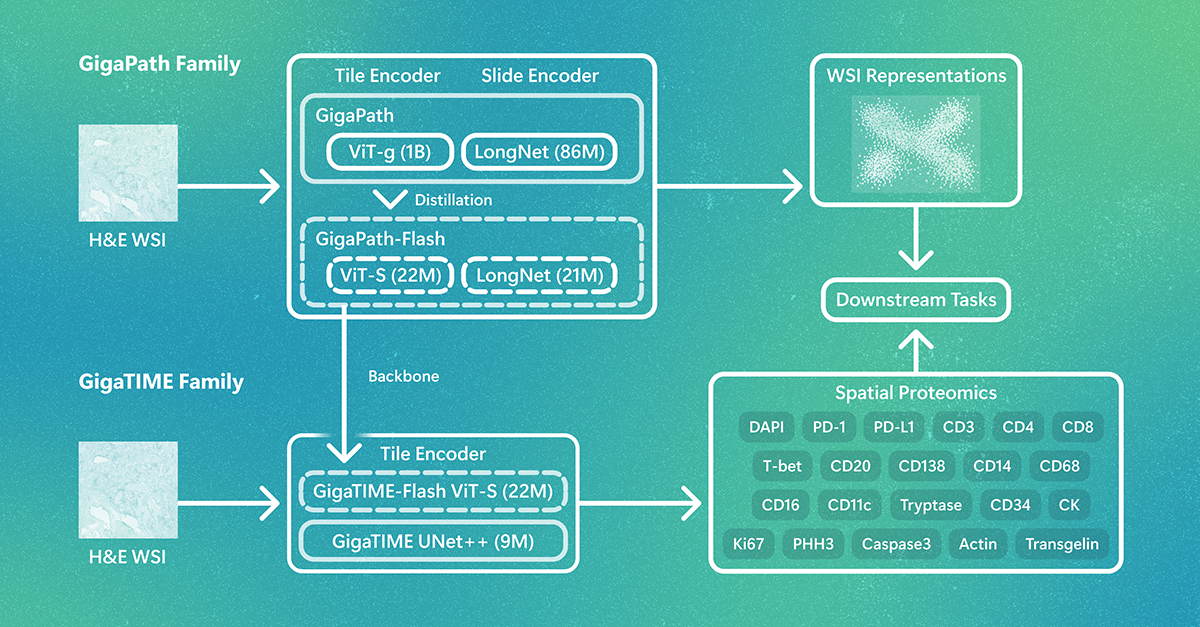
What if pathology foundation models could do more with less? GigaPath-Flash and GigaTIME-Flash cut computational demands while maintaining strong performance, opening the door to larger studies and broader exploration. The post GigaPath-Flash and GigaTIME-Flash: Toward population-scale discovery with efficient pathology foundation models appeared first on Microsoft Research.