Results indicate that LLM-augmented analytics on a converged Oracle 26AI platform can reduce average analytical query resolution time by approximately 60 percent relative to traditional BI report cycles, achieve semantic retrieval precision above 90 percent for enterprise knowledge corpora, and reduce generative output hallucination rates by more than half when grounding is enforced through in-database retrieval.
ProphDR is an interpretable deep learning framework that integrates multiomics data and drug structural information using a hierarchical attention mechanism, and generates biologically interpretable attention maps that highlight key pharmacophores and resistance-related genes consistent with established mechanisms in NSCLC and BRCA.
Yundian Zeng, Qing Ye, Jike Wang et al.· Journal of Chemical Informat...· 0 citations
Society is steadily embracing the idea of coinhabitant service robots in the built environment for assistance with household tasks and chores. In particular, the growing number of older adults, individuals with disabilities, and people requiring daily assistance has further created an urgent need for intelligent coinhabitant robots capable of supporting mobility, independence, and safety within physical living spaces. The growing complexity of modern built environments and the increasing prevalence of coinhabitant robots have underscored the need for advanced computational methods to support analysis, monitoring, and management. To provide users with meaningful assistance and clear scene understanding in such settings, robots must be able to perceive, interpret, and reason about their surroundings in a way that aligns with human spatial understanding. Place segmentation, which delineates spatial regions such as rooms or functional areas, together with semantic recognition, which assigns meaningful labels to these regions, forms the basis for accurate scene understanding in building-scale environments. Existing deep learning approaches have largely relied on closed-vocabulary detection systems, which are limited to a predefined set of categories of rooms and therefore struggle to interpret diverse or naturalistic descriptions of spaces. Furthermore, most current methods neglect the uncertainty inherent in scene recognition—for example, when rooms have overlapping functions (e.g., kitchen–dining areas) or when people use linguistically similar descriptions to refer to distinct spaces—thereby reducing their effectiveness in ambiguous or complex environments. To address these challenges, we propose an open-vocabulary semantic segmentation and classification pipeline that leverages vision–language models (VLMs) and large language models. Our framework follows a “segment–detect–select” paradigm for open-vocabulary scene understanding, consisting of three modules: (1) segmentation of distinct rooms and regions in the scene; (2) VLM-based similarity scoring between descriptive queries and segmented regions; and (3) adaptive conformal prediction to select among candidate regions while explicitly accounting for uncertainty. Evaluation results on the large-scale Matterport3D dataset, which comprises diverse photorealistic indoor environments, show that the proposed framework outperforms state-of-the-art open-vocabulary methods in scene segmentation [by 30% in AP50 and 5% in mean intersection over union (mIOU)], classification (by 200% in F1 score and 263% in mean average precision), and selection (by 50% in room mIoU). These advances are significant for built environments, as improved scene understanding directly supports safer, more adaptive, and more intuitive coinhabitant assistive agents for humans in complex indoor spaces.
Yifan Xu, V. Kamat, C. Menassa· Journal of computing in civi...· 0 citations
These findings show that reliable evaluation of LLM-generated code requires validated ground truth, protected tests, and multiple explicitly interpreted measures, and that CodeAssay provides a reproducible basis for evidence-based model evaluation in AI-augmented software development.
Shahbaz Siddeeq, Muhammad Waseem, Umar Subhan Malhi et al.· 0 citations
The first comprehensive benchmarking framework specifically designed to accommodate inter-dataset heterogeneity is presented, finding that well-designed small datasets can match or even surpass the performance of larger benchmarks, suggesting that different metrics are applicable to different datasets/testing scenarios.
Yingjuan Cheng, Qing Ye, Linlong Jiang et al.· Journal of Cheminformatics· 0 citations
A novel committor learning framework grounded in the AlphaFold 3 paradigm is proposed that elucidates how ligand substituents regulate the ratio between distinct binding pathways, offering new perspectives for structure-based drug design.
Jintu Zhang, Zichang Jin, Huifeng Zhao et al.· 0 citations
The Comprehensive VS Platform with AI Engine (CVSP-AIE) for drug discovery from compound libraries integrates three AI models: KarmaDock, a fast docking model that directly updates atomic coordinates; CarsiDock, an accurate docking model that predicts protein-ligand distances and reconstructs binding poses; and RTMScore, an accurate scoring model that learns residue-atom distance distributions for affinity prediction.
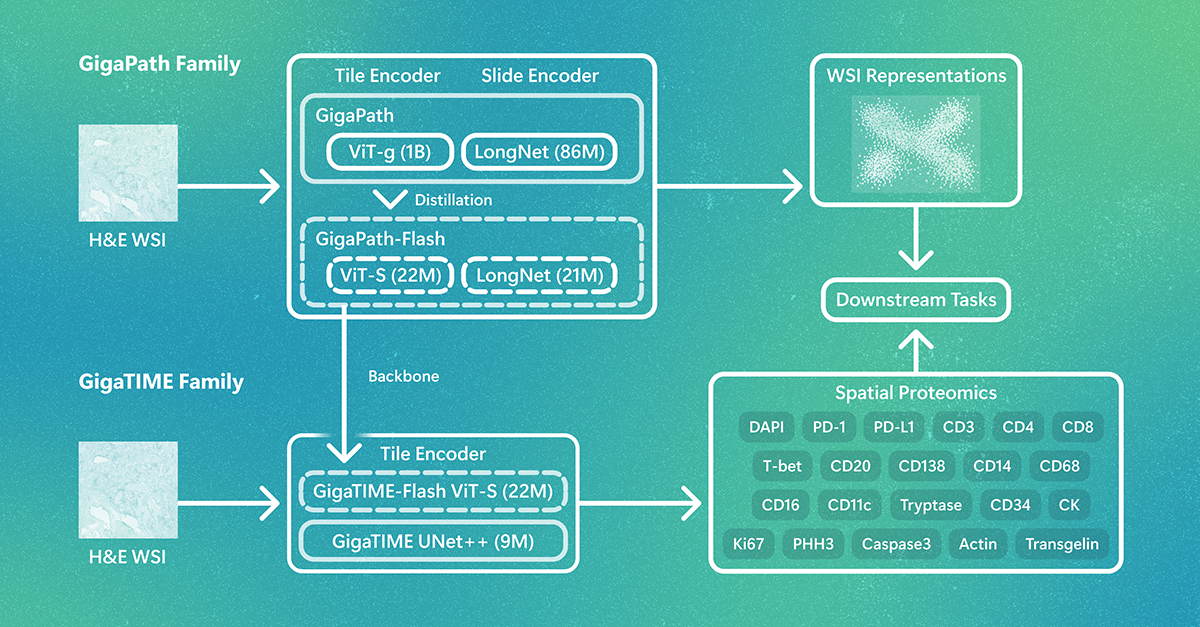
What if pathology foundation models could do more with less? GigaPath-Flash and GigaTIME-Flash cut computational demands while maintaining strong performance, opening the door to larger studies and broader exploration. The post GigaPath-Flash and GigaTIME-Flash: Toward population-scale discovery with efficient pathology foundation models appeared first on Microsoft Research.
We use cookies to run the site and, with your consent, for analytics and to show ads.
See our Cookie Policy.