Machine learning (ML) and deep learning (DL) have dominated Intrusion Detection System (IDS) research in recent years. Unfortunately, many existing studies have produced inflated results and unreliable benchmarks due to critical oversights and mistakes in the ML and DL pipeline, from data collection and labeling to fea...
Among distinct optimal acceleration mechanisms for deterministic monotone root-finding problems and fixed-point problems, dual-anchoring has recently been shown to admit a more robust direct stochastic extension than standard anchor acceleration. However, without additional strong monotonicity, the existing stochastic...
A literature review around the interfaces connecting contextual evidence to execution, distinguishing four families: context-conditioned policies, geometric demonstration transfer, world-model-based control, and skill- and agent-based execution.
Hao-Jian Huang, Ze-Xi Li, Ju-Hao Guo et al.· 1 citation
Radio-interferometric images are reconstructed from sparsely sampled visibilities, and CLEAN-based imaging can struggle with spatial filtering, complex morphologies, and uncertainty quantification. Alternative methods that fit visibilities directly can address some of these limitations but often require manual choices...
S. Mao, A. Isella, P. Perdikaris et al.· 0 citations
Reach audiences
Advertise in front of researchers, engineers, and readers.
Consider a community of agents who are seeking consensus on a set of parameters. The agents agree to use the same Bregman-type divergence to quantify disagreement between their individual estimates of the parameters but have varying confidence in each other's abilities. Each agent is happy to revise their estimate by m...
Federated Learning (FL) enables collaborative model training across distributed clients without sharing raw data, making it suitable for privacy-sensitive applications such as healthcare, finance, and edge intelligence. However, conventional FL approaches rely on static client participation and fixed aggregation strate...
Deepthy K. Bhaskar, VP Binu, B Minimol· 0 citations
This paper proposes Wasserstein Causal Forests (WCF) for settings in which each unit's outcome is itself a probability distribution. This study also defines finite-grid transformed average and conditional average treatment effects, including a reference-distance contrast that asks whether treatment moves unit-level dis...
Genome foundation models are growing into sparse mixture-of-experts (MoE) networks whose expert weights no longer fit on the machines that hold the sequences, yet sending a private genome to rented accelerators exposes it: we show that a single server hosting one expert recovers the input nucleotides with 99.8% top-1 a...
Genome foundation models are most useful where sequences are generated, yet the largest models need datacenter accelerators and a place to send private DNA. We ask whether a 15-billion-parameter genome mixture-of-experts (MoE) model can instead run on volunteers'web browsers, with the experts spread across many untrust...
Can a genome model retain a detectable record of the synthetic sequences used to train it? We study watermark inheritance through distillation with GenoTrace, a codon-aware extension of green-list watermarking. Two token-level factors modulate the teacher's generation bias using codon position and organism-specific cod...
Many DNA foundation models are pretrained by masking parts of a sequence and asking the model to reconstruct them. Standard masked pretraining exposes the encoder to special [MASK] tokens that are absent at inference, creating a mismatch between training and downstream use. The role of an explicit global sequence repre...
Monireh Safari, Pablo Millan Arias, Scott C. Lowe et al.· 0 citations
Modern bioacoustic foundation models like Perch and BirdNET can identify species with high discriminative accuracy, yet their confidence scores are often uncalibrated and difficult to interpret as probabilities of real-world occurrence. This limits their use for ecological inference beyond threshold-based detection. We...
Neha Sajja, Bart van Merri\"{e}nboer, Burcu Karagol Ayan et al.· 0 citations
Learn how Google DeepMind and GovTech Singapore uses lightweight on-device Gemma models to intercept conversational scams in private chats with zero cloud data egress.
MIT News · Artificial Intelligence· news.mit.eduOct 13, 2026
Machine-learning networks can learn without detailed instructions from a designer. Those that do may offer insight into how the brain reorganizes itself during learning.
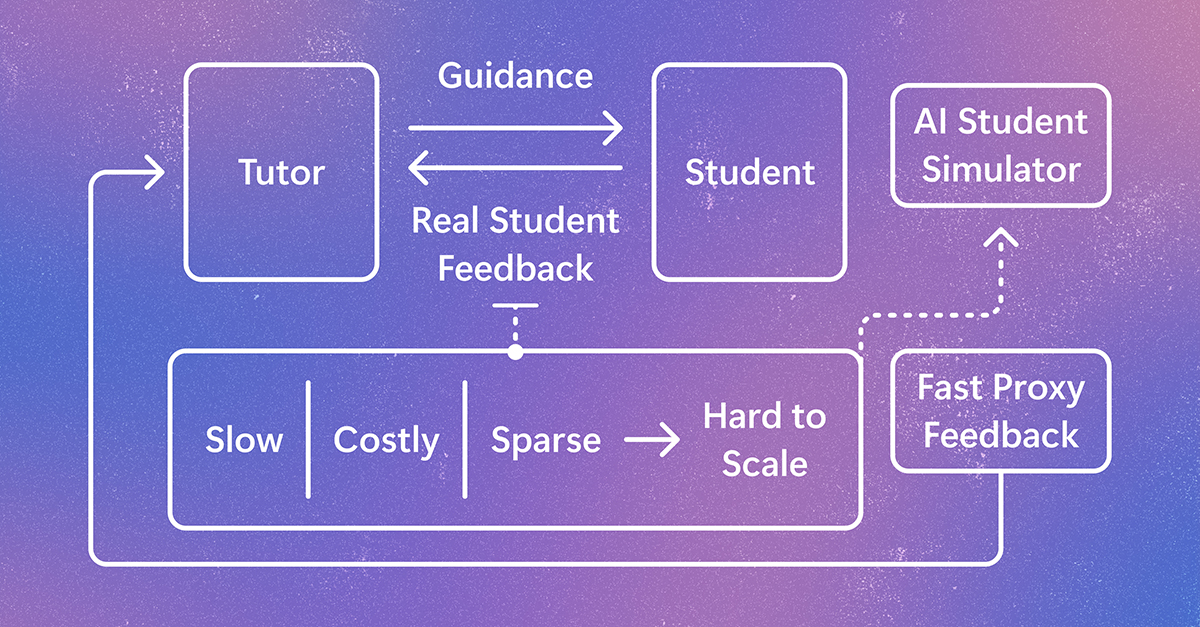
StudentSim is a research system for evaluating and improving AI tutoring tools before they are tested with learners. It models how individuals may engage with tutors, giving feedback to improve tutor performance across subjects like chess, writing, and mathematics. The post Simulating student learning for better AI tutoring appeared first on Microsoft Research.
Exploring how generative AI could make machine vision more accessible to businesses. The post GenEye in a Box: Making Machine Vision Something You Can Just Ask For appeared first on GPT-Lab.
We use cookies to run the site and, with your consent, for analytics and to show ads.
See our Cookie Policy.