This work proposes BrainWAM, a structured action-space coordination framework that converts semantic reasoning and predictive world modeling into two specialized action-oriented pathways, and aligns them at the level of compact action representations, and introduces an asynchronous rectified-flow inference strategy with decoupled video and action denoising.
Bing Zhan, Shuyao Shang, Shuo Lu et al.· 0 citations
This work considers rectangular 2D grids, where uniform-sized loads are first stored, up to full capacity, and subsequently retrieved according to prescribed arrival and departure sequences, and develops an online prioritized multi-agent path planning algorithm for this problem.
William Zhang, Tzvika Geft, Jingjin Yu et al.· 0 citations
Mask2Real-WM is presented, a two-stage action-conditioned world model for dexterous manipulation that decouples pixel prediction into a dynamics model and a rendering model that shows that mask conditioning and simulation pretraining are both required for per-DoF action controllability across all 23 degrees of freedom.
Riccardo Feingold, Davide Liconti, Chenyu Yang et al.· 1 citation
This work proposes COMPACT-VA, a planning-aligned working memory framework built on conditional VQ-VAE, compressing extended context into bounded representations, and evaluates on high-signal dynamic scenarios where historical context is most critical for behavior correctness, and accordingly design behavioral metrics.
Zhixuan Liang, Yuxiao Chen, Yurong You et al.· arXiv.org· 1 citation
Reach audiences
Advertise in front of researchers, engineers, and readers.
We introduce Accelerating Dexterity via Pre-Training (ADEPT), a large-scale reinforcement learning (RL) framework for learning sim-to-real transferable dexterity across high degree-of-freedom (DoF) robot embodiments that can solve long-horizon tasks directly from raw visuo-tactile perception. ADEPT pretrains a dexterous policy on a generic object reposing task, then post-trains downstream policies with this pretrained behavior as a prior. ADEPT enables learning new behaviors that are otherwise difficult to discover from scratch on multi-fingered robots and avoids learning the same set of skills over again for every new downstream task. The pretrained policy zero-shots the reposing phase of downstream tasks, but na\"ive RL fine-tuning rapidly degrades this capability during transfer. We address this with a stable post-training recipe combining behavior-cloning distillation, critic warm-up, and conservative on-policy updates. To safely exploit the full kinematic dexterity, we introduce a joint-space Geometric Fabric that mediates between the RL policy and the robot. We distill post-trained teachers into perceptive students that zero-shot sim-to-real transfer on two embodiments: a 23 DoF Kuka-Allegro with two RGB cameras, and a 29 DoF Flexiv-Sharpa with two RGB cameras and five vision-based tactile sensors, and can solve long-horizon tasks from challenging initial states with dexterity at human-level speed.
Jayjun Lee, Jessica Yin, Asif Rana et al.· 0 citations
DA-WAM is proposed, a framework that unifies predictive representation learning, action-conditioned future modeling, and trajectory scoring under a single decision-making objective and demonstrates state-of-the-art performance on NAVSIM-v1 and NAVSIM-v2.
Ruiguo Zhong, Benshan Ma, Xiaolong Chen et al.· 0 citations
We present the orienteering problem with uncertain time-varying rewards (OP-UTVR), a novel variant of the orienteering problem (OP). While most existing OP formulations assume rewards to be known in advance, practical applications involve uncertain and time-varying rewards, as with shifting customer demand for delivery agents. OP-UTVR relaxes this assumption by allowing agents to estimate reward dynamics from observations and forecast future rewards. This enables informed routing decisions despite stochastic reward changes and inevitable prediction errors. We address this problem using three planners that differ in planning horizon and online adaptivity, and derive theoretical bounds on their performance under reward stochasticity. We further introduce a mobile service robot benchmark for OP-UTVR, where a robot navigates among pedestrians in indoor environments. Experiments reveal trade-offs between planning horizon and adaptivity, and demonstrate the effectiveness of long-horizon planning with online adaptation.
Masafumi Endo, Kohei Honda, Yuu Jinnai et al.· 0 citations
Grid cell signals are introduced to mitigate spatial aliasing in geometrically ambiguous environments and indicate that grid cells provide information complementary to boundary-based inputs, yielding more reliable place representations in geometrically ambiguous environments.
Alexander B. Johnson, Obadah Ghizawi, A. Minai· 0 citations
GigaBrain-WBC-0.5, the first Behavior World Model for humanoid whole-body control, is presented, which trains a causal Transformer to jointly predict its next action, next state, and the distribution over its next latent behavior command, so the network that acts also models how the environment shapes what it can do next.
Ziyang Cheng, Tianshu Tang, Jinxi Lan et al.· 0 citations
Drone propeller faults can create safety and reliability risks when their effects are distributed across multiple flight-log channels rather than appearing as a single diagnostic signal. This paper proposes a Metamorphic Artificial Age Score (AAS) decision-support prototype for flight-log-based drone propeller health monitoring. Using selected historical real flight logs from the 2024 DronePropA public dataset, the framework computes six health-related indicators from raw MATLAB matrices: trajectory tracking error, attitude instability, thrust-command burden, motor-command imbalance, ESC-command instability, and battery-level stress. These indicators are normalized relative to a healthy baseline and evaluated through candidate scoring policies, metamorphic adequacy relations, and a redundancy-adjusted AAS formulation. In this context, AAS is used as a structural policy-adequacy and burden measure rather than as a chronological age measure. A controlled retrospective evaluation was performed using one healthy baseline and three defective propeller cases under the same speed profile and trajectory. The healthy case was assigned to routine monitoring. The Severity 1 case was dominated by ESC-command instability and assigned to maintenance review. The Severity 2 case reached maximum motor-command and ESC-command burden, while the Severity 3 case reached maximum trajectory tracking error; both triggered mandatory inspection. The results show that propeller fault effects may appear through different operational channels, supporting the need for a multi-indicator decision-support layer for post-flight maintenance prioritization and autonomous-system oversight.
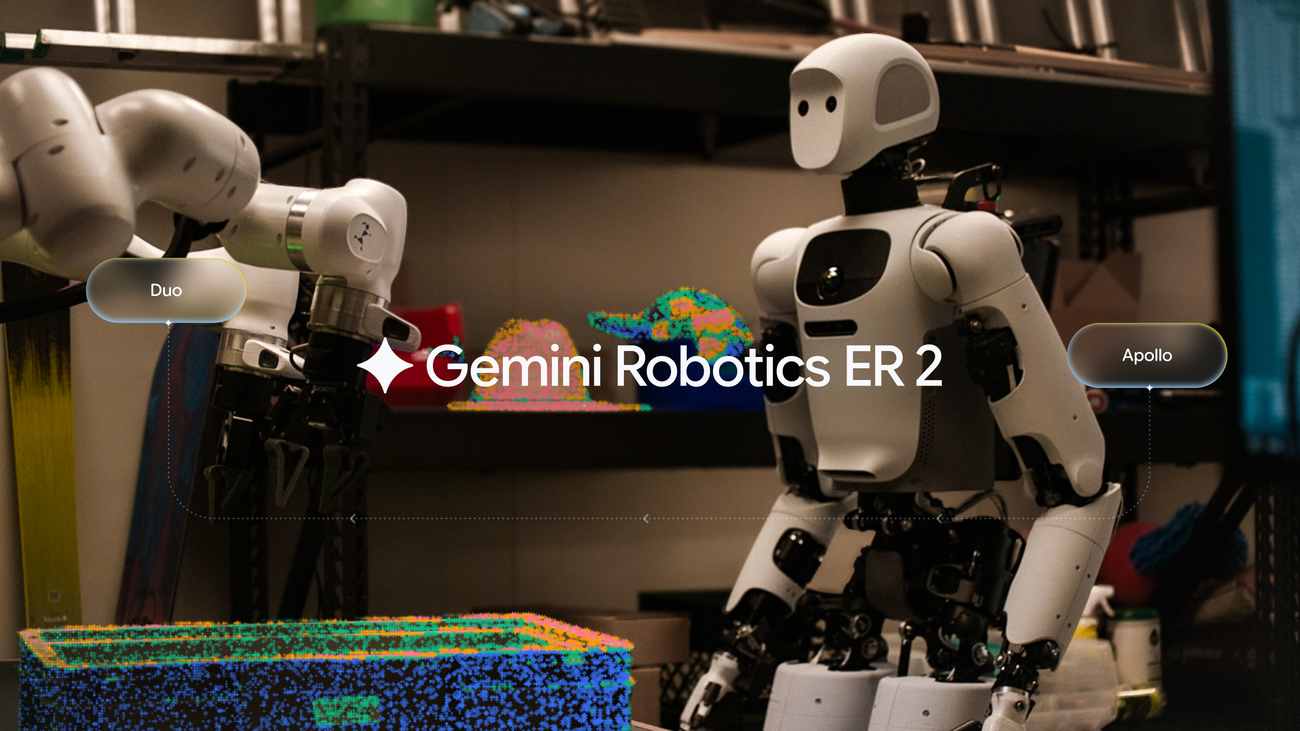
Gemini Robotics ER 2 helps robots reason, collaborate, and solve real-world tasks. It represents a step change in video understanding, tool orchestration, and multi-robot collaboration for robotic applications.
From feet to fingertips — we are teaching robots intelligent whole-body control, fine dexterity, and teamwork to complete a broad range of complex tasks.