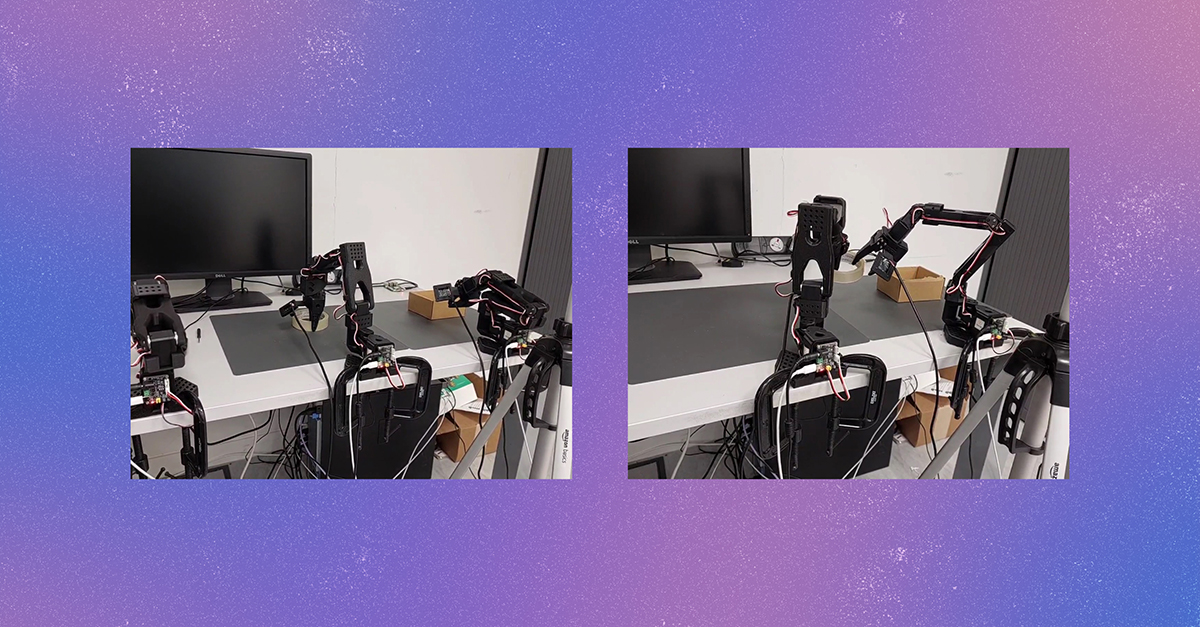
Existing teleoperation systems are often tailored to specific robot hardware and task domains, limiting their scalability and adaptability. We present ModPack, a modular and extensible teleoperation system designed to support diverse robot embodiments and task requirements within a unified framework. At the core of Mod...
Joshua Citron, Renee Zbizika, Zeyi Liu et al.· 0 citations
OptCar (Optimized Car), a recipe for bridging the gap from generalist to specialist FKD models that preserves cross-terrain generalization while optimizing performance for a specific vehicle, is presented.
Rwik Rana, Jesse Quattrociocchi, Christian Ellis et al.· arXiv.org· 0 citations
Robot policies inevitably encounter failures when deployed in real environments. Naive retries often repeat the same mistakes, while many existing recovery methods rely on human intervention. In this paper, we propose Failure-Aware Retry (FAR), a framework that enables robots to learn from previous failures at test tim...
Robotics are expected to support environmental monitoring and disaster detection, where decisions must be made under uncertainty, resource limitations, and strict operational constraints. In critical missions, such as wildfires, robots must not only identify hazardous events with sufficient confidence, but also manage...
Lina Magoula, Nikolaos Koursioumpas, Nancy Alonistioti et al.· 0 citations
Reach audiences
Advertise in front of researchers, engineers, and readers.
World models have recently seen a rapid growth in both their popularity and capability as more data efficient tools for generating robot training data or simulating real world environments, with many works proposing their integration into the robot learning pipeline. While highly practical, in this work we demonstrate...
Ethan Rathbun, Ahmed Agha, Saaduddin Mahmud et al.· 0 citations
Visual world models have shown great potential in learning complex system dynamics. Recent advancements leverage these models as transition functions within Model Predictive Control (MPC) frameworks to solve various control tasks. When applied to robotics, however, they are limited to single-stage tasks such as reachin...
Video world models (WMs) have shown promise for policy evaluation and improvement by imagining realistic future observations conditioned on ego-robot actions. While WMs can model distributions over futures, policy evaluation and improvement typically rely on nominal imaginations, which can miss high-impact outcomes of...
Junwon Seo, Sushant Veer, Ran Tian et al.· 0 citations
Active vision -- where a policy controls its own gaze during manipulation -- has emerged as a key capability for imitation learning, with multiple independent systems demonstrating its benefits in the past year. Yet there is no shared benchmark to compare approaches or quantify what active vision contributes, on which...
Partial driving automation creates a tension: drivers remain legally responsible while being less active in control. Meaningful human control (MHC), a normative framework that can potentially address this tension, proposes that automated systems are designed to track relevant human reasons and that humans should at all...
Ashwin George, Lucas Elbert Suryana, Lorenzo Flipse et al.· 0 citations
Solving complex long-horizon robotic tasks requires joint reasoning over abstract task structure and low-level physical interaction. While combining Vision-Language Models (VLMs) and video generation models offers a promising path for zero-shot planning, their individual tendencies to hallucinate physics or violate geo...
Jiahui Fu, Junyu Nan, Lingfeng Sun et al.· 0 citations
RoboPilot is presented, a dual-thinking closed-loop agentic framework for robotic manipulation that supports adaptive reasoning for complex tasks in real-world dynamic environments and dynamically switches between fast and slow thinking to balance efficiency and accuracy.
Xin-Yi Liu, M. Sani, Ze-Wei Zhou et al.· 0 citations
Vision-Language-Action (VLA) models have recently advanced robotic manipulation by translating natural-language instructions and visual observations into control actions. However, existing VLAs are primarily trained on successful expert demonstrations and lack structured supervision for failure diagnosis and recovery,...
Zewei Ye, Weifeng Lu, Minghao Ye et al.· 0 citations
A new system identifies and corrects unreliable object descriptions stored in a robot’s memory, improving the robot’s ability to interact with its environment.
Robots are getting smarter, but how can their hardware match that growth? New Microsoft Research findings show that moving AI inference beyond the robot can improve task success, boost efficiency, and support more advanced physical AI workloads. The post Offloaded inference for real-world physical AI robotics appeared first on Microsoft Research.