It is shown that when a video model generates physically incorrect motion, the correct motion remains available inside the model and can still be made to control the generated video, and a stronger downstream write can restore physical motion, while excessive gain overshoots.
Abstract
When a video model generates physically incorrect motion, did it fail to learn the correct motion, or did it learn it but fail to use it? We show the latter: the correct motion remains available inside the model and can still be made to control the generated video. We train on videos where red masses oscillate slowly and blue masses oscillate quickly, then test a red mass with fast observed motion. Even when the model generates slow motion in this conflicting case, a low-dimensional edit predicted from simple physical variables restores the correct fast motion. We call this ability causal writability. At fixed strength, we find a sharp depth boundary: the same edit changes the video before the boundary but not after it. This closure marks commitment for that write. The motion signal nevertheless remains, and a stronger downstream write can restore physical motion, while excessive gain overshoots. Early causal writability predicts which errors training later corrects: those errors are writable at more network depths than errors that persist. We reproduce both causal writability and its sharp closure in a pretrained 1.3B video model, supporting generality across model scale and training regime.
An action-conditioned video Shell Game, a visual analogue of $S_5$ state tracking that separates visual rendering from compositing the unobserved world state, and finds that length generalization requires a revisable state carried across chunks and an update expressive enough to apply a swap.
Joonghyuk Shin, Yi-Cong Hong, Jaesik Park et al.· 2 citations
MotionBlind, a contrastive benchmark of self-recorded video for physically grounded motion, the variables a world model must predict, is introduced, a pair of near-identical clips that differ only in motion.
Dhairya Bhatia, Bishoy M. Galoaa, Oliver Fritsche et al.· 0 citations
Symbolic state supervision raises the 20M model's frame accuracy from 31.1% to 67.3% at the same training-data budget, suggesting that learning representations of state changes can complement scaling.
Wei-Hang Guo, Xiao-Yu Wu, Yi-Fei Wang et al.· 0 citations
GlanceWAM is introduced, which decouples imagination from control within a single video DiT: an asynchronous proposer glances ahead on a slow clock to imagine a single lookahead frame seconds into the future in the background, while an action head decodes action chunks at control rate purely in latent space without blo...
Lin-Han Wang, Zi-Jian An, Mingyuan Zhang et al.· 2 citations
Prior research on learning from humans often requires real human demonstrations. But advances in video generation models offer a new paradigm: we can now prompt these generators to make synthetic videos of the task. On the plus side, these synthetic videos take place in the robot's current environment, and do not requi...
Yin-Long Dai, Homanga Bharadhwaj, Dylan P. Losey· 0 citations
Image-to-video generators are often credited with absorbing physical dynamics as implicit world models, a claim the community currently checks with plausibility scores that ask whether a clip looks consistent with real-world motion. Plausibility is the wrong test on its own, because a clip can look natural while encodi...
Exploring how generative AI could make machine vision more accessible to businesses. The post GenEye in a Box: Making Machine Vision Something You Can Just Ask For appeared first on GPT-Lab.
Microsoft Research Blog· microsoft.comAug 11, 2026
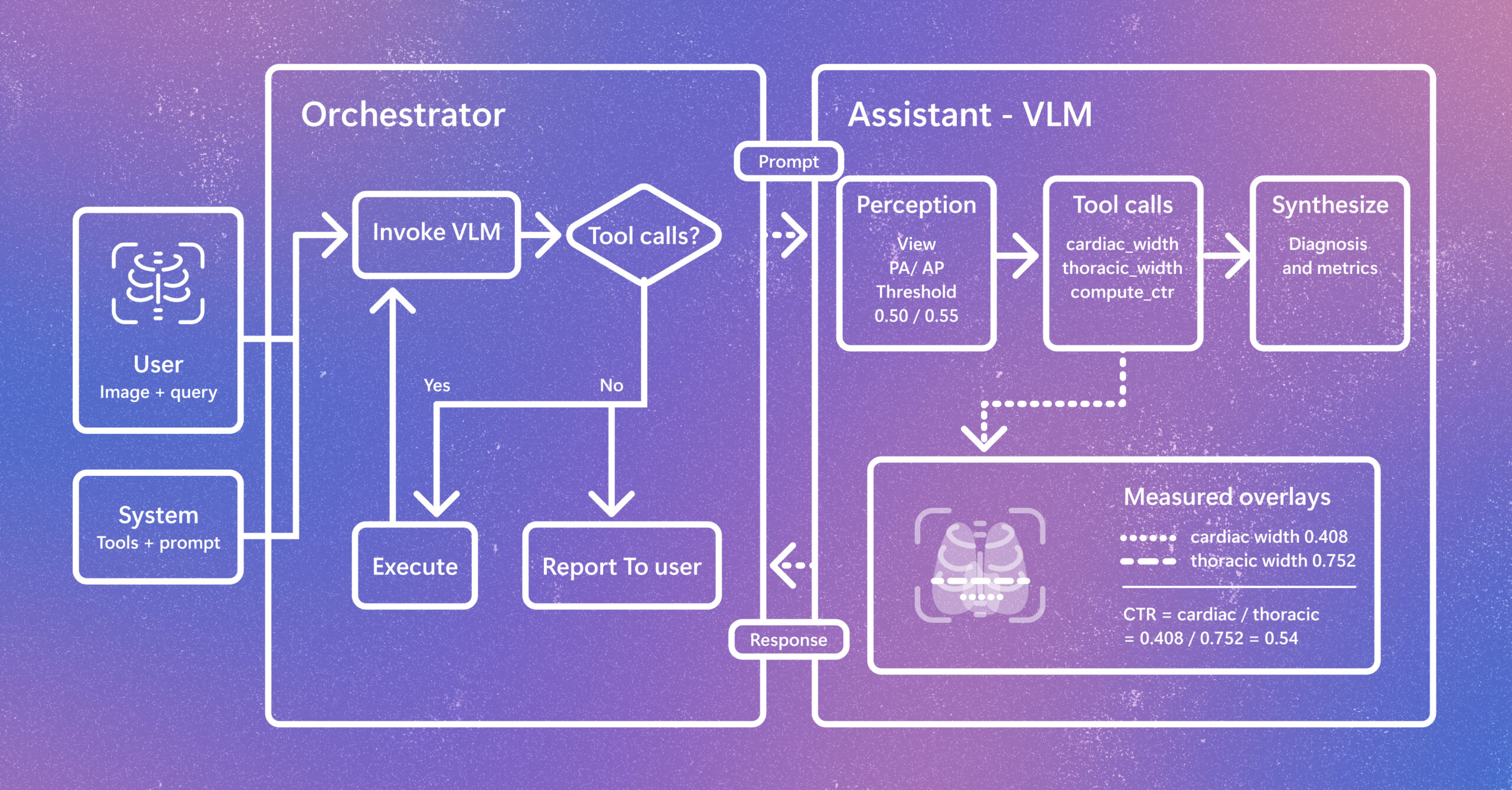
Radiology AI is evolving beyond report generation. CARE-X explores a unified approach that combines flexible reasoning, calibrated predictions, and measurement-based tools for chest X-ray interpretation. The post Introducing CARE-X: Towards Clinically Useful Radiology VLMs with Auxiliary Supervision, Reward-Aligned Learning, and Tool-Augmented Measurement appeared first on Microsoft Research.