This work constructs a Gaussian random-field approximation whose velocity field matches the mean and covariance of the original stochastic gradient, and shows that the Gaussian approximation captures the SGD dynamics with second-order weak accuracy.
Abstract
Stochastic gradient descent (SGD) admits diffusion approximations that replace the complicated randomness of stochastic gradients by Gaussian noise, providing a powerful tool for understanding its dynamics and long-time behavior. We investigate whether an analogous approximation principle holds for optimization over probability measures, where the objective is a functional defined on the Wasserstein space P2. The nonlinear geometry and infinite-dimensional nature of P2 prevent a direct extension of the classical Euclidean theory. Using Lions differentiability, we lift the problem to a linear Hilbert space, where higher-order differential calculus becomes available. We then construct a Gaussian random-field approximation whose velocity field matches the mean and covariance of the original stochastic gradient. By exploiting this moment matching through higher-order Taylor expansions, we show that the Gaussian approximation captures the SGD dynamics with second-order weak accuracy. Our result provides a rigorous foundation for replacing sample-driven randomness by analytically tractable Gaussian fluctuations in stochastic optimization over probability measures.
Wasserstein gradient flow extends gradient descent to probability measures. Its Hessian-guided perturbed variant (PWGF) adds Gaussian perturbations to escape saddle points in nonconvex problems. We investigate when its approximation by finitely many interacting particles remains accurate over growing time horizons. Our...
We propose a continuous-time algorithm for zeroth-order global optimization of smooth functions on compact manifolds that synthesizes Riemannian gradient dynamics using only objective measurements, without evaluating gradients. The algorithm is formulated as an ordinary differential equation driven by piecewise-smooth...
Mahmoud Abdelgalil, Miroslav Krstić, J. Poveda· 1 citation
We study gradient-type dynamics for weak stochastic control through the laws of controlled diffusions on path space. Although the objective is generally nonconvex in the drift, a uniformly convex running cost induces a strictly convex functional of the corresponding path law and hence a natural Bregman geometry. We con...
Yu-Peng Bai, Louis-Pierre Chaintron, Zhen-Jie Ren et al.· 0 citations
This work introduces SCMO (Stochastic Control Measure Optimizer), a gradient-free particle method derived from entropy regularized stochastic control, and proves finite-candidate consistency and shows that the signed, curvature-dependent effect of nonmatched covariance can reduce the resulting upper bound on the approx...
We prove asymptotic bias bounds for stochastic gradient Langevin dynamics in Wasserstein distance of order two. We assume that the negative log-density is strongly convex with a Lipschitz gradient, and that the stochastic gradient estimator is unbiased with an error satisfying a mean-square Lipschitz condition. The bou...
Stochastic approximation provides a general framework for online estimation and optimization. Statistical inference based on the resulting estimates requires understanding their fluctuations around the target. For Polyak--Ruppert averaging, functional central limit theorems describe the normalized cumulative estimation...
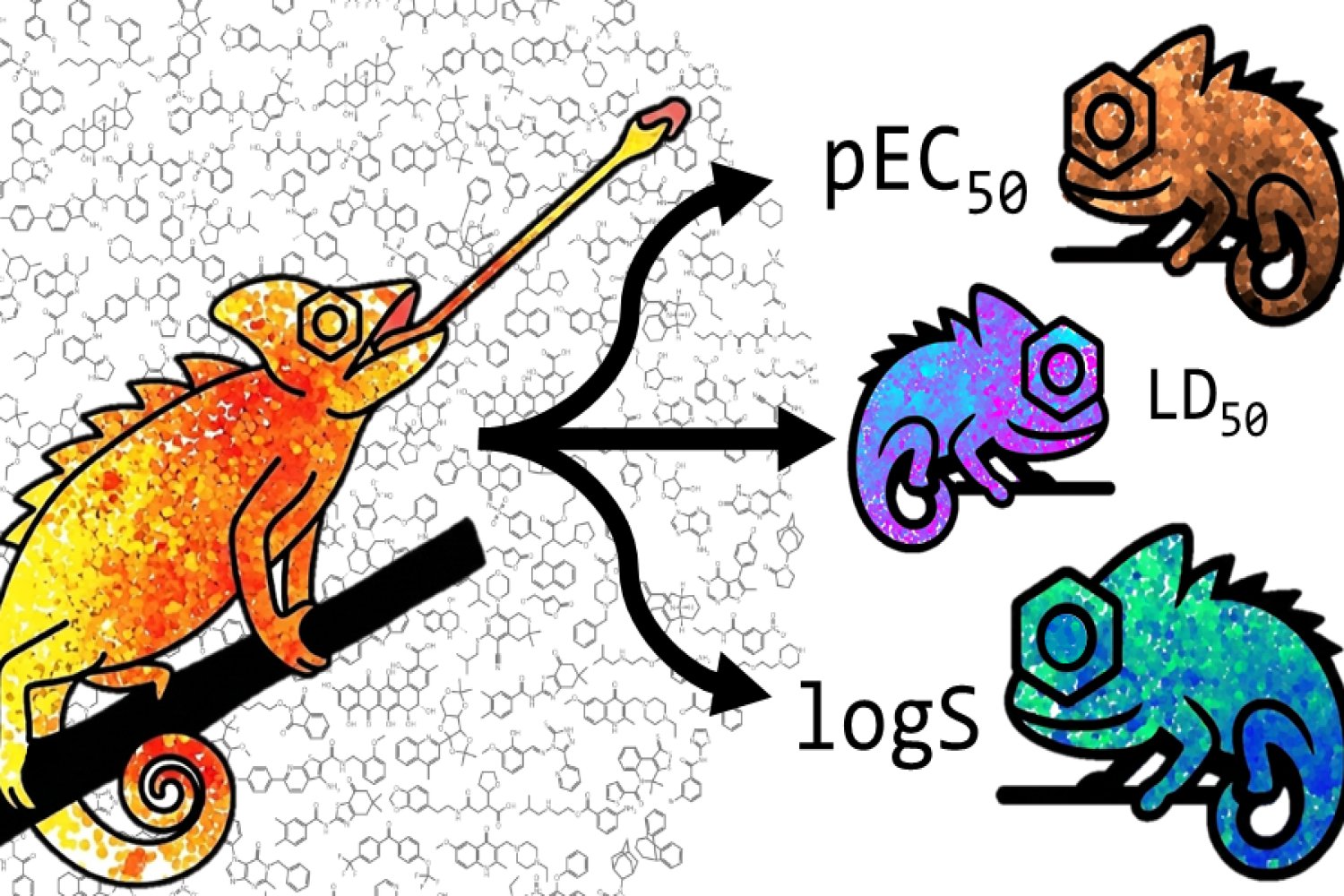
A machine-learning approach called CheMeleon provides a practical way to develop new drugs or other molecules with much less detailed, expensive experimentation.
Learn how Google DeepMind and GovTech Singapore uses lightweight on-device Gemma models to intercept conversational scams in private chats with zero cloud data egress.