Numerical tests show that the learned models outperform fixed transforms and per-image optimization while matching the performance of much larger unitary architectures, yet with far fewer parameters.
Abstract
This work introduces quantum-inspired tensor-network circuits as trainable transforms for image inpainting. Among the proposed architectures, the diagonal quantum Fourier transform (QFT) relaxation is invertible with $O(N^2 \log N)$ computational cost for $N\times N$ images, inherently preserving minimum coherence throughout training via its circuit structure and eliminating the need for explicit coherence penalties. Unconstrained gradient-based phase optimization (Riemannian-optimization free) enables efficient learning from randomly sampled training data, allowing the learned transform to generalize to test images observed through fixed sampling masks. Numerical tests show that the learned models outperform fixed transforms and per-image optimization while matching the performance of much larger unitary architectures, yet with far fewer parameters.
We introduce Bernstein-Vazirani Networks (BVNs), a non-variational quantum machine learning framework that leverages quantum interference for supervised learning, demonstrated on vision and representation learning tasks. In their standard form, BVNs follow the principle of quantum Fourier sampling: labelled data are pl...
N. Meli, Tolga Birdal, Prayag Tiwari et al.· 0 citations
Image reconstruction and generation have become fundamental tasks in computer vision and quantum-inspired machine learning. Existing quantum-inspired variational autoencoders have demonstrated promising capabilities; however, they often suffer from limited local feature representation, unstable optimization, and perfor...
Dina A. Amer, Asmaa F. Hassan· Information· 0 citations
Adapting large pretrained vision models under limited data and frozen-backbone constraints remains a central challenge in transfer learning. While lightweight adapters and parameter-efficient fine-tuning methods are widely adopted, most rely on generic multilayer perceptrons or low-rank linear updates, offering limited...
Developed as a workhorse for classical simulations of quantum algorithms and quantum many-body systems, Tensor Network methods have entered the scientific mainstream in quantum physics. Among various types of tensor networks, Tensor Trains (commonly know as Matrix Product States in the quantum computing community) have...
QT is introduced, a Quantum-inspired Transformer for vision tasks with three components: angle-inspired encoding that maps image tokens to learned trigonometric Hilbert-space features analogous to quantum rotation-based state encoding; self-attention over these periodic features, inducing a classical cosine kernel appr...
Adaptive regularization is an effective means of improving the flexibility of classical variational reconstruction methods while retaining their interpretability and mathematical structure. In this work, we propose an approach for learning deep-reparameterized adaptive regularization maps (DREAM) for Total Variation (T...
T. Vu, A. Biguri, Christoph Kolbitsch et al.· 0 citations
Exploring how generative AI could make machine vision more accessible to businesses. The post GenEye in a Box: Making Machine Vision Something You Can Just Ask For appeared first on GPT-Lab.
Microsoft Research Blog· microsoft.comAug 11, 2026
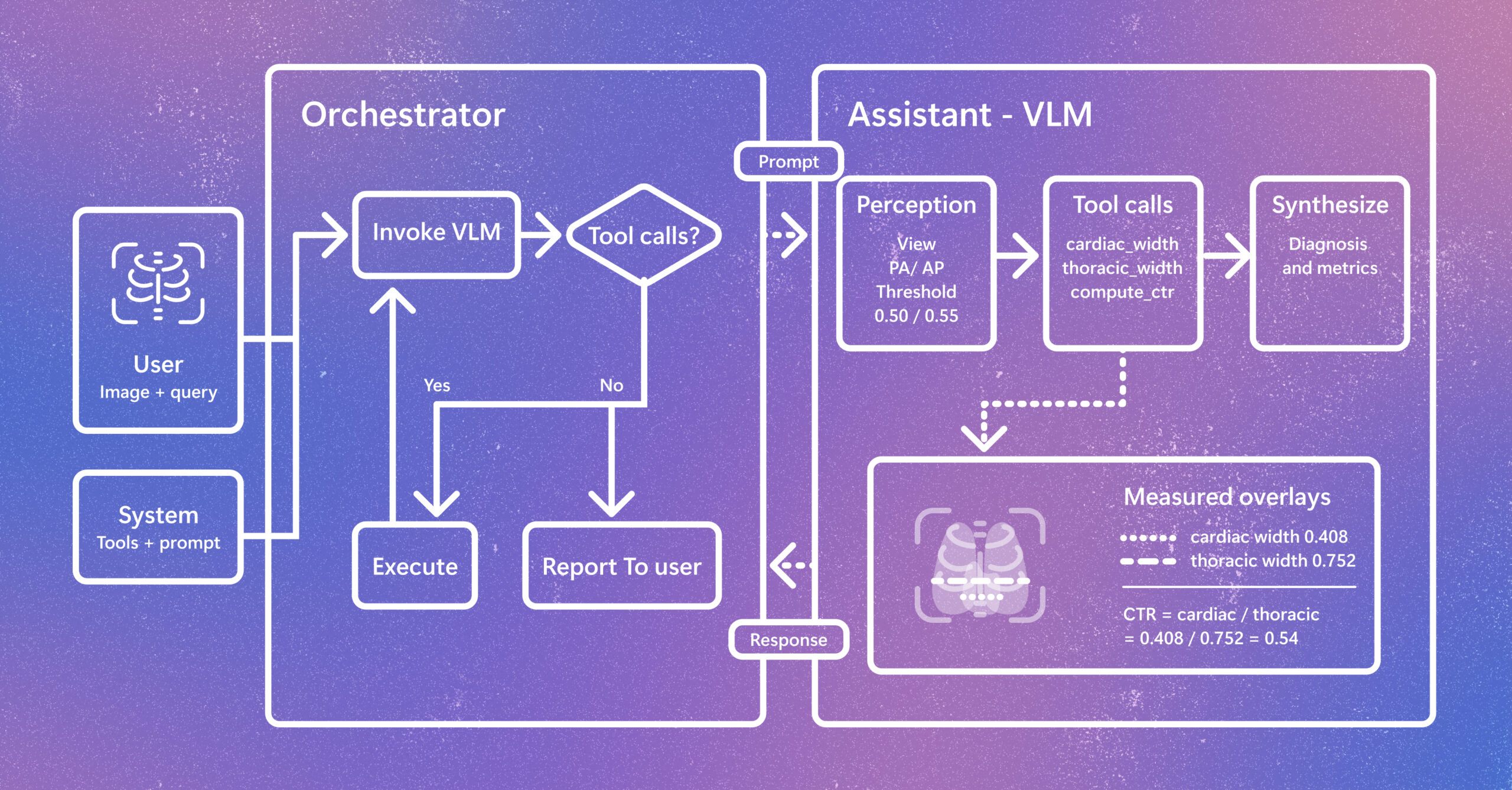
Radiology AI is evolving beyond report generation. CARE-X explores a unified approach that combines flexible reasoning, calibrated predictions, and measurement-based tools for chest X-ray interpretation. The post Introducing CARE-X: Towards Clinically Useful Radiology VLMs with Auxiliary Supervision, Reward-Aligned Learning, and Tool-Augmented Measurement appeared first on Microsoft Research.