Skip to content
#edge computing Open access

FedMCP++: Integrating Modular Expert Heads with Prototype-Guided Contrastive Distillation for Wireless Personalized Federated Learning

Aug 2026 · Italian National Conference on Sensors · 0 citations · 21 references

TL;DR

FedMCP++, a modular and communication-efficient personalized FL framework in which every client owns a complete private model—a lightweight convolutional backbone with a private expert head—and collaboration is carried out entirely through knowledge exchange rather than parameter exchange, is introduced.

Abstract

Federated learning (FL) enables collaborative model training across decentralized clients while preserving data privacy, yet real-world deployments still face communication bottlenecks, performance degradation under heterogeneous client data, and limited personalization. In this study, we introduce FedMCP++, a modular and communication-efficient personalized FL framework in which every client owns a complete private model—a lightweight convolutional backbone with a private expert head—and collaboration is carried out entirely through knowledge exchange rather than parameter exchange. In each round, clients share only temperature-softened class predictions and class-wise feature prototypes computed on a small public proxy set; the server fuses them into an accuracy-weighted teacher and broadcasts the result, and clients realign their models through knowledge distillation, an instance-level contrastive objective, and prototype alignment. We evaluate FedMCP++, its ablations, and two knowledge-based baselines on six benchmark vision datasets with 10, 20, and 30 clients. The results indicate dataset-dependent trade-offs rather than uniform superiority: collaborative distillation improves average client-level accuracy over independent local training in twelve of eighteen configurations—most clearly under severe per-client data scarcity (e.g., up to +2.7 percentage points on KMNIST and +2.4 on STL-10 with 20–30 clients)—whereas independent training ensembles remain strongest on SVHN and CIFAR-10 at the studied budgets. Because no parameters are transmitted, the per-round uplink payload is a fixed-size 42.6 KB message, 9.9–12.8× smaller than full-model synchronization, and is invariant to model capacity. These properties make FedMCP++ a flexible framework for personalized FL in wireless edge and Internet of Things environments where bandwidth and privacy constraints are paramount.
Read PDF

Similar papers

Conference Jun 2026

FedOPAL: One-Shot Federated Learning via Analytic Visual Prompt Tuning

Experimental results show that FedOPAL not only significantly outperforms the original analytical methods on several benchmarks, but also achieves accuracy comparable to state-of-the-art iterative methods while maintaining zero server-side training costs, providing a new engineering paradigm for efficient collaboration of large models on the edge.

Lingyu Qiu, Daniela Annunziata, Stefano Izzo et al. · 0 citations
Preprint Aug 2026

CRIP: Channel Level Representation Injection for Personalized One-Shot Federated Learning

One-shot federated learning (OSFL) has emerged as a promising collaborative model learning framework with only a single round of communication, offering significant advantages in communication efficiency and privacy preservation. However, OSFL often faces inherent limitations under severe domain heterogeneity across clients due to the lack of iterative knowledge exchange. Most existing OSFL methods require an auxiliary public dataset for knowledge distillation or leverage statistical information for parameter-level aggregation, overlooking feature shift caused by domain heterogeneity. To address these challenges, we propose CRIP, a personalized OSFL framework that operates in the representation space via channel-level feature alignment. To achieve this, each client uploads its feature extractor to the server, which broadcasts all extractors back to every client. Since not all source clients share compatible feature distributions with the target client, indiscriminate fusion of cross-client features would introduce domain-specific noise. Therefore, CRIP effectively measures the channel-wise representational similarity between the target client and each source client on a small local mini-batch, and selectively fuses only the most compatible features. Extensive experiments on domain-heterogeneous benchmarks such as DomainNet, PACS, and Office-Home demonstrate that CRIP consistently outperforms local models and state-of-the-art baselines, validating the effectiveness of representation-space personalization under extreme domain heterogeneity.

Zijian Jiang, Chaoli Sun, Handing Wang et al. · 0 citations
Open access Aug 2026

BiFCL : A Bi‐Level Federated Contrastive Learning Framework With Auxiliary Model‐Guided Alignment

Federated learning (FL) enables collaborative model training over distributed clients without sharing raw data, but its performance can degrade severely under non‐independent and non ‐ identically distributed (non‐IID) client data. To address this challenge, we propose BiFCL , a Bi‐Level Federated Contrastive Learning framework that improves global representation alignment through a lightweight server‐side auxiliary model trained on a small public dataset. BiFCL enforces bidirectional semantic consistency: on the client side, each local model is regularized by contrastively aligning its representations to the auxiliary model; on the server side, the auxiliary model is further updated via contrastive alignment with the evolving global model, preventing stale guidance and forming a closed‐loop regularization mechanism. We provide convergence guarantees for BiFCL under standard smooth non‐convex assumptions. Extensive experiments on five benchmarks (MNIST, EMNIST, SVHN, CIFAR‐10 and CIFAR‐100) demonstrate that BiFCL consistently outperforms strong FL baselines in both final accuracy and convergence speed. Overall, BiFCL provides an effective representation‐alignment strategy for heterogeneous federated learning when a small, diverse, and semantically relevant public, proxy or privacy‐preserving synthetic auxiliary source is available. We also discuss practical auxiliary‐data construction strategies, normalized communication cost and limitations under severe auxiliary‐domain mismatch and larger‐client deployments.

Shiqiang Zhang, Yang Cao, Yongli Yang · 0 citations

Related blog posts

Microsoft Research Blog Aug 31, 2026

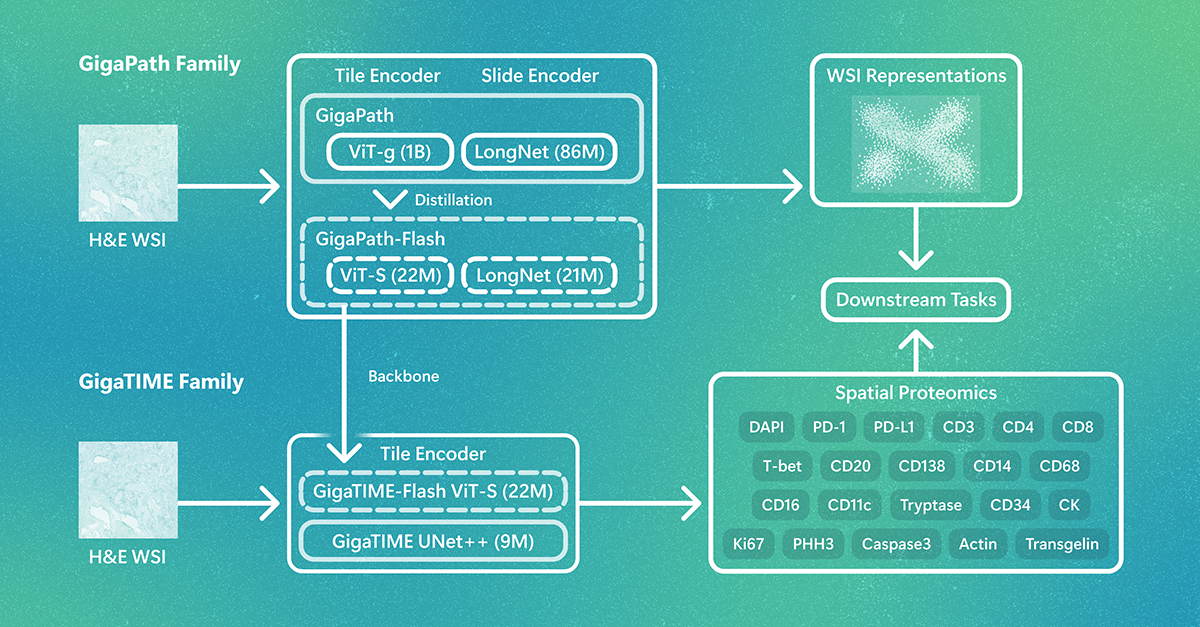
GigaPath-Flash and GigaTIME-Flash: Toward population-scale discovery with efficient pathology foundation models

What if pathology foundation models could do more with less? GigaPath-Flash and GigaTIME-Flash cut computational demands while maintaining strong performance, opening the door to larger studies and broader exploration. The post GigaPath-Flash and GigaTIME-Flash: Toward population-scale discovery with efficient pathology foundation models appeared first on Microsoft Research.

MIT News · Artificial Intelligence Aug 27, 2026

Looking beyond natural sequences

A new machine-learning framework aims to improve the success rate of computational protein design while moving away from results that reproduce sequences found in nature.
