Many real-world processes exhibit long-range dependence, where the current state depends on a slowly decaying trace of past states rather than on the most recent state alone. This paper studies system identification for discrete-time fractional-order linear time-invariant systems from a single observed trajectory of length $t$, a setting that captures such non-Markovian dynamics through the Gr\"unwald--Letnikov difference operator. Unlike Markovian systems, fractional-order systems couple estimation across the entire history, making both statistical analysis and practical identification more challenging. We propose \emph{Fractional-Order Ordinary-Least-Squares Grid-Search (FO-GS)}, a simple two-stage estimator that exploits the diagonal structure of the fractional-difference operator to decouple the identification problem row-wise. Under the stability assumption, we establish high-probability, non-asymptotic error bounds for estimating both the fractional order and the system matrix in the heterogeneous setting, with both estimation errors scaling as \(\mathcal{O}(t^{-1/2})\). Through experiments, we show that \emph{FO-GS} outperforms existing baselines in recovering both the fractional order and the underlying system dynamics.
Accurately learning nonlinear dynamics from a finite-duration experiment requires the efficient collection of informative data. We address this challenge for stochastic controlled nonlinear dynamical systems whose state is observed along a single trajectory. Our goal is to reconstruct the unknown controlled state-incre...
Juncal Arbelaiz, Anushri Arora, Jonathan W. Pillow· 0 citations
Many stochastic systems in operations and economics exhibit feedback between their long-run state distribution and the transition law governing their dynamics. In this paper, we develop a computational framework for stationary equilibria in such measure-dependent Markov systems when this feedback operates through a fin...
We study trend estimation in state-space models in which the trend has a fractional stochastic difference of order $d>0$ and the observation errors form a short-range-dependent stationary process. Using finite-sequence fractional summation and differencing operators, we analyze the penalized least-squares estimator obt...
Physical systems evolve continuously in time, yet their states are typically observed only at discrete times. Generating trajectories consistent with their probability densities from such observations therefore requires capturing the continuous-time evolution rather than only learning transition mappings between consec...
We study the reconstruction of an unknown dynamical system from a single noisy scalar time series. The goal is to recover the underlying dynamics for forecasting. We introduce a method that uses differential embedding coordinates to identify a rational closure of the embedding dynamics directly from data. The closure i...
This work exploits the affine state update to obtain the exact one-step conditional-mean sensitivity by differentiating normalized reaction propensities, and defines the propensity straight-through (PST) estimator, a temperature- and Gumbel-free path to scalable gradient-based learning through exact stochastic trajecto...
Jose M. G. Vilar, Leonor Saiz· 0 citations
Related blog posts
MIT News · Artificial Intelligence· news.mit.eduOct 2, 2026
Martin Trust Center Managing Director Bill Aulet introduces Dear Dreamer, a free platform for middle and high school students who want to learn about entrepreneurship.
Microsoft Research Blog· microsoft.comSep 30, 2026
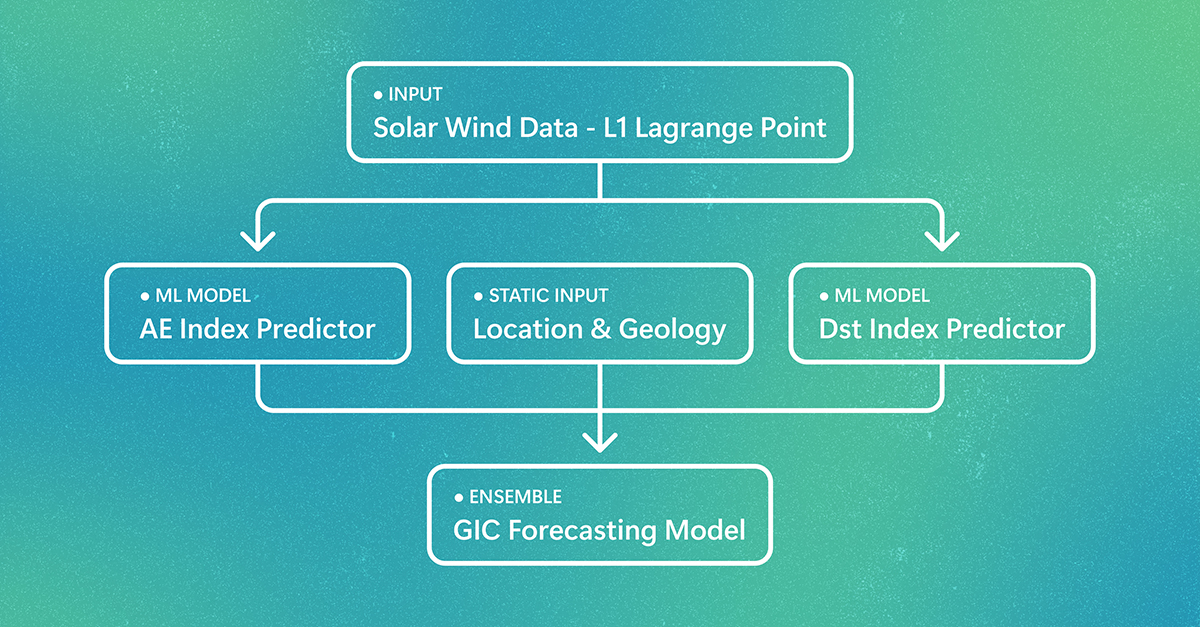
Extreme space-weather events can damage power systems on Earth and degrade GPS accuracy and satellite operations. A new machine learning system can predict where damage is likely to occur 30-60 minutes before a storm arrives. The post Forecasting space weather risks on power grids appeared first on Microsoft Research.
We use cookies to run the site and, with your consent, for analytics and to show ads.
See our Cookie Policy.