Skip to content

A battery life prediction method based on graph neural network assisted by deep reinforcement learning

Dec 2026 · Journal of Energy Storage · 0 citations · 35 references
Advanced Battery Technologies Research

Abstract

With the wide utilization of new energy batteries, the accurate prediction of battery life has become an urgent technical issue that needs to be addressed. Studies have developed battery life prediction models based on correlation analysis for feature extraction. This study introduces a DQN-based graph structure generation method that further incorporates the correlations among early-cycle feature data. Based on the correlations, an improved GraphSAGE model is developed, incorporating early-stage feature expansion, a graph global attention mechanism, and relative position information encoding. This design enables the neural network to focus on the most critical parts of the features while enhancing their representational capabilities. Experimental results demonstrate that the proposed method outperforms existing data-driven approaches. On the MIT dataset, it achieves a root mean square error (RMSE) of 82.27, a mean absolute error (MAPE) of 0.08, and a coefficient of determination ( R 2 ) of 0.961. Furthermore, validation on the HUST dataset confirms the model’s robustness in long-cycle scenarios, achieving an optimal RMSE of 185, MAPE of 0.083, and R 2 of 0.757.


View source

Similar papers

#machine learning Review Open access Oct 2014

Software development in startup companies: A systematic mapping study

The results indicate that software engineering work practices are chosen opportunistically, adapted and configured to provide value under the constrains imposed by the startup context.

Nicolò Paternoster, Carmine Giardino, M. Unterkalmsteiner et al. · 394 citations · ⚡54
#machine learning Review Open access Jun 2014

Why Early-Stage Software Startups Fail: A Behavioral Framework

This state-of-practice investigation was performed using a literature review followed by a multiple-case study approach and presents how inconsistency between managerial strategies and execution can lead to failure by means of a behavioral framework.

Carmine Giardino, Xiaofeng Wang, P. Abrahamsson · 175 citations · ⚡19
#machine learning Review Open access Oct 2016

“Failures” to be celebrated: an analysis of major pivots of software startups

This study conducts a case survey study based on the secondary data of the major pivots happened in 49 software startups, and demonstrates that customer need pivot is the most common among all pivot types.

Sohaib Shahid Bajwa, Xiaofeng Wang, Anh Nguyen-Duc et al. · 127 citations · ⚡15
#computer vision Review Open access Mar 2016

Determinants of overweight or obesity among ever-married adult women in Bangladesh

The findings of the study indicate that a large number of women in Bangladesh are suffering from being overweight or obese, and multiple factors are responsible for this including, older age,being from wealthy households, higher education, being from food-secured households, watching TV at least once a week, and being...

Haribondhu Sarma, N. Saquib, M. Hasan et al. · 75 citations · ⚡5
#artificial intelligence Open access Sep 2026

Generating Interesting Scientific Ideas using Knowledge Graphs and LLMs: Evaluations with 100 Research Group Leaders

The rapid growth of scientific literature makes it increasingly challenging for researchers to identify novel and impactful ideas, especially across disciplines. Modern artificial intelligence (AI) systems offer new opportunities for scientific ideation, but how compelling are AI-generated ideas, and how can their qual...

Xuemei Gu, Mario Krenn · 65 citations

Related blog posts

Microsoft Research Blog Jul 13, 2026

Verifying Rust cryptography in SymCrypt, from standards to code

Cryptographic code supports vital protections in modern computing systems. Learn how a new method helps verify code as developers write it while preserving speed and adaptability as it gets implemented and evolves. The post Verifying Rust cryptography in SymCrypt, from standards to code appeared first on Microsoft Research.

Microsoft Research Blog Nov 16, 2026

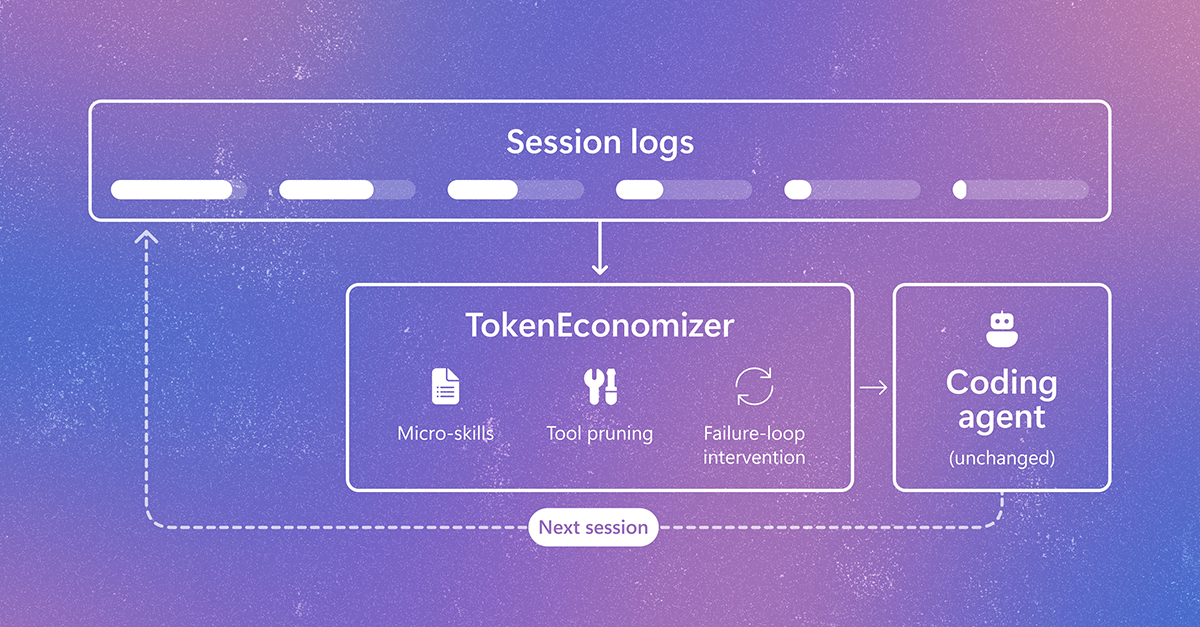
TokenEconomizer: Learning from Experience to Make AI Coding Agents More Efficient

AI coding agents are increasingly help developers fix bugs and build features largely on their own, but every interaction with their models consumes tokens. In each session, an agent sends instructions, tool descriptions, and session history to its model. Most efforts to reduce this cost focus on individual tasks. Yet developers return to the same […] The post TokenEconomizer: Learning from Experience to Make AI Coding Agents More Efficient appeared first on Microsoft Research.

We use cookies to run the site and, with your consent, for analytics and to show ads. See our Cookie Policy.