A two-step strategy for correcting ML-based state estimation, where an offline computation is used to characterize the uncertainties resulting from the ML module's state estimation, using preimages of perception contracts at runtime, using a risk heuristic.
Abstract
Learning-enabled perception is important in many autonomous systems. Unlike traditional sensors, the boundary where ML perception does or does not work is poorly characterized. Incorrect perception can lead to unsafe or overtly conservative downstream control actions. In this paper, we propose a two-step strategy for correcting ML-based state estimation. First, an offline computation is used to characterize the uncertainties resulting from the ML module's state estimation, using preimages of perception contracts. Second, at runtime, a risk heuristic is used to choose particular states from the uncertain estimates to drive the control decisions. We perform extensive simulation-based evaluation of this runtime perception correction strategy on different vision-based adaptive cruise controllers (ACC modules), in different weather conditions, and road scenarios. Out of 45 ACC scenarios where the original perception-based control system using Yolo and LaneNet led to safety violations, in 73% of the scenarios, our runtime perception correction preserved safety; our method wouldn't be able to recover 27% of the scenarios where the construction of the preimages of perception contracts is not fully conformant. Further, our runtime perception correction strategy is not overly conservative---on the average only a 2.8% increase in completion time is experienced in the corrected scenarios, with mild interventions.

Autonomous Vehicles (AVs) rely heavily on perception systems to understand their operational environment. However, prevailing AI-driven perception algorithms are prone to errors that may propagate through downstream motion planning and control systems, potentially causing safety risks. This paper investigates a critica...
Zhe-Yu Zhang, Jing-Jing Jiang, Tao Yan et al.· IEEE Open Journal of Intelli...· 0 citations
This work develops two new control barrier function (CBF) formulations: drift-measurement-robust (DMR)-CBFs and neural measurement-robust (NMR)-CBFs and provides theoretical analysis of the DMR-CBF along with numerical results on a planar double integrator and a 12D quadrotor.
Nicholas Rober, Yi-Xuan Jia, Jonathan P. How· 1 citation
Context-dependent consequence modelling provides a principled mechanism for allocating conservatism by physical risk in autonomous robot navigation failure prediction as consequence-sensitive forecasting.
AI-based environment perception systems are a key enabler of autonomous driving, yet assuring their safety remains a fundamental challenge. Just like human drivers, such perception systems will never be completely safe to use, in the same way as human driving will never be completely safe. Due to the inherent limitatio...
F. Schaller, Rüdiger Ehlers, Iqra Aslam et al.· Discover Artificial Intellig...· 0 citations
In this paper, we present an approach for combining stochastic nonlinear model predictive control (SNMPC) and reinforcement learning (RL) to enable probabilistically-safe perception-based navigation in unknown environments. Our method first uses RL to train probabilistic actor-critic and sensor prediction models. We th...
A. Polevoy, Dillon Capalongo, Katherine Tang et al.· 0 citations
Large vision-language models (VLMs) provide powerful open-world perception and reasoning for autonomous driving, but their high computational cost and inference latency make continuous cloud-side use impractical. This motivates fast--slow collaboration, where efficient onboard modules handle real-time perception and co...
Jia-Yi Chen, Shuai Wang, Guang-Xu Zhu et al.· 0 citations
Exploring how generative AI could make machine vision more accessible to businesses. The post GenEye in a Box: Making Machine Vision Something You Can Just Ask For appeared first on GPT-Lab.
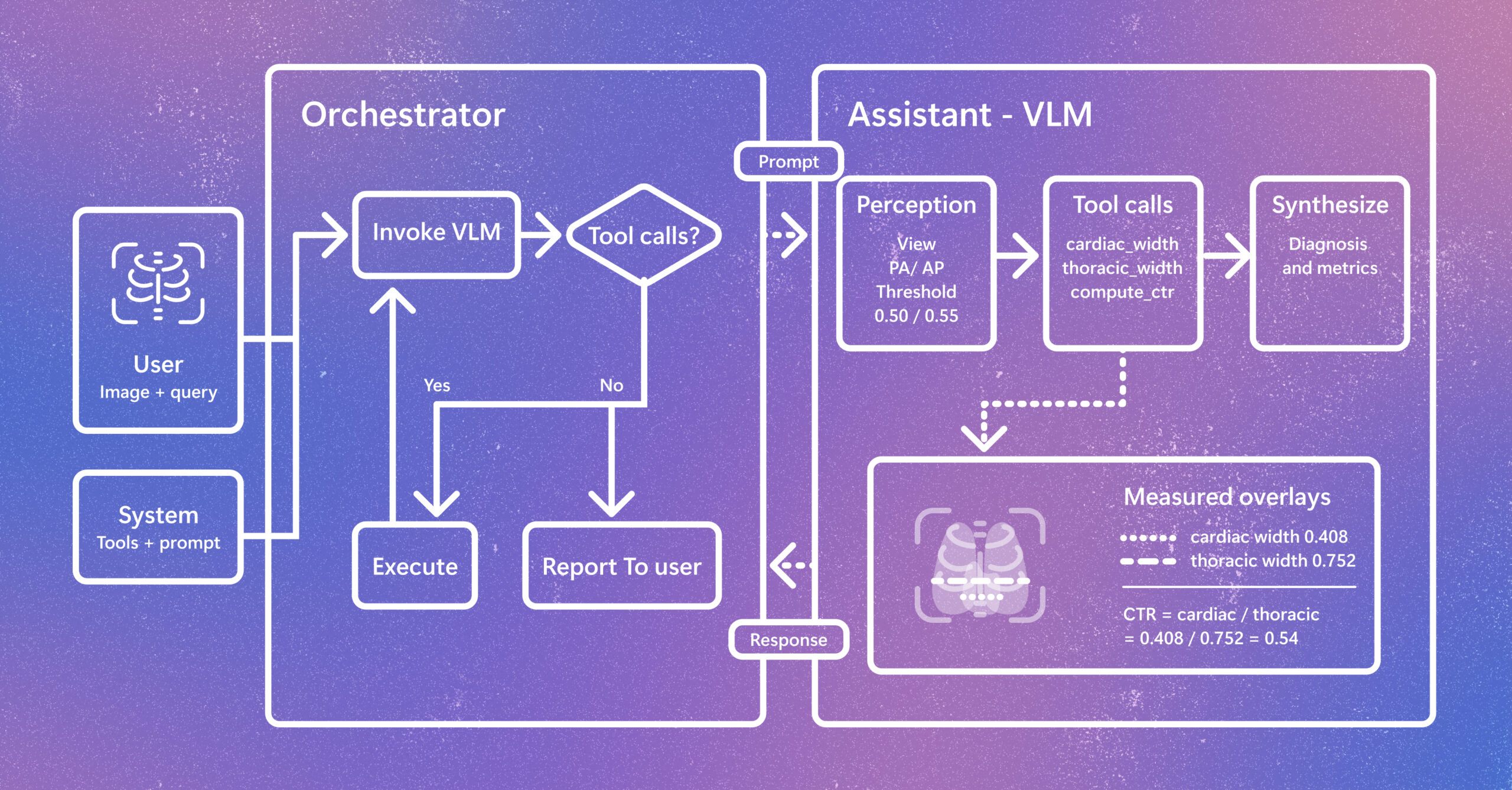
Radiology AI is evolving beyond report generation. CARE-X explores a unified approach that combines flexible reasoning, calibrated predictions, and measurement-based tools for chest X-ray interpretation. The post Introducing CARE-X: Towards Clinically Useful Radiology VLMs with Auxiliary Supervision, Reward-Aligned Learning, and Tool-Augmented Measurement appeared first on Microsoft Research.