An ultra-lightweight spatial-relational architecture for few-shot image classification that combines fixed Gabor edge-energy guidance with a windowed, content-adaptive patch locator is presented, showing that the architecture's pairwise relational computation, while present, is not the primary driver of its performance; the content-adaptive patch locator is.
Abstract
Few-shot learning research is predominantly evaluated on accuracy alone, with limited attention to the parameter and training-sample budgets required to reach that accuracy - a real constraint for practitioners without large-scale compute. We present an ultra-lightweight (22,249-34,917 parameter) spatial-relational architecture for few-shot image classification that combines fixed Gabor edge-energy guidance with a windowed, content-adaptive patch locator. Under a strictly matched, iso-episode-budget protocol (250 meta-training episodes, 5 canonical seeds, 600 evaluation episodes per seed), our architecture achieves 5-shot accuracy gains, consistent across all five seeds, over Prototypical Networks, Relation Networks, and MAML on both CIFAR-FS and MiniImageNet, while using 27-53% fewer parameters than any baseline. It also converges in fewer training episodes, generalizes better to an unseen fine-grained domain (CUB-200-2011 birds, zero retraining), and is more robust to 50% occlusion and 25% spatial translation than all three baselines. A series of falsification ablations - zeroing relational tokens at inference and retraining without them entirely - shows that the architecture's pairwise relational computation, while present, is not the primary driver of its performance; the content-adaptive patch locator is. We report this honestly, together with a capacity sweep showing a genuine accuracy plateau near 22-35k parameters, and release full seed-level results and checkpoint hashes for reproducibility.
A unified comparison of attribute-based ZSL, episodic meta-learning, metric and prototype estimators, graph and optimal-transport inference, generative any-shot models, and adaptation of vision–language models is analyzed.
Jie Li, Yu-Bo Sun, Xun Du et al.· Mathematics· 0 citations
The results support cross-resolution KD as a practical way to recover fine-grained information during training while preserving low-resolution inference cost and show that a stronger teacher does not automatically produce a stronger student: transfer quality depends on the balance between teacher supervision strength a...
Chen-Qiang Li· Applied and Computational En...· 0 citations
Few-shot recognition with frozen visual features is especially fragile under domain shift and one-shot supervision, where a single labelled image is an unreliable estimate of its class. We ask how far this fragility can be reduced purely at test time, without retraining the encoder or augmenting the source domain. We p...
F. Rahman, S. Rohan, Mahmound Sayed et al.· 0 citations
Few-Shot Class-Incremental Learning (FSCIL) requires models to continuously learn new classes from limited samples while retaining prior knowledge, under strict constraints on compute and memory. Existing approaches lie along a difficult trade-off: simple fine-tuning is computationally efficient but suffers from catast...
Eeham Khan, Abdulmoumen Al-Atrash, Ali Ayub· 0 citations
Few-shot object counting (FSC) aims to estimate counts for previously unseen (novel) categories given only a few exemplars, leveraging knowledge learned on seen (base) categories for generalization. However, most existing methods rely on unidirectional matching and underuse scene context, limiting the effective use of...
Jing-Hui He, Bo Liu, Fan Cao et al.· Neural Networks· 0 citations
Vision transformers typically treat every image token as equally important, yet for most tasks in computer vision only a fraction are needed. Adaptive computation methods accelerate inference by choosing which tokens to process, but existing methods struggle at extreme sparsity and require heuristics that may not gener...
Sreehari Rammohan, Yousef Yassin, A. Fuller et al.· 0 citations
Exploring how generative AI could make machine vision more accessible to businesses. The post GenEye in a Box: Making Machine Vision Something You Can Just Ask For appeared first on GPT-Lab.
Microsoft Research Blog· microsoft.comAug 11, 2026
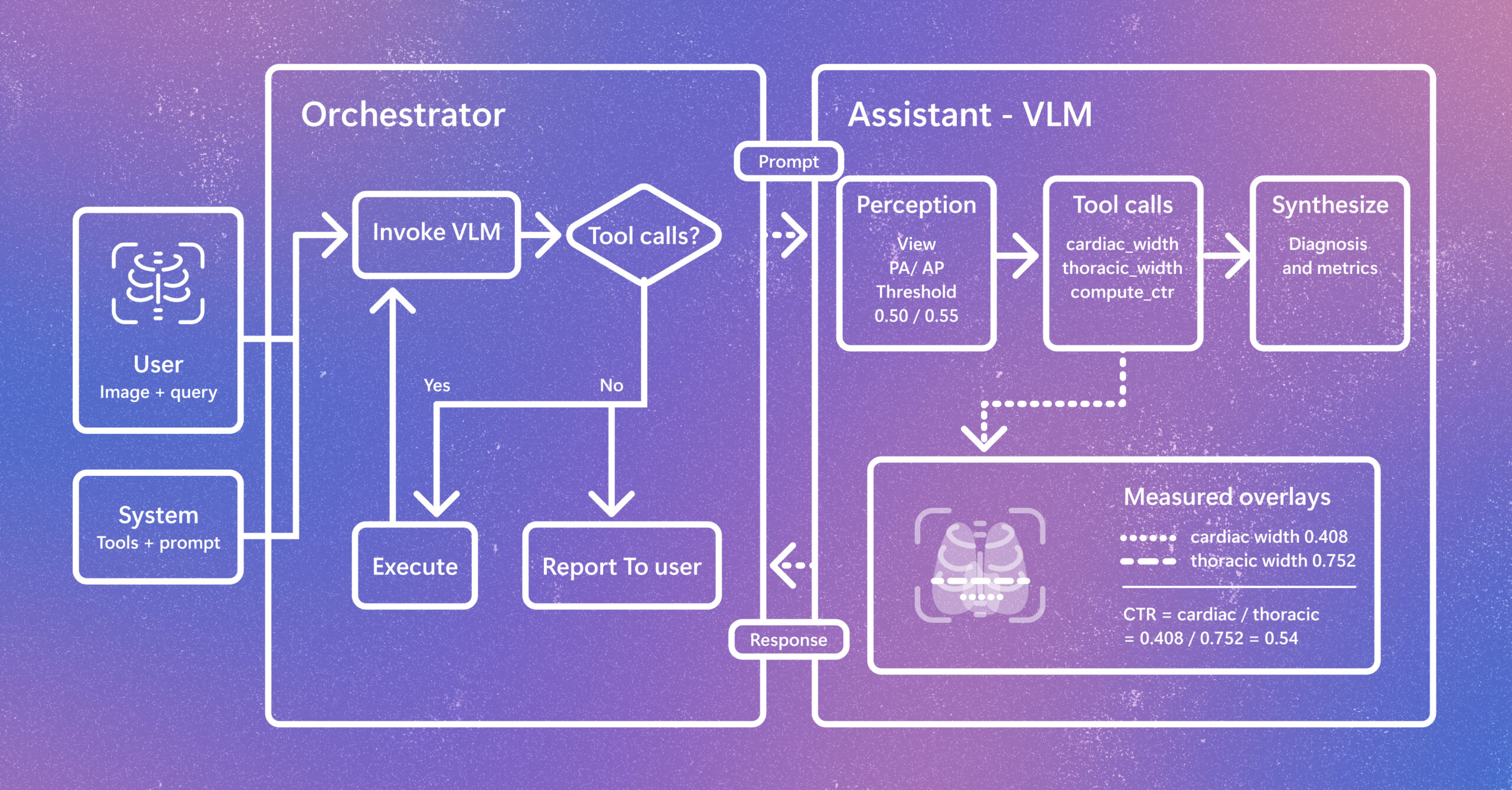
Radiology AI is evolving beyond report generation. CARE-X explores a unified approach that combines flexible reasoning, calibrated predictions, and measurement-based tools for chest X-ray interpretation. The post Introducing CARE-X: Towards Clinically Useful Radiology VLMs with Auxiliary Supervision, Reward-Aligned Learning, and Tool-Augmented Measurement appeared first on Microsoft Research.