Methods operating on Vision Transformer (ViT) feature spaces typically rely on Euclidean distance or cosine similarity. This assumes that every direction is equally meaningful, but there is no reason to believe the true task geometry has this property. The task-sensitive geometry of the feature space is given by the pullback metric $g(F) = J(F)^\top J(F)$, where $J$ is the Jacobian of the decoder's output fed to a task-specific distance, with respect to the features. Storing the full $g$ is infeasible at modern scales, and for dense outputs such as depth maps even forming $J$ is impractical. We show that whether a low-rank approximation of this metric can be learned depends on the model-decoder pair, and we characterize this with a matrix-free diagnostic $\kappa_{cap}(r)$ computable with a low number of Jacobian-vector products. For tractable pairs, we develop the Spectral Pullback Network (SPN), which learns a low-rank version of the metric from randomized power iteration, and we distill it into a $310$K-parameter importance head that predicts token importance directly from the features. When the Jacobian spectrum is too spread out for a low-rank approximation, passing the decoder's input features through a VAE bottleneck can restore tractability. Across DPT, DINOv2, CLIP, and VGGT backbones, $\kappa_{cap}(r)$ predicts which learned-metric architectures are viable. The importance head reaches Spearman $\rho = 0.998$ on DINOv2 CLS, and our geometric token pruning reduces the additional depth error of ToMe-based token selection by $25\%$ on DPT depth at prune ratio $0.5$, without fine-tuning the ViT. Project page: https://cyberiada.github.io/TaskInducedViTs/
This publication proposes a definition and a classification of agile software development approaches and analyses ten software development methods that can be characterized as being "agile" against the defined criterion.
P. Abrahamsson, O. Salo, Jussi Ronkainen et al.· arXiv.org· 727 citations· ⚡54
The study shows that agile practices improve both informal and formal communication, but indicates that, in larger development situations involving multiple external stakeholders, a mismatch of adequate communication mechanisms can sometimes even hinder the communication.
M. Pikkarainen, Jukka Haikara, O. Salo et al.· Empirical Software Engineeri...· 401 citations· ⚡48
The results indicate that software engineering work practices are chosen opportunistically, adapted and configured to provide value under the constrains imposed by the startup context.
Nicolò Paternoster, Carmine Giardino, M. Unterkalmsteiner et al.· Information and Software Tec...· 394 citations· ⚡54
The possibility of inferring high-dimensional data inference in a model that consists of a prior and an auxiliary differentiable constraint given some additional information is considered, thereby allowing a range of potential applications in adapting models to new domains and tasks.
Alexandros Graikos, Esmeralda S. Whitammer, N. Jojic et al.· Neural Information Processin...· 316 citations· ⚡15
It is proved that any global minimizer of the trajectory balance objective can define a policy that samples exactly from the target distribution, and empirically demonstrate the benefits of the trajectories balance objective for GFlowNet convergence, diversity of generated samples, and robustness to long action sequenc...
Esmeralda S. Whitammer, Moksh Jain, Emmanuel Bengio et al.· Neural Information Processin...· 302 citations· ⚡60
Related blog posts
Microsoft Research Blog· microsoft.comAug 11, 2026
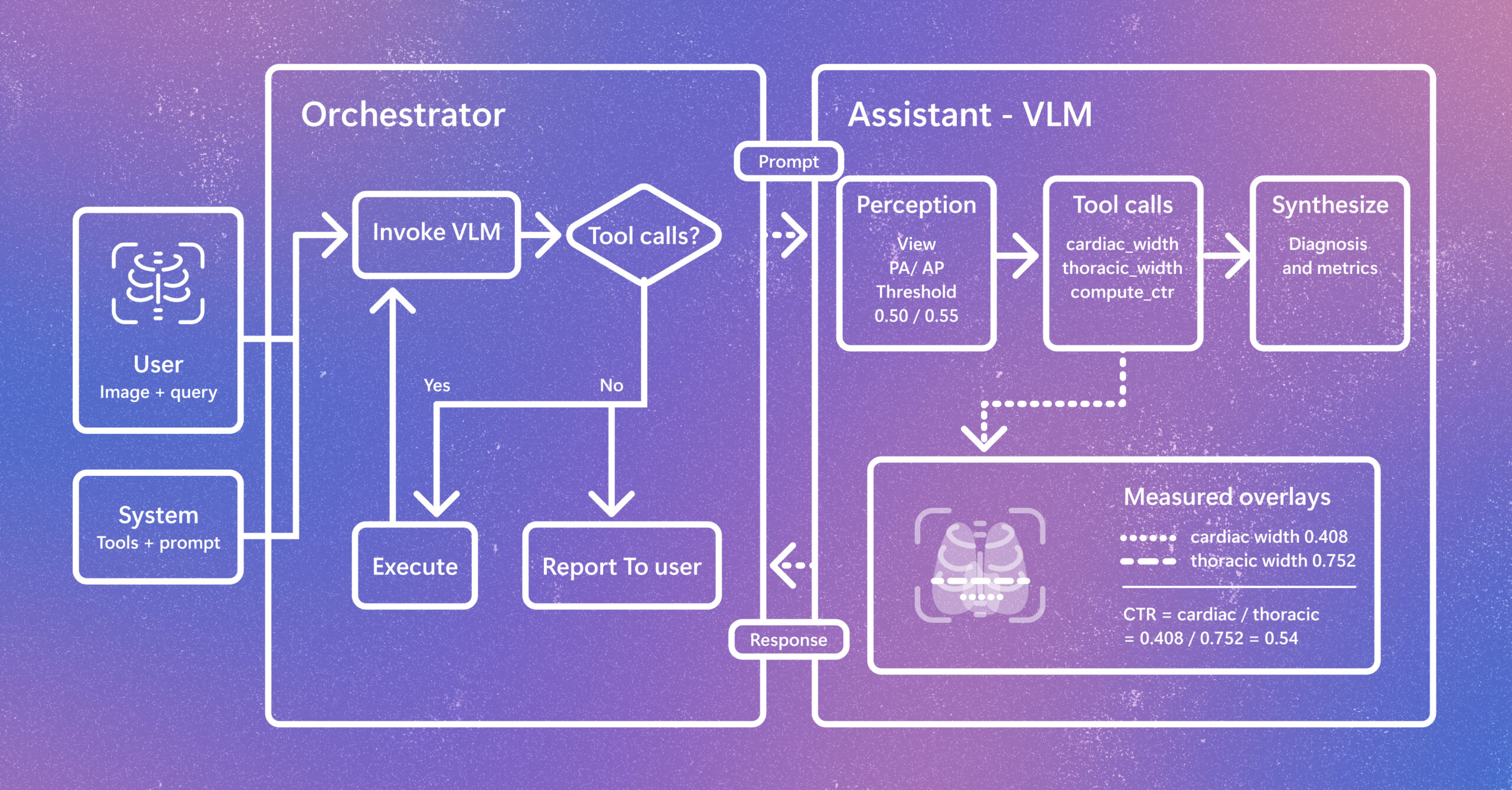
Radiology AI is evolving beyond report generation. CARE-X explores a unified approach that combines flexible reasoning, calibrated predictions, and measurement-based tools for chest X-ray interpretation. The post Introducing CARE-X: Towards Clinically Useful Radiology VLMs with Auxiliary Supervision, Reward-Aligned Learning, and Tool-Augmented Measurement appeared first on Microsoft Research.