Visual Tripwires is introduced, a predictive reliability framework that uses temporal instability in model behaviour to anticipate impending failure and demonstrate that temporal instability contains useful information about future model reliability and provides a practical basis for early warning in deep vision systems.

Abstract
Deep vision systems remain vulnerable to corruption, occlusion, and distribution shift despite strong benchmark performance. Existing reliability methods typically evaluate uncertainty at individual time steps and do not explicitly model how a system progresses toward failure. We introduce Visual Tripwires, a predictive reliability framework that uses temporal instability in model behaviour to anticipate impending failure. Our central hypothesis is that predictive degradation develops progressively through measurable changes in latent representations, prediction trajectories, and attention structure. Visual Tripwires captures these changes using representation drift, prediction oscillation, trajectory curvature, and attention entropy. A lightweight tripwire predictor aggregates these signals over a temporal window to estimate the probability of failure within a future prediction horizon. Experiments across multiple datasets, architectures, and progressive perturbation settings show that the proposed instability signals emerge before predictive degradation and provide earlier and more accurate failure warnings than conventional uncertainty estimation methods. These results demonstrate that temporal instability contains useful information about future model reliability and provides a practical basis for early warning in deep vision systems.

Time series anomaly detection aims to identify time points or intervals that deviate from normal temporal behavior. In reconstruction-based detection, this requires errors that distinguish anomalies rather than merely accurate reconstruction. However, most existing methods rely solely on temporal modeling, while vision...
Xue-Song Zeng, Min Cao, Hao Miao et al.· Proceedings of the 35th ACM...· 0 citations
Despite impressive visual quality, state-of-the-art video diffusion models often generate content that violates real-world physical laws. While existing solutions rely on external priors or specialized data, we investigate the root cause by exploring the internal mechanisms of these models. Specifically, we present the...
Reliable uncertainty estimation is important across visual recognition tasks, providing information about the confidence and reliability of model predictions. Many uncertainty estimation methods obtain predictive diversity through mechanisms that can suppress intermediate features, perturb the input, or require substan...
Mohammad Sarhangzadeh, Amirreza M. Shebly, D. Oner· 0 citations
Long chain-of-thought reasoning improves vision-language models (VLMs), but it also exposes a temporal grounding failure: as generation unfolds, models may drift from image evidence while reinforcement learning still provides only a final-answer reward. We study this gap through visual revisit, a temporally localized r...
Zhaolu Kang, Tai-Long Luo, Chen-Xin Li et al.· 0 citations
Vision-Language-Action models (VLAs) enable general-purpose embodied intelligence, but their performance is brittle under distribution shift, where unanticipated failures can damage equipment or endanger people. Deploying VLAs in real-world systems therefore requires a runtime monitor that is timely, calibrated, and in...
Michal P. Podolinsky, Yunhao Yang, Daniel R. Little et al.· 0 citations
Video Large Language Models (VideoLLMs) receive frames in sequential order and interpret how visual content evolves along the temporal axis, yet temporal reasoning remains a persistent weakness across architectures. Reversing the frame order of a video, a transformation that should invert temporal answers, often leaves...
Youngwoo Shin, Yusung Ro, Minseo Kim et al.· 0 citations
Related blog posts
MIT News · Artificial Intelligence· news.mit.eduOct 28, 2026
Professor Paris Smaragdis develops computers with superhuman hearing for applications like speech recognition, music understanding, and environmental monitoring.
Exploring how generative AI could make machine vision more accessible to businesses. The post GenEye in a Box: Making Machine Vision Something You Can Just Ask For appeared first on GPT-Lab.
Microsoft Research Blog· microsoft.comAug 11, 2026
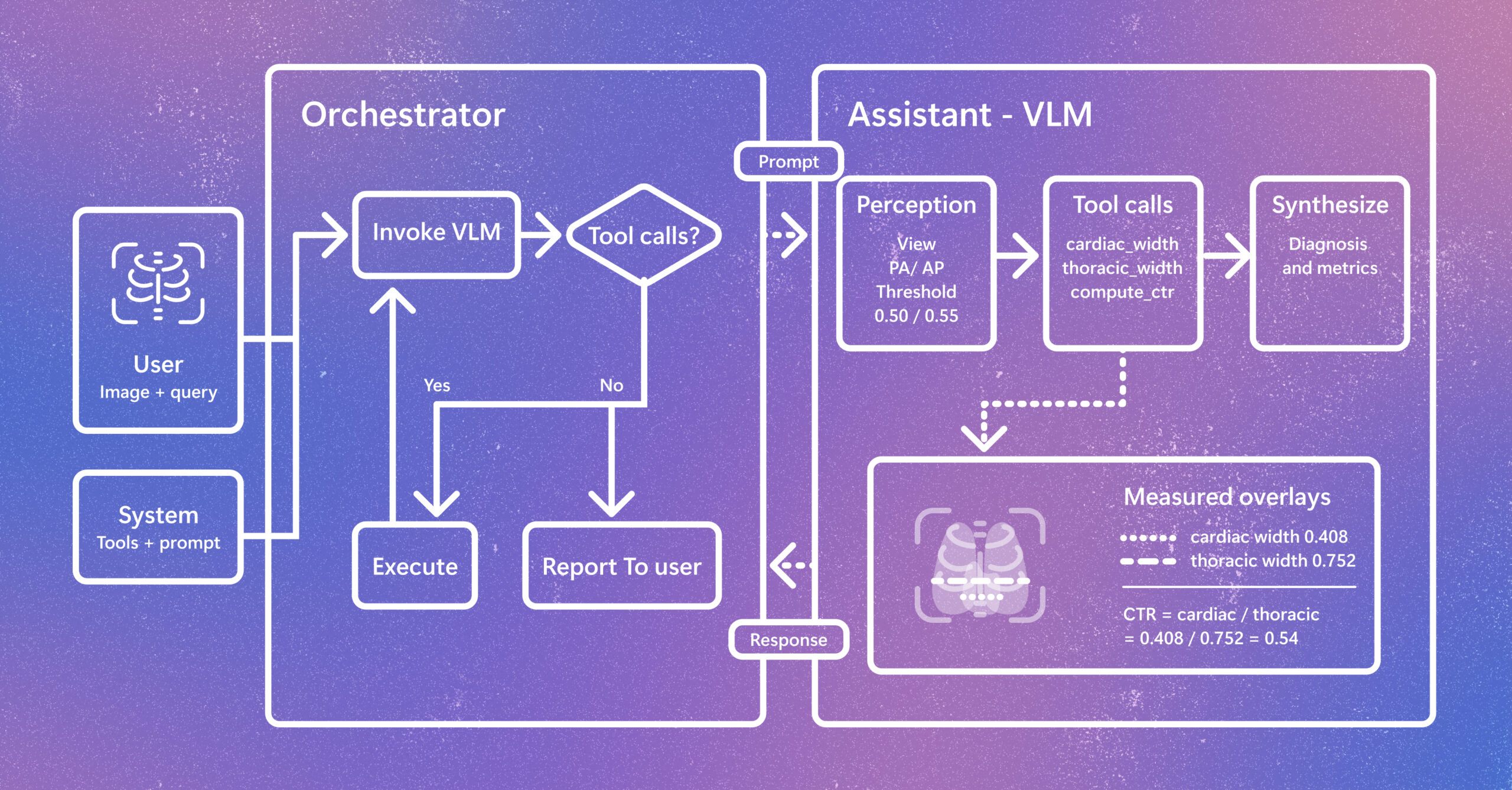
Radiology AI is evolving beyond report generation. CARE-X explores a unified approach that combines flexible reasoning, calibrated predictions, and measurement-based tools for chest X-ray interpretation. The post Introducing CARE-X: Towards Clinically Useful Radiology VLMs with Auxiliary Supervision, Reward-Aligned Learning, and Tool-Augmented Measurement appeared first on Microsoft Research.