Representation Autoencoders (RAEs) enable diffusion models to operate in the feature spaces of pretrained visual encoders. However, many off-the-shelf encoders are not optimized for faithful reconstruction, discarding fine-grained visual details. As expected, finetuning these encoders for image reconstruction recovers such details. However, perhaps counterintuitively, this procedure reduces the effective dimensionality of the resulting representation, and the altered geometry has downstream effects on generation. Specifically, we show that using the standard velocity prediction in flow matching in this high-dimensional space requires the model to fit orthogonal noise directions outside the low-dimensional signal manifold, making optimization inefficient. This motivates using the clean data parameterization ($\boldsymbol{x}_{0}$-prediction) instead, which focuses learning on the underlying signal manifold. Across experiments with multiple strong-reconstruction encoders, we show that $\boldsymbol{x}_{0}$-prediction consistently improves text-to-image generation performance.
This publication proposes a definition and a classification of agile software development approaches and analyses ten software development methods that can be characterized as being "agile" against the defined criterion.
P. Abrahamsson, O. Salo, Jussi Ronkainen et al.· arXiv.org· 727 citations· ⚡54
The study shows that agile practices improve both informal and formal communication, but indicates that, in larger development situations involving multiple external stakeholders, a mismatch of adequate communication mechanisms can sometimes even hinder the communication.
M. Pikkarainen, Jukka Haikara, O. Salo et al.· Empirical Software Engineeri...· 401 citations· ⚡48
The results indicate that software engineering work practices are chosen opportunistically, adapted and configured to provide value under the constrains imposed by the startup context.
Nicolò Paternoster, Carmine Giardino, M. Unterkalmsteiner et al.· Information and Software Tec...· 394 citations· ⚡54
The possibility of inferring high-dimensional data inference in a model that consists of a prior and an auxiliary differentiable constraint given some additional information is considered, thereby allowing a range of potential applications in adapting models to new domains and tasks.
Alexandros Graikos, Esmeralda S. Whitammer, N. Jojic et al.· Neural Information Processin...· 316 citations· ⚡15
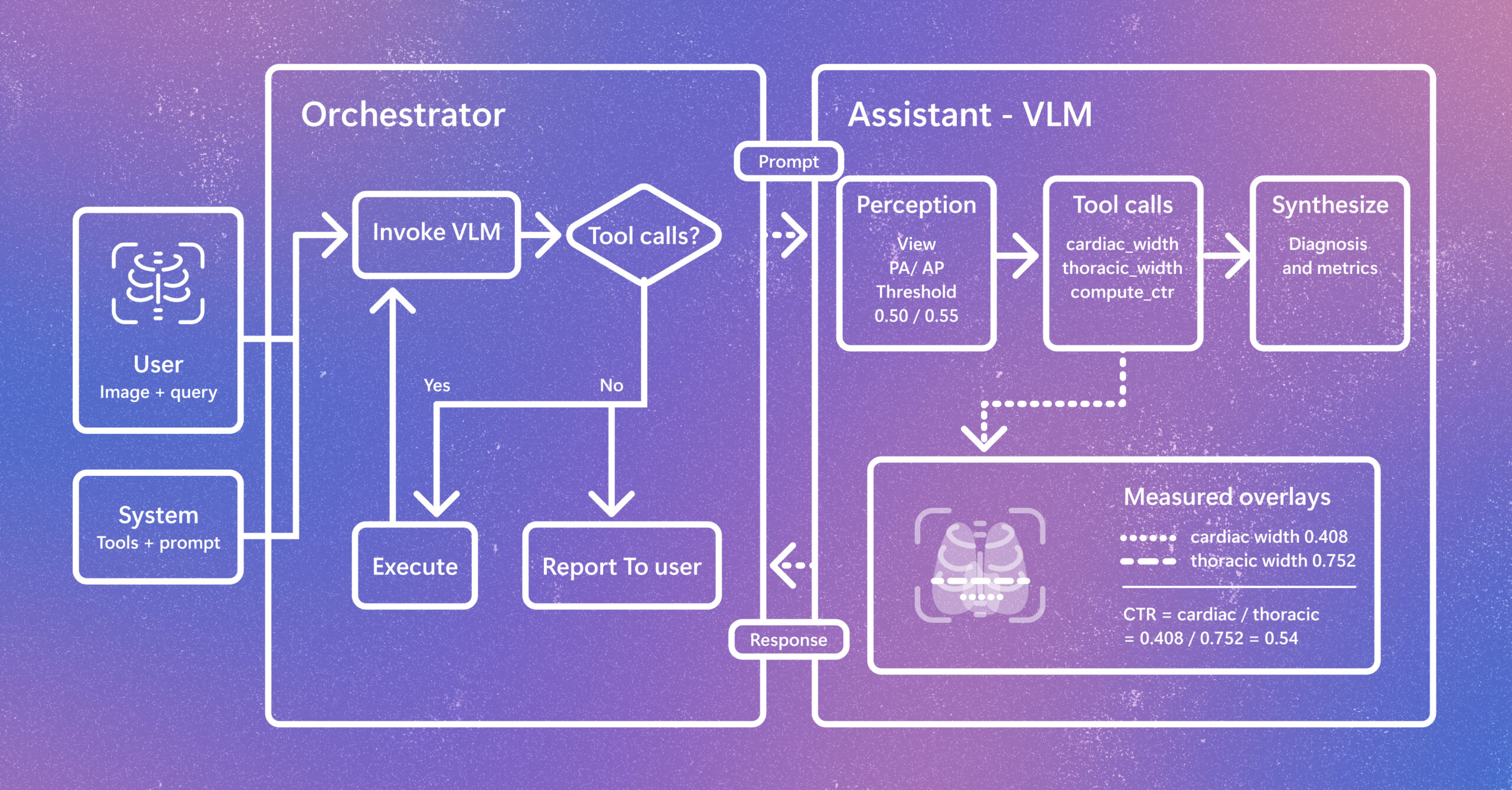
Radiology AI is evolving beyond report generation. CARE-X explores a unified approach that combines flexible reasoning, calibrated predictions, and measurement-based tools for chest X-ray interpretation. The post Introducing CARE-X: Towards Clinically Useful Radiology VLMs with Auxiliary Supervision, Reward-Aligned Learning, and Tool-Augmented Measurement appeared first on Microsoft Research.