Sep 2026· Annals of Biomedical Engineering· Vol 54, pp. 3721 - 3725· 1 citation· 15 references
Medicine
TL;DR
It is argued that each of the four challenges facing responsible development is addressed by a clinical testing harness: a structured evaluation environment comprising scenario libraries built from clinical edge cases, full-trajectory observability, explicit escalation testing, and staged evidence thresholds tied to scope of practice.
A framework that treats diagnosis as a coordination problem rather than a modeling one is described and improved on both across accuracy, F1-score, explanation faithfulness and clinician-rated trust, at an added latency of roughly five seconds per case.
Ganesh Dagadu Puri· Natural Resources for Human...· 0 citations
Abstract Clinical artificial intelligence (AI) has advanced rapidly, with frontier large language models now matching or exceeding physician performance on simulated diagnostic reasoning and clinical decision-support tasks. Yet adoption has outpaced the evidence base: fewer than 5% of cleared U.S. Food and Drug Adminis...
J. Worth, Anastasia Perez, David Wu et al.· BMJ digital health & AI· 1 citation
Clinical AI systems increasingly match or exceed clinicians on some diagnostic benchmarks. Yet this reveals little about how AI output functions within clinical reasoning or how repeated reliance affects clinicians' independent capability. This paper proposes Bounded Reciprocal Adaptation for Clinician Engagement (BRAC...
C. Greengrass· Frontiers in Digital Health· 0 citations
This manuscript defines AI-as-intervention as AI whose output is itself part of the assigned clinical intervention being evaluated for its effect on participant care or outcomes, and AI-for-trial-operations as AI used to support trial design, conduct, or analysis without itself constituting the treatment under study.
A. Armoundas, C. Tarabanis, J. Loscalzo· EClinicalMedicine· 0 citations
This article proposes seven questions that clinicians can run through to evaluate any clinical AI tool in the time it takes to read an abstract, alongside a traffic-light schema for matching oversight to risk and a short list of demands clinicians should make of vendors and institutions.
Alaa Abdelqader, M. Alkhateeb, Abdullah Al-Marrawi et al.· Avicenna Journal of Medicine· 0 citations
Related blog posts
Microsoft Research Blog· microsoft.comNov 12, 2026
What's new in research at Microsoft? Host Anson Ho explores the latest, including AI-powered universal translation, a breakthrough in a 31-year-old mathematics challenge, and advances making AI coding agents faster and more efficient. The post Microsoft Research Focus – Edition #98 appeared first on Microsoft Research.
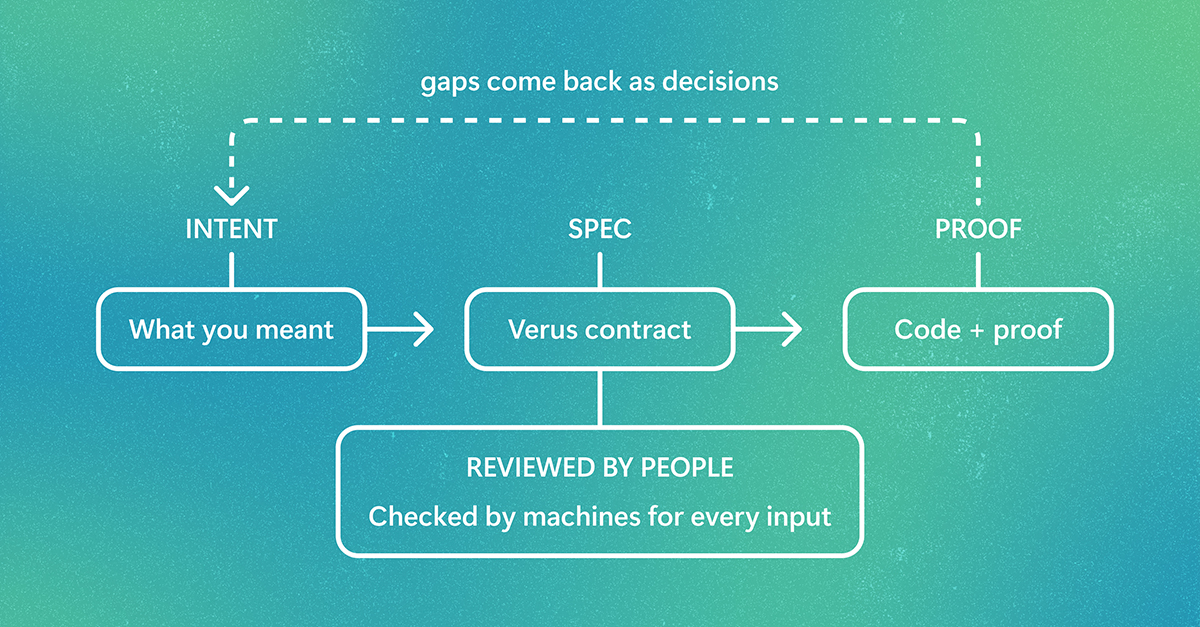
AI agents can generate code at a scale that’s hard for humans to review line-by-line. PDD Kit helps ensure the code is doing what the developer intended by creating formal specifications and testing against them. It converts developer intent into a Verus specification, proves AI-generated code meets it for every input, and uses tests where proofs aren't practical. Developers review intent, not every line. The post Formally verifying agent-written full-stack web apps with PDD Kit appeared first o…