It is demonstrated that high natural-trajectory accuracy can coexist with weak controlled target-state responsiveness in fixed representation-readout pairs and adding responsiveness and context sensitivity to a failure predictor reduces policy-failure prediction error on new initializations relative to the specified baseline while same-observation controlled MAE is also informative.
Abstract
Accurately decoding object states from the internal representations of vision-language-action (VLA) models does not establish that the predictions respond faithfully to changes in the target physical state. In natural observations, object state, robot configuration, occlusion, and task progress vary together, allowing contextual cues to contribute to prediction. In this paper, we introduce an evaluation framework that separates prediction accuracy, target-state responsiveness, and context stability using physically validated observations that cross target coordinates with robot contexts. We demonstrate that high natural-trajectory accuracy can coexist with weak controlled target-state responsiveness in fixed representation-readout pairs. Comparisons and interventions involving representations, readouts, and training data show that the three properties provide distinct diagnostic information. Furthermore, adding responsiveness and context sensitivity to a failure predictor based on initial state error and physical variables reduces policy-failure prediction error on new initializations relative to the specified baseline while same-observation controlled MAE is also informative. These findings motivate evaluating target-state responsiveness and context stability alongside natural prediction accuracy, and examining their relationship to actual policy behavior and task outcomes.

The analysis of the imitation objective shows how narrow conditional action support can leave grounded and instruction-keyed solutions indistinguishable on the demonstrations, and motivates Equivariant Counterfactual Training (ECT), which acts at two levels.
Hung-Jen Chen, Yue-Ling Hou, Yan-Hong Chen et al.· 0 citations
LM-X is introduced, which organizes prediction across task, event, and motor scales without claiming anatomical correspondence and shows that explicit multi-timescale predictive state can strengthen control while exposing interpretable internal estimates.
Jin Lou, Zhi Jing, Xu-Peng Wang et al.· 0 citations
Learning to predict how the world evolves can provide vision-language-action (VLA) policies with predictive context for long-horizon control, but its effectiveness depends on what future representation is modeled and how it conditions action generation. We introduce PLaW-VLA, which models task-relevant future states in...
Yu Liu, He-Tian Guo, Tianlv Huang et al.· 0 citations
This work studies what determines whether predictive supervision improves the visual representation used by a VLA policy, and finds that different prediction interfaces produce markedly different forecasts and visual representations, including in the spatial, dynamics, and action information that transfers beyond famil...
Hanseul Kim, J. Yeom, Youngjoon Jeong et al.· 0 citations
Vision-Language-Action models (VLAs) have achieved high success rates on familiar manipulation tasks, yet it remains unclear whether such scores reflect genuine zero-shot generalization and perturbation robustness. Existing evaluation frameworks provide limited capability-level diagnosis and combinatorial perturbation...
Jun Xiao, Rui Ye, Dong-Run Cao et al.· 0 citations
It is shown that reconstruction fidelity alone cannot reliably select action representations for autoregressive control, motivating joint evaluation of geometric fidelity, sequence predictability, decoder stability, and closed-loop performance.
Yu-Xin Yang, Gao-Han He, Chang-Xue Guan et al.· 0 citations
Exploring how generative AI could make machine vision more accessible to businesses. The post GenEye in a Box: Making Machine Vision Something You Can Just Ask For appeared first on GPT-Lab.
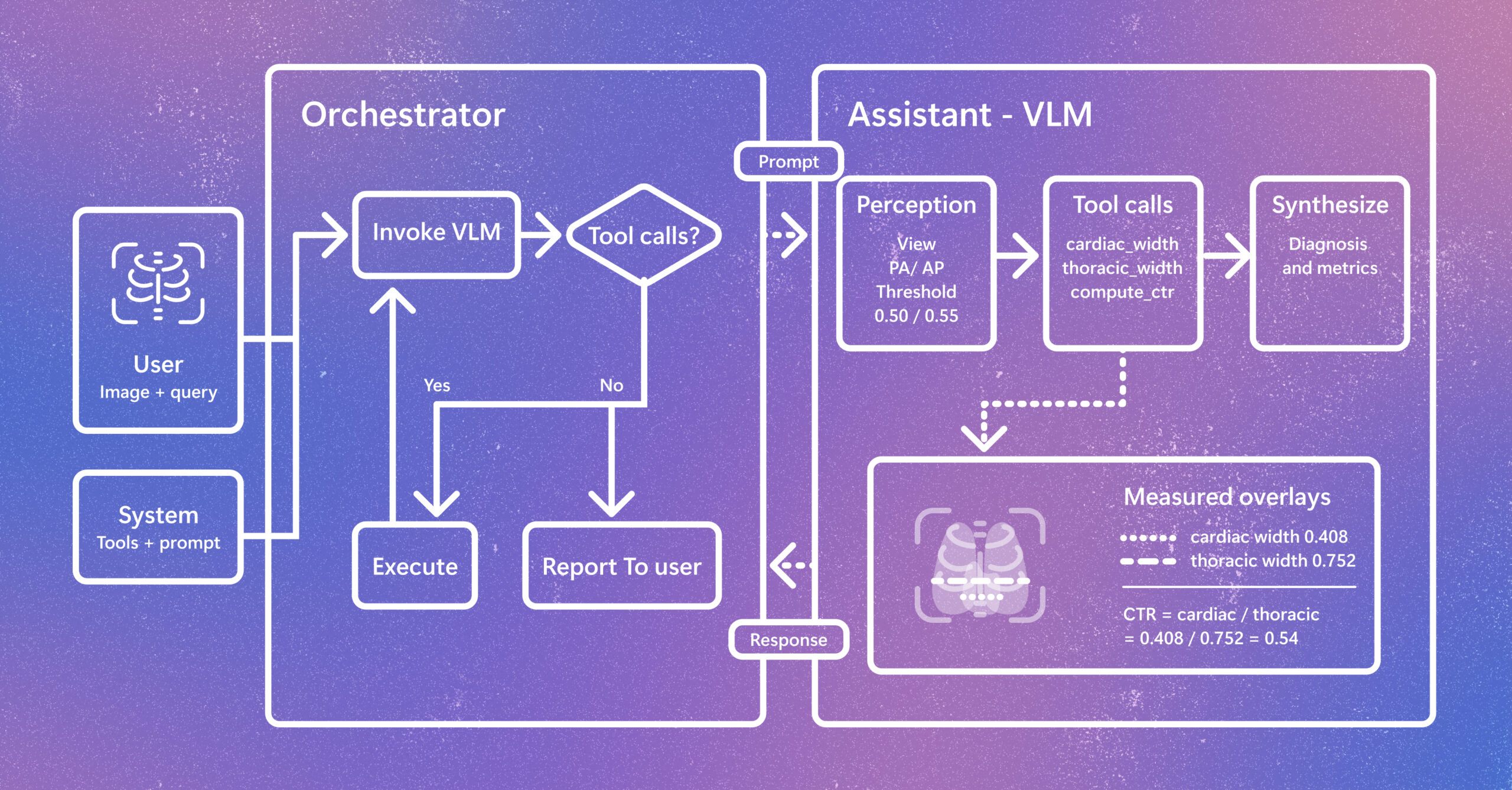
Radiology AI is evolving beyond report generation. CARE-X explores a unified approach that combines flexible reasoning, calibrated predictions, and measurement-based tools for chest X-ray interpretation. The post Introducing CARE-X: Towards Clinically Useful Radiology VLMs with Auxiliary Supervision, Reward-Aligned Learning, and Tool-Augmented Measurement appeared first on Microsoft Research.