AnswerMap is introduced, a training-free, task-agnostic, black-box visual rationale constructed from the output head that offers a new lens on VLM interpretability and, through its read-outs, a new output interface for visual tasks beyond text tokens.

Abstract
When a VLM answers a visual query, current interpretability tools rely on text rationales, which use a mismatched modality, or on internal read-outs, which originate too early to reflect the final output and require white-box access to the model. We introduce AnswerMap, a training-free, task-agnostic, black-box visual rationale constructed from the output head. The image is cut into K row and K column bands, each shown alone to the frozen model along with the query in the format of a yes/no relevance question. The outer product of the row and column ``yes''posteriors gives the query-conditioned spatial map. Crucially, by defining a fixed read-out R (e.g., expectation, maximum) on top of AnswerMap, we can derive continuous outputs like location natively. This bypasses the reliance on discrete text tokens for continuous-output tasks and guarantees an image-dependent answer by construction. However, a rationale can be confabulated, so we validate AnswerMap across four models and three query distributions with two tests: (a) agreement with the model's own generated point and (b) deletion of the map's region. The map lands where the model points (AUC 0.85 against 0.38 for attention), and deleting its region flips 53% of correct answers (against 19% for attention's). Beyond establishing faithfulness, we demonstrate the map's task-agnostic utility through three distinct read-outs: its maximum flags hallucinated objects without generation, its expectation localizes correctly when the model's own pointing fails, and its top-mass region, fed back as a crop, fixes half of the model's wrong answers. AnswerMap thus offers a new lens on VLM interpretability and, through its read-outs, a new output interface for visual tasks beyond text tokens.
Using a three-phase protocol that separates diagram-only, diagram-plus-description, and description-only inputs, it is shown across five open-weight and closed-source VLMs that description-only performance is statistically indistinguishable from diagram-plus-description performance, establishing structured descriptions...
Khan Raiyan Ibne Reza, Sanjana Aktar Maria, Sumaiya Tabassum Nimi et al.· 0 citations
Failures of high-resolution MLLMs are commonly attributed to a visual problem, motivating zooming, cropping, and related visual interventions to recover fine-grained evidence or suppress interference. Yet recent studies suggest that relevant visual evidence is already encoded in intermediate representations, indicating...
Z. Mao, Wen-Zhuo Zhao, Xian-Jie Liu et al.· 1 citation
Spatial reasoning remains a persistent weakness of vision-language models (VLMs), because RGB inputs do not directly provide geometric evidence. Existing remedies either inject 3D into the model at inference, paying architecture and latency costs, or train with outcome rewards that supervise only the final answer. Spat...
Hong-Xing Li, Yi-Xin Li, Ding-Ming Li et al.· 0 citations
Spatial-OPSD, a label-free self-improvement framework that instead exploits spatial structure naturally available from perception and reconstruction tools, is introduced, achieving the highest average among the open models and the best results on three of five spatial reasoning benchmarks.
Zhen-Yu Liu, Zhangquan Chen, Ke-Yi Chen et al.· 0 citations
VisLens (Visual Focus via Logit Lens), a Visual Search method built on the logit lens, which decodes the semantics held in a hidden state by projecting it through the LLM head, and which matches or exceeds prior baselines while delivering a substantial latency advantage.
Jingfeng He, Sanghwan Kim, Zeynep Akata· 0 citations
ReVA is proposed, a region-aware VQA model that employs a frozen CLIP ViT-L/14 Vision Transformer (ViT) and a Qwen2.5-7B-Instruct large language model (LLM) connected through a dual bridge that aligns both whole-image and region-level representations with the LLM's embedding space.
Exploring how generative AI could make machine vision more accessible to businesses. The post GenEye in a Box: Making Machine Vision Something You Can Just Ask For appeared first on GPT-Lab.
Microsoft Research Blog· microsoft.comAug 11, 2026
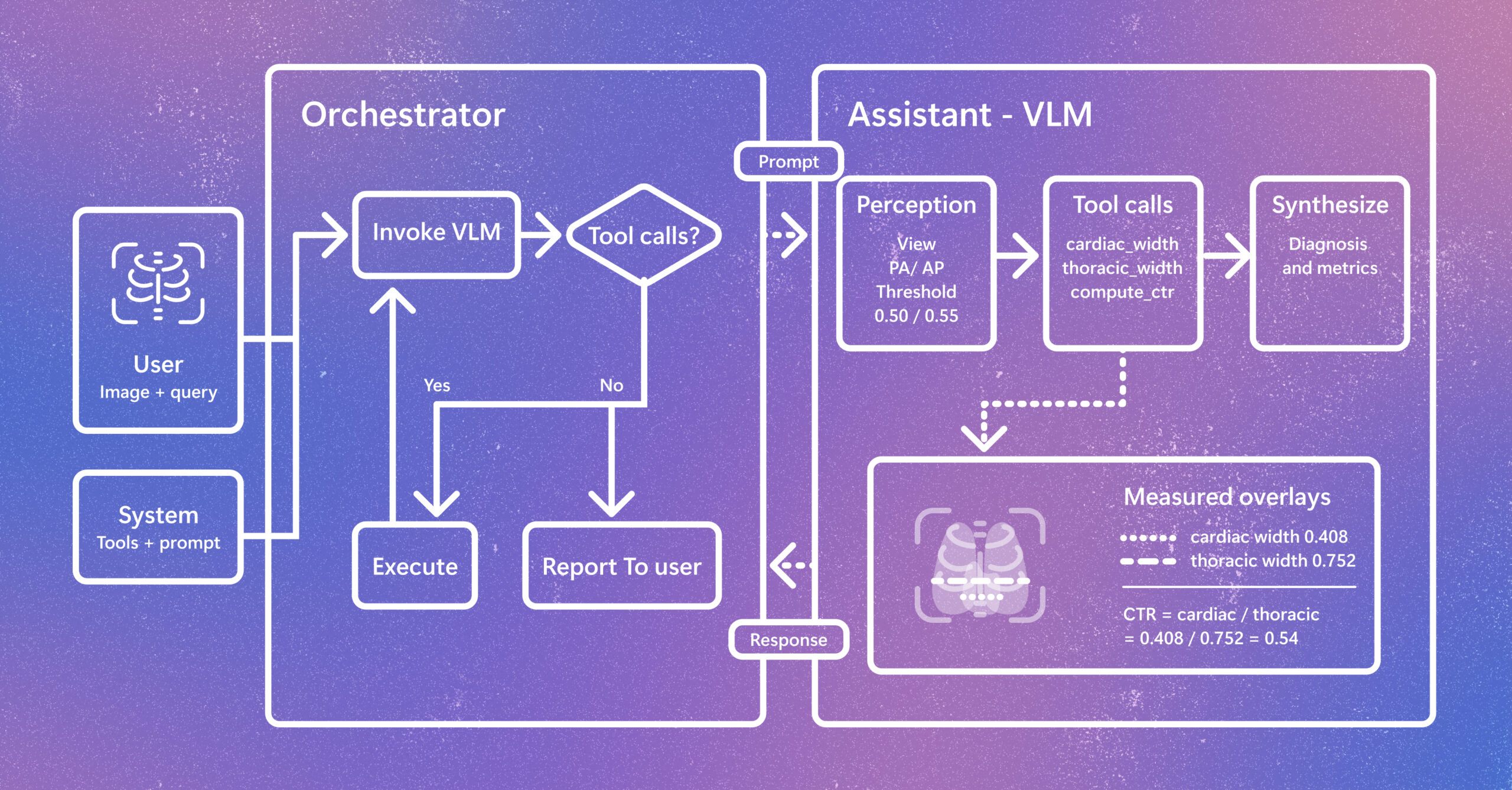
Radiology AI is evolving beyond report generation. CARE-X explores a unified approach that combines flexible reasoning, calibrated predictions, and measurement-based tools for chest X-ray interpretation. The post Introducing CARE-X: Towards Clinically Useful Radiology VLMs with Auxiliary Supervision, Reward-Aligned Learning, and Tool-Augmented Measurement appeared first on Microsoft Research.
Assistant Professor Benjamin Lindquist studies how engineers deliberately injected randomness into early AI, giving rise to deep-learning models that sometimes hallucinate.
We use cookies to run the site and, with your consent, for analytics and to show ads.
See our Cookie Policy.