May 2026· arXiv.org· Vol abs/2605.01766· 1 citation· 45 references
Computer ScienceEngineering
TL;DR
This work finds that hallucinations often arise when the model relies less on perceptual inputs, and that changing this reliance affects its predictions, and proposes a training-free framework that shifts relevance toward perceptual tokens by optimizing key-value representations during decoding, without modifying model parameters or requiring training data.
Abstract
Multimodal large language models (MLLMs) achieve strong performance on vision- and audio-language tasks, yet can generate responses that conflict with the given visual or auditory inputs, a problem known as multimodal hallucinations. Prior work suggests that this occurs when models rely more on textual cues and learned language patterns than on evidence from the perceptual input. To obtain a more direct account of this imbalance, we apply Layer-wise Relevance Propagation (LRP), which attributes predictions to individual input tokens, and use the resulting relevance scores to analyze and mitigate hallucinations. First, we examine whether this imbalance leads to multimodal hallucinations. We find that hallucinations often arise when the model relies less on perceptual inputs, and that changing this reliance affects its predictions. We further leverage LRP and propose a training-free framework that shifts relevance toward perceptual tokens by optimizing key-value representations during decoding, without modifying model parameters or requiring training data. We call this method Learning Inference-time Modality Enhancement (LIME). Despite using no spatial or temporal supervision, LIME concentrates relevance on query-relevant regions. We evaluate LIME across multiple multimodal benchmarks in both vision and audio domains, demonstrating consistent reductions in hallucinations and enhanced grounding while preserving generation quality.

Audio-Visual Large Language Models (AV-LLMs) remain prone to cross-modal hallucinations, where one modality incorrectly affects predictions about another. Although contrastive decoding reduces hallucinations in vision-language models, its direct extension to AV-LLMs overlooks a key challenge: different questions requir...
Hyunjae Ra, Aecheon Jung, Jungin Park et al.· 0 citations
Large Audio Language Models (LALMs) are prone to hallucinating and over-relying on text priors when simultaneously presented with audio and text inputs. To mitigate these hallucinations, we propose utilizing the multimodal Direct Preference Optimization (mDPO) objective, which forces the model to ground its generation...
Bebe Cosgrove, A. Grace, Wei-Ran Wang· 0 citations
Hallucination remains a significant challenge in Large Vision-Language Models (LVLMs). Existing training-free methods generally mitigate hallucinations through contrastive decoding or visual enhancement, often increasing the relative influence of visual evidence during generation. This raises a fundamental question: Ca...
Shu-Ran Ma, Jia-Le Li, Yu-Xi Dong et al.· 0 citations
EviAnchor is proposed, a training-free and single-branch inference framework that preserves and reactivates visual evidence throughout generation in large vision-language models and demonstrates consistent improvements in visual grounding.
Sihang Jia, Shuliang Liu, Song-Bo Yang et al.· 0 citations
Generative speech enhancement models can produce cleaner and more natural-sounding speech than conventional discriminative approaches, but may hallucinate by changing speech content or speaker identity, even with transcript conditioning. We present AuraSE, a flow-matching framework that addresses hallucination through...
Ying Shen, Yao Qian, Yuxuan Hu et al.· 0 citations
Adversarial Contrastive Fine-Tuning (ACFT) uses an Adversarial Hallucination Attribute Flipping procedure, involving minimal, targeted adversarial perturbations that flip an image's hallucination attribute, to construct perfectly aligned positive-negative pairs, which are then used for contrastive fine- tuning.
Pei-Yang Xu, Xiaopei Zhu, Jun Zhu et al.· 0 citations
Exploring how generative AI could make machine vision more accessible to businesses. The post GenEye in a Box: Making Machine Vision Something You Can Just Ask For appeared first on GPT-Lab.
Microsoft Research Blog· microsoft.comAug 11, 2026
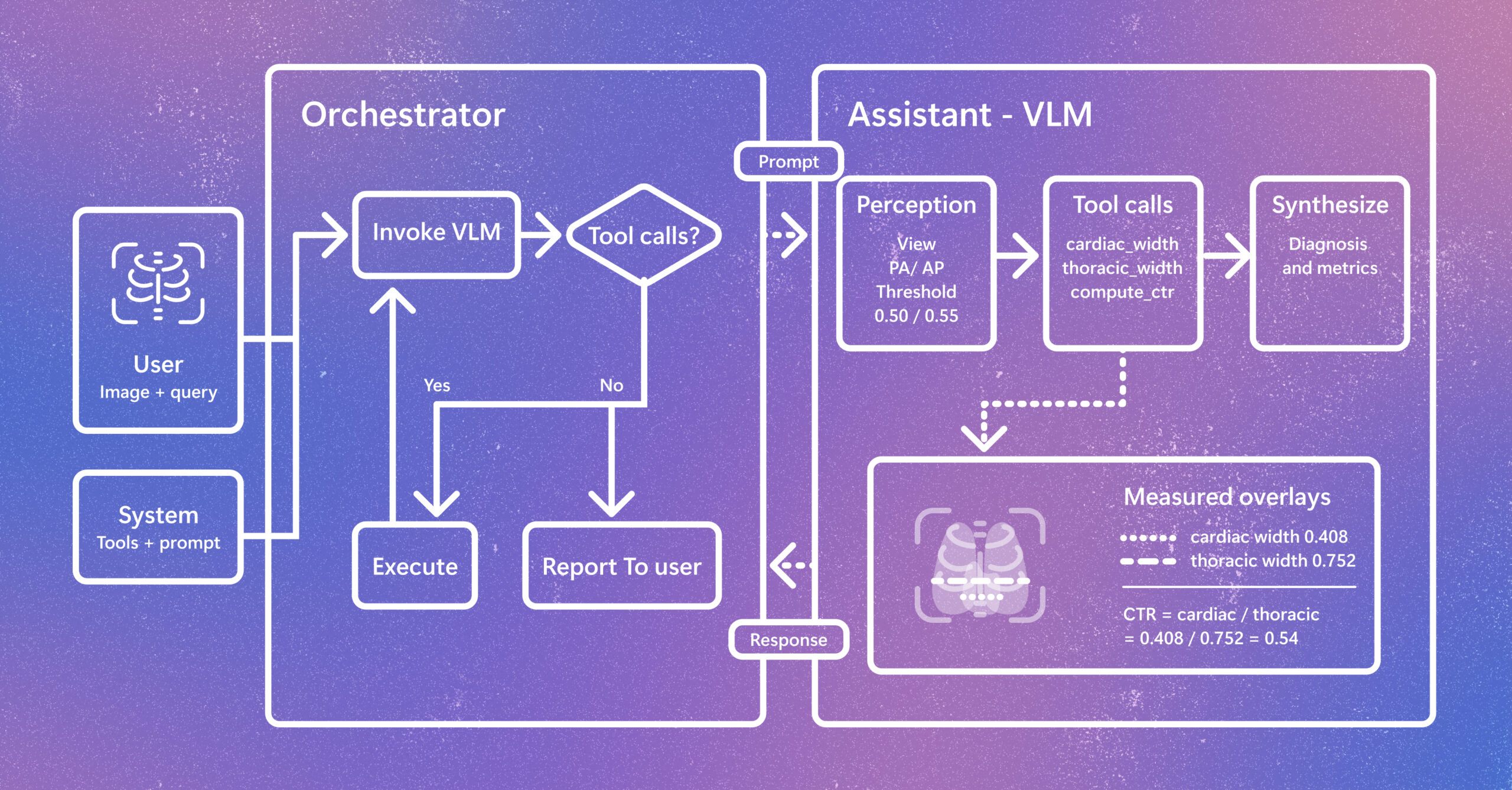
Radiology AI is evolving beyond report generation. CARE-X explores a unified approach that combines flexible reasoning, calibrated predictions, and measurement-based tools for chest X-ray interpretation. The post Introducing CARE-X: Towards Clinically Useful Radiology VLMs with Auxiliary Supervision, Reward-Aligned Learning, and Tool-Augmented Measurement appeared first on Microsoft Research.
Assistant Professor Benjamin Lindquist studies how engineers deliberately injected randomness into early AI, giving rise to deep-learning models that sometimes hallucinate.
We use cookies to run the site and, with your consent, for analytics and to show ads.
See our Cookie Policy.