DMC-Repair is proposed, which trains models on the same kind of cross-modal swapped samples while assigning supervision according to the modality specified by the question, and reduces the image-induced share of the answer effect by 59.9%, effectively suppressing the cross-modal shortcut without compromising audio-question answering performance.
Abstract
Omni-modal large language models (LLMs) are expected to answer a question using the modality it explicitly refers to. However, existing training paradigms rarely verify whether models actually follow this modality, because multimodal inputs from the same sample often provide redundant evidence for the same answer. In this work, we uncover a pervasive cross-modal shortcut in omni-modal LLMs: when asked an audio-related question, models rely on the image as much as on the audio, and sometimes even more. To systematically diagnose this behavior, we introduce the Factorized Modality Diagnostic, which independently swaps audio and images between samples to isolate each modality's causal contribution. Across two model families in different settings, we find that this shortcut persists throughout supervised fine-tuning and reinforcement learning post-training, while judge-based RL may further amplify such reliance on irrelevant visual information. Based on this finding, we propose DMC-Repair, which trains models on the same kind of cross-modal swapped samples while assigning supervision according to the modality specified by the question. This prevents models from exploiting the spurious correspondence between modalities within the same clip. Experiments demonstrate that DMC-Repair reduces the image-induced share of the answer effect by 59.9%, effectively suppressing the cross-modal shortcut without compromising audio-question answering performance. The reduction in shortcut reliance generalizes across two model families and zero-shot to an unseen dataset and an unseen benchmark, and persists through subsequent post-training. Code is available at https://anonymous.4open.science/r/DMC-Repair.

The proposed Synchrony-Guided Representation Alignment (SyncRA), a lightweight method for strengthening temporal correspondence between audio and vision, consistently outperforms answer-only fine-tuning across all model-benchmark combinations, while substantially improving the ability to track changing audio-visual pai...
Omni-modal large language models (Omni-LLMs) extend LLMs to process heterogeneous modalities (e.g., vision, audio, and IMU signals) alongside language, enabling a broader range of multimodal tasks. Yet we find that these models often fail to express information from non-textual modalities even when they perceive it cor...
Na-Min An, Taekyung Kim, Jaemyung Yu et al.· 0 citations
Audio-Visual Large Language Models (AV-LLMs) remain prone to cross-modal hallucinations, where one modality incorrectly affects predictions about another. Although contrastive decoding reduces hallucinations in vision-language models, its direct extension to AV-LLMs overlooks a key challenge: different questions requir...
Hyunjae Ra, Aecheon Jung, Jungin Park et al.· 0 citations
Savor is introduced, a training framework that augments the output schema with token and answer confidence, optimises the policy with a Group Relative Policy Optimisation objective that penalises calibration error and poor abstention decisions, and uses the learned confidence at inference time to revisit visual evidenc...
Zian Ding, Zi-Lin Zhao, Ying-Jie He et al.· 0 citations
SCEval (Structure-Corruption Evaluation) a diagnostic evaluation protocol that keeps the question, answer space, and modality channels fixed while applying controlled structural corruptions to text, vision, and audio individually and jointly is introduced.
Zhaolu Kang, Mei-Xin Wu, Yu Xue et al.· 1 citation
Improving joint audio-visual reasoning in Omni Large Language Models typically incurs substantial data construction and training costs. Our diagnostics reveal multi-hop reasoning difficulties despite correct answers to all corresponding single-hop questions and suggest partial decoupling in the local optimization of pe...
Zi-Yang Cheng, Yu-Hao Wang, Hong-Cheng Liu et al.· 0 citations
Exploring how generative AI could make machine vision more accessible to businesses. The post GenEye in a Box: Making Machine Vision Something You Can Just Ask For appeared first on GPT-Lab.
A new machine-learning framework aims to improve the success rate of computational protein design while moving away from results that reproduce sequences found in nature.
Microsoft Research Blog· microsoft.comAug 11, 2026
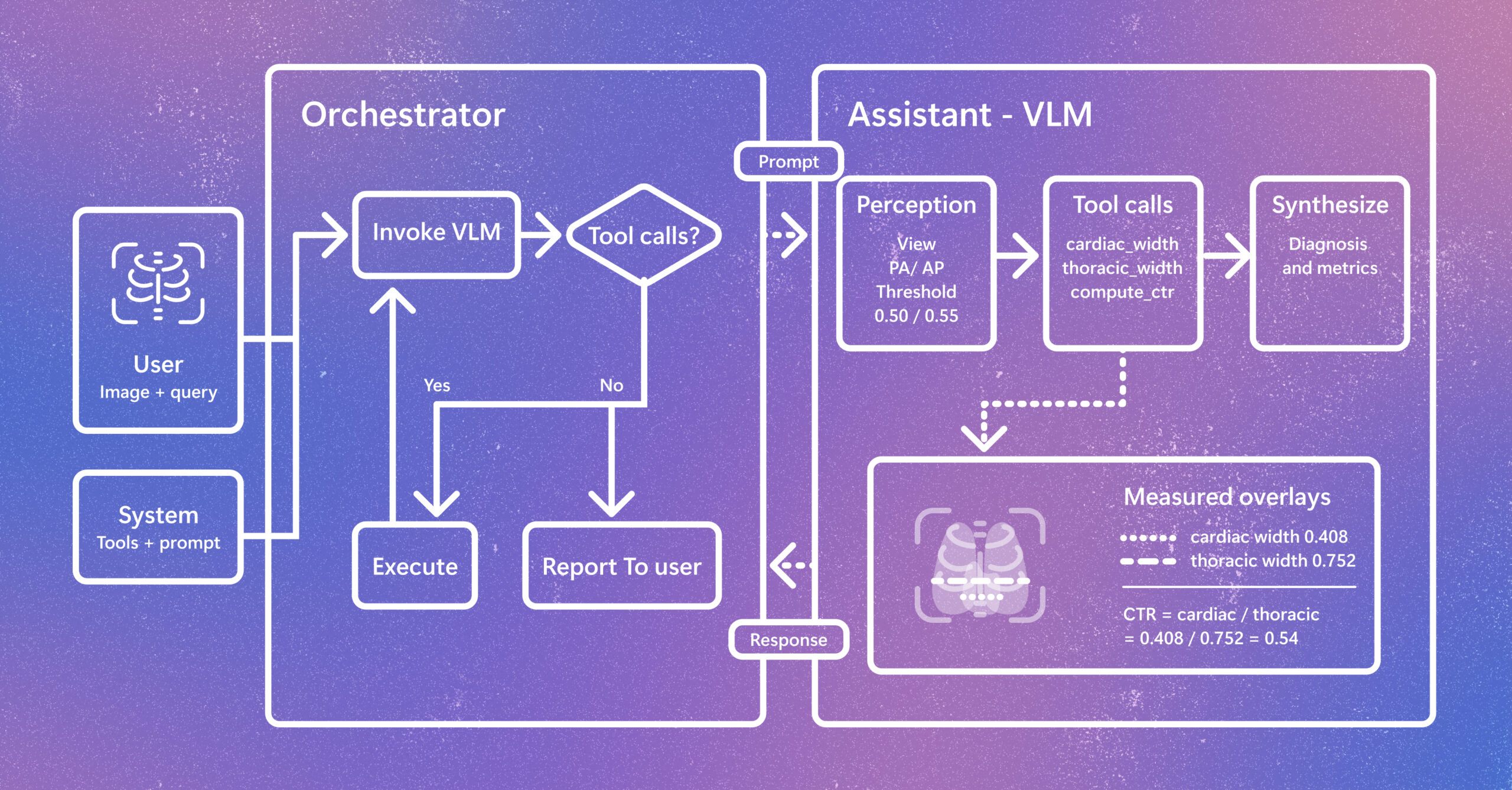
Radiology AI is evolving beyond report generation. CARE-X explores a unified approach that combines flexible reasoning, calibrated predictions, and measurement-based tools for chest X-ray interpretation. The post Introducing CARE-X: Towards Clinically Useful Radiology VLMs with Auxiliary Supervision, Reward-Aligned Learning, and Tool-Augmented Measurement appeared first on Microsoft Research.
We use cookies to run the site and, with your consent, for analytics and to show ads.
See our Cookie Policy.