An exact, information-theoretic analysis of stochastic gradient descent and its variants is given, showing that a preconditioned SGD step is the posterior-mean update of a Gaussian Bayes model, and that its one-step regret splits into an intrinsic-time cost and a change in comparator information.
Abstract
As an alternative to the standard geometric analyses, we give an exact, information-theoretic analysis of stochastic gradient descent (SGD) and its variants. We show that a preconditioned SGD step is the posterior-mean update of a Gaussian Bayes model, and that its one-step regret splits into an intrinsic-time cost and a change in comparator information. The split extends to an identity for the objective itself. Convex convergence, strict-saddle-point escape, the link between flatness and generalization, the standard learning-rate schedules, adaptive optimizers, and the noisy, momentum, heavy-tailed, and gradient-free variants of SGD each correspond to a term or a special case of this identity. We measure its terms on synthetic and real training runs. On real networks it attributes the slack of classical convergence bounds to the terms their derivations drop and separates optimizers that reach the same training loss. That separation follows the number and consistency of their steps. Its relation to which of them generalizes better differs between networks. For gradient-free SGD the identity determines how a curvature preconditioner should enter the update. The sharpness-based generalization certificate it yields, with a data-independent isotropic prior, is vacuous at network scale unless the curvature spectrum is nearly flat across all parameters.
This work proposes Batched SGD, a simple variant that partitions online samples into epochs and performs a single update per epoch using a refined, low-variance gradient estimate, and provides the first high-probability guarantees for FL.
Feng Zhu, Robert W. Heath, Aritra Mitra· 0 citations
This work describes its accuracy through exact first-order tail probabilities for the last iterate of nonlinear, constant-stepsize SGD, and proves its relative accuracy at shrinking tolerances above the central scale, with state-dependent noise and a growing observation horizon.
Xiao-Lin Li, Qi Lei, Zi-Yang Wei et al.· 0 citations
Differentiable learning typically assumes that the scalar objective evaluated in the forward pass and the gradient supplied to the optimizer in the backward pass describe the same mathematical object. We show that this correspondence can fail when probabilistic objectives rely on finite special-function recurrences, cu...
Ning-Kang Peng, Xiao-Qian Peng, Yi-Fan He et al.· arXiv.org· 0 citations
This paper investigates the statistical behavior of Stochastic Gradient Descent (SGD) with constant step size under the framework of iterated random functions. Compared to previous studies establishing the convergence of SGD in probability measure, e.g., Wasserstein distance, our approach directly provides the converge...
Jia-Qi Li, Zhipeng Lou, S. Richter et al.· 9 citations
This work shows that this non-smooth pointwise behavior becomes locally quadratic after averaging over the data distribution, and derives the curvature in closed form, specifically, a matrix-valued measure supported on the walls of the normal fan.
Konstantinos Ziliaskopoulos, A. Vinel, Alice E. Smith· 0 citations
This paper investigates the numerical resolution of the Beurling-LASSO (BLASSO), a convex optimization framework that promotes sparsity in the space of measures. We consider its application to the estimation of Gaussian mixture models (GMMs) with an unknown number of components and unknown diagonal covariance matrices....
Romane Giard, Y. de Castro, Roland Denis et al.· 0 citations
Related blog posts
MIT News · Artificial Intelligence· news.mit.eduNov 6, 2026
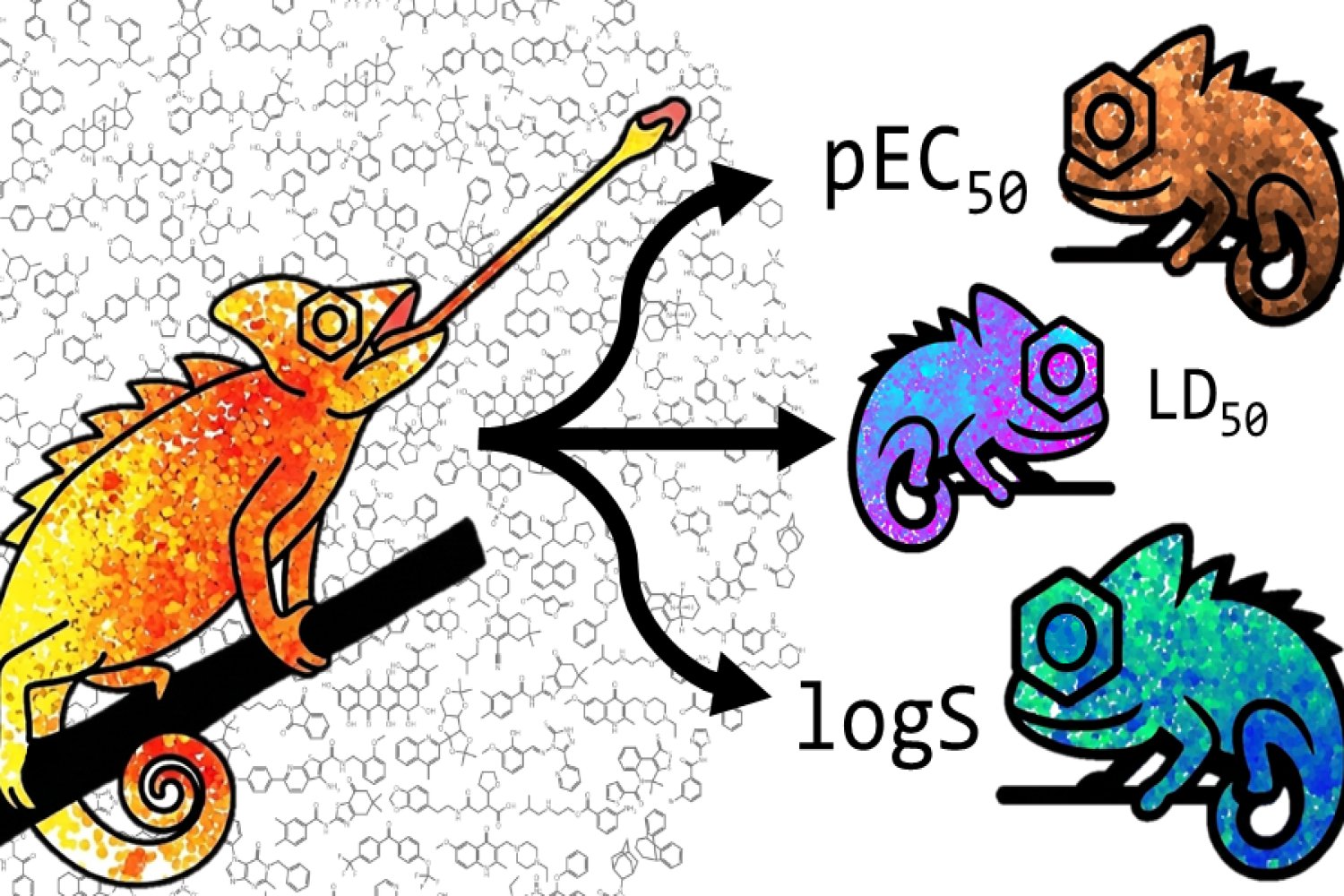
A machine-learning approach called CheMeleon provides a practical way to develop new drugs or other molecules with much less detailed, expensive experimentation.
Learn how Google DeepMind and GovTech Singapore uses lightweight on-device Gemma models to intercept conversational scams in private chats with zero cloud data egress.