How many labelers do you have? A closer look at gold-standard labels
Chen ChengHilal AsiJohn Duchi
Oct 2026
Machine LearningHuman-computer Interaction
Abstract
The construction of most supervised learning datasets revolves around collecting multiple labels for each instance, then aggregating the labels to form a type of "true" label. We question the wisdom of this pipeline by developing a (stylized) theoretical model of this process and analyzing its statistical consequences, showing how access to non-aggregated label information can make training well-calibrated models more feasible than it is with cleaned labels. The entire story, however, is subtle, and the contrasts between aggregated and fuller label information depend on the particulars of the problem, where estimators that use aggregated information exhibit robust but slower rates of convergence, while estimators that can effectively leverage all labels converge more quickly if they have fidelity to (or can learn) the true labeling process. The theory makes several predictions for real-world datasets, including when non-aggregate labels should improve learning performance, which we test to corroborate the validity of our predictions.

This paper investigates developing real-world perception for active agents, proposes Gibson Environment for this purpose, and showcases a set of perceptual tasks learned therein.
F. Xia, Amir Zamir, Zhi-Yang He et al.· 2018 IEEE/CVF Conference on...· 1,069 citations· ⚡112
This publication proposes a definition and a classification of agile software development approaches and analyses ten software development methods that can be characterized as being "agile" against the defined criterion.
P. Abrahamsson, O. Salo, Jussi Ronkainen et al.· arXiv.org· 727 citations· ⚡54
The study shows that agile practices improve both informal and formal communication, but indicates that, in larger development situations involving multiple external stakeholders, a mismatch of adequate communication mechanisms can sometimes even hinder the communication.
M. Pikkarainen, Jukka Haikara, O. Salo et al.· Empirical Software Engineeri...· 401 citations· ⚡48
The results indicate that software engineering work practices are chosen opportunistically, adapted and configured to provide value under the constrains imposed by the startup context.
Nicolò Paternoster, Carmine Giardino, M. Unterkalmsteiner et al.· Information and Software Tec...· 394 citations· ⚡54
The possibility of inferring high-dimensional data inference in a model that consists of a prior and an auxiliary differentiable constraint given some additional information is considered, thereby allowing a range of potential applications in adapting models to new domains and tasks.
Alexandros Graikos, Esmeralda S. Whitammer, N. Jojic et al.· Neural Information Processin...· 316 citations· ⚡15
Related blog posts
MIT News · Artificial Intelligence· news.mit.eduOct 28, 2026
Professor Paris Smaragdis develops computers with superhuman hearing for applications like speech recognition, music understanding, and environmental monitoring.
MIT News · Artificial Intelligence· news.mit.eduOct 23, 2026
Assistant Professor Benjamin Lindquist studies how engineers deliberately injected randomness into early AI, giving rise to deep-learning models that sometimes hallucinate.
MIT News · Artificial Intelligence· news.mit.eduOct 7, 2026
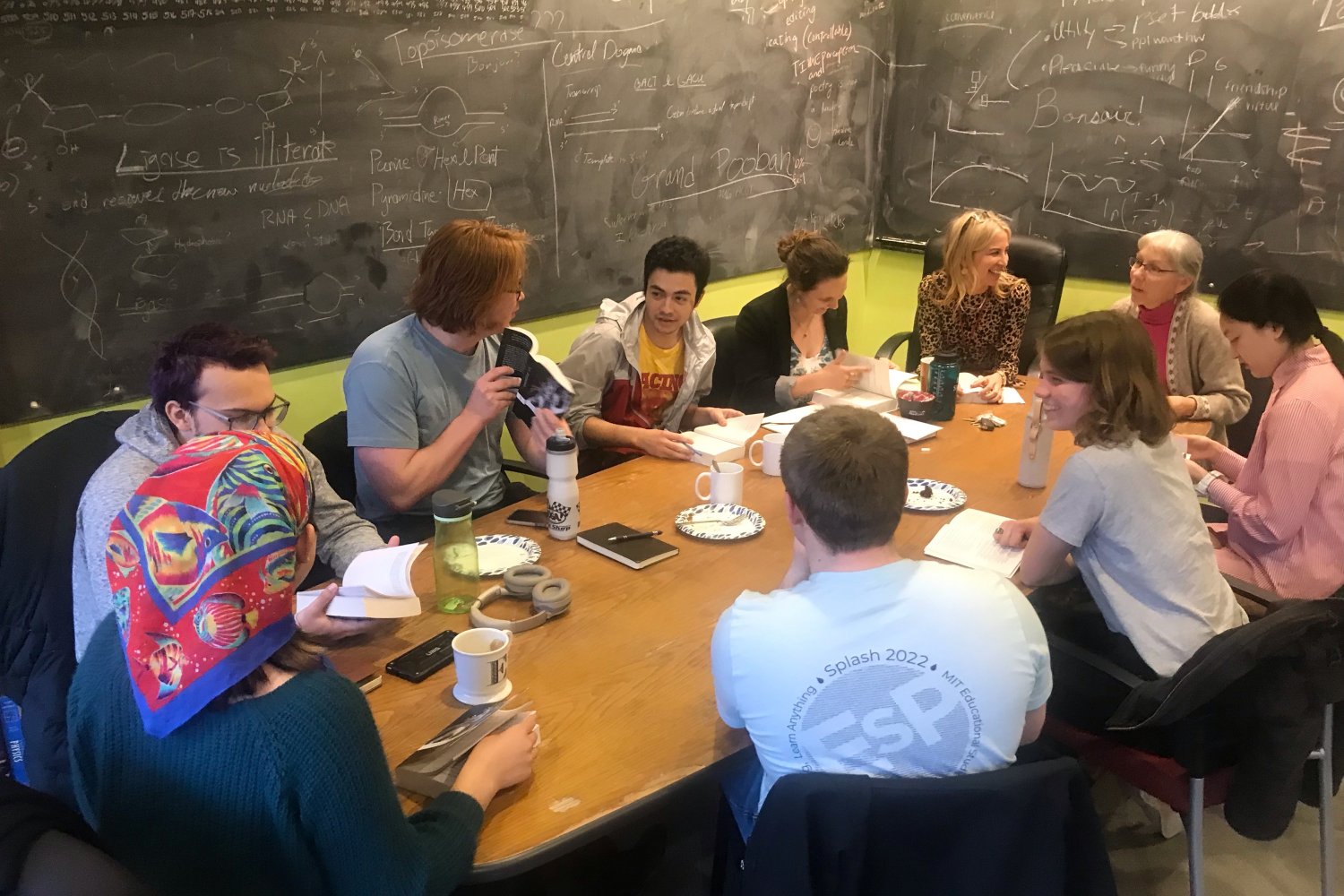
Students in MIT’s Concourse program delve deeply into the human condition, debate challenging questions, and learn to develop judgment about issues that can’t be quantified.
MIT News · Artificial Intelligence· news.mit.eduSep 25, 2026