This paper introduces a sample-wise inverse-temperature update for TTM by locally minimizing the Kullback-Leibler divergence between the temperature-scaled teacher distribution and the student's prediction and derives closed-form first and second derivatives with respect to the inverse temperature.
Abstract
Temperature scaling is a core component of knowledge distillation, yet its role and effect are still not fully understood. Transformed Teacher Matching (TTM) clarifies the role of temperature scaling by applying it only to the teacher distribution and interpreting the resulting objective as standard distillation with an implicit R\'enyi entropy regularization on the student. However, TTM still relies on a fixed temperature and does not specify how the teacher-side temperature should be adapted for individual samples. In this paper, we introduce a sample-wise inverse-temperature update for TTM by locally minimizing the Kullback-Leibler divergence between the temperature-scaled teacher distribution and the student's prediction. We derive closed-form first and second derivatives with respect to the inverse temperature, and show that they can be expressed using variance and covariance statistics of centered teacher and student logits under the transformed teacher weighting. This yields an efficient curvature-aware update that requires one softmax evaluation and a constant number of class-wise weighted sums. Experiments on standard image classification distillation benchmarks show that our temperature adaptation generally improves TTM and WTTM, while remaining competitive with or outperforming prior temperature-adaptive distillation baselines.

Multi-teacher on-policy distillation (MOPD) aims to combine the strengths of RL-trained teachers in a single student, but how teacher signals affect parameter changes remains underexplored. We study Qwen3-1.7B with four domain teachers trained with RL from the same initialization as the student, comparing gradients, op...
Si-Qi Zhu, Suo-Zhi Huang, Kai-Xuan Zhang et al.· 0 citations
A distributional view in which the teacher is represented not by a single softened output but by a family of multi-temperature views - marginals of the annealing path of its logits - and the student is trained against a geometry-aware aggregate of these views under an embedding-based ground cost is developed.
In probabilistic contrastive learning, a shared temperature is commonly interpreted as a shared similarity scale, but this interpretation does not hold for high-dimensional distributional class representations. We study the exact von Mises-Fisher (vMF) probabilistic score used by ProCo when representation dimension and...
Ning-Kang Peng, Qian-Feng Yu, Jing Mao et al.· 0 citations
It is shown that information contained in the teachers can be leveraged to tailor the noise for multi-teacher distillation, and a method is proposed that generates teacher-specific, improved samples optimized for data-free distillation.
Feyza Yavuz, Mert Bulent Sariyildiz, Diane Larlus· 0 citations
The flatness of the loss landscape at a minimizer is a widely used heuristic for reasoning about neural-network generalization, yet evidence for this relation is mostly empirical and controversial, and it is found that the answer strongly depends on the learning task and on the ratio of the number of parameters to the...
B. Annesi, Davide Straziota, E. M. Malatesta· 0 citations
Distillation has become a core primitive of large language model training, but its properties are not yet well understood. We take an entropic perspective, studying how the entropy of the student depends on the data and the divergence that define the distillation objective. We prove that forward KL inflates the entropy...
Exploring how generative AI could make machine vision more accessible to businesses. The post GenEye in a Box: Making Machine Vision Something You Can Just Ask For appeared first on GPT-Lab.
Microsoft Research Blog· microsoft.comAug 11, 2026
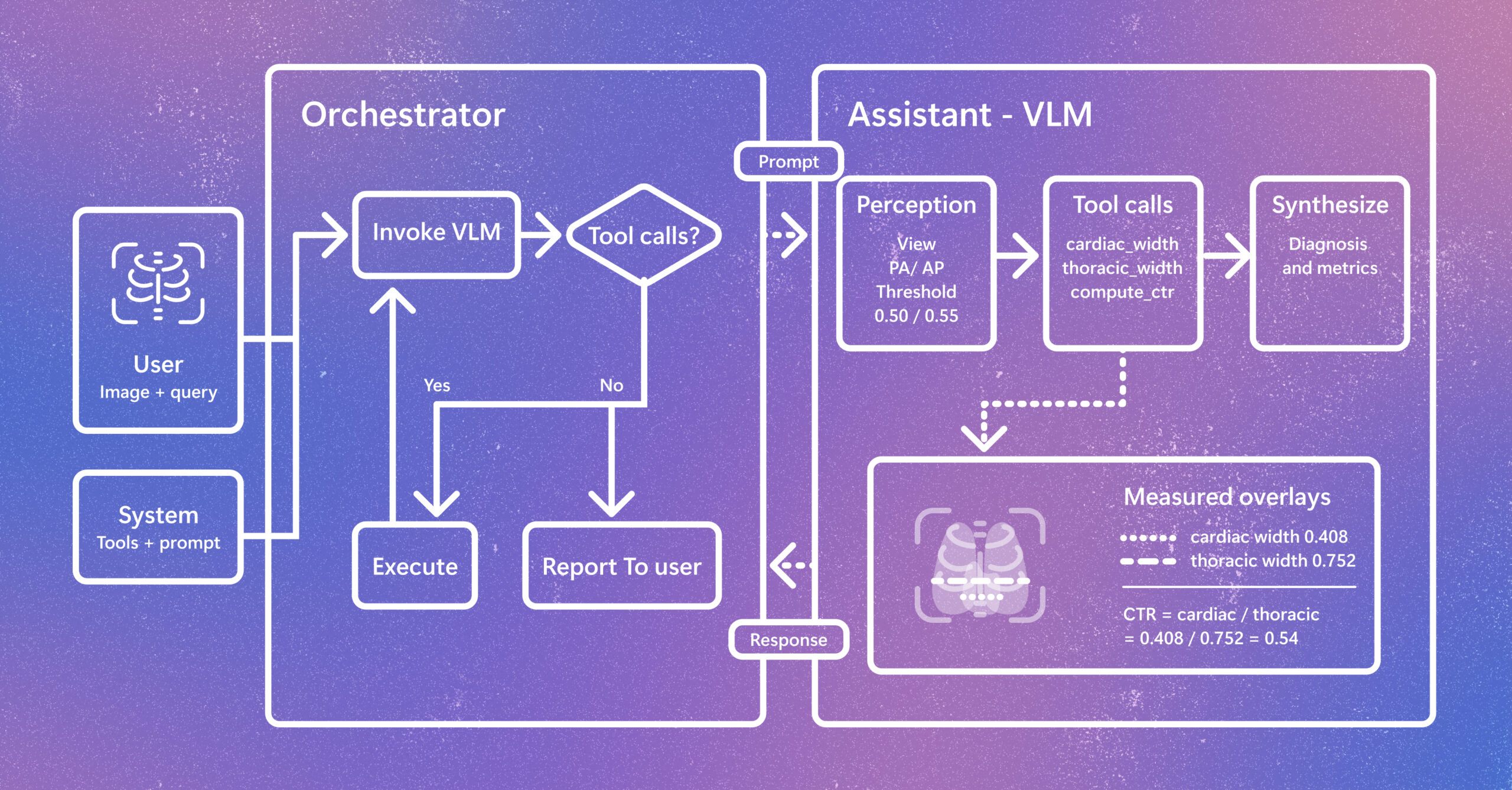
Radiology AI is evolving beyond report generation. CARE-X explores a unified approach that combines flexible reasoning, calibrated predictions, and measurement-based tools for chest X-ray interpretation. The post Introducing CARE-X: Towards Clinically Useful Radiology VLMs with Auxiliary Supervision, Reward-Aligned Learning, and Tool-Augmented Measurement appeared first on Microsoft Research.