Adversarial Calibration Attack (ACA), the first physical attack against camera-LiDAR online calibration, is presented and demonstrated that online calibration is a practical and safety-critical attack surface for AVs.
Abstract
Autonomous vehicles (AVs) rely on accurate camera-LiDAR calibration for multimodal sensor fusion. In practice, calibration can drift due to vibration, temperature variation, or minor sensor displacement, motivating online calibration algorithms that detect and correct misalignment at runtime while allowing the vehicle to continue operating without a factory visit. Existing AV attacks largely assume correct calibration. We instead identify online sensor calibration as a new attack plane. A corrupted calibration update can persist across subsequent fusion operations, causing system-wide errors that propagate from perception to planning and control. We present Adversarial Calibration Attack (ACA), the first physical attack against camera-LiDAR online calibration. Using a single adversarial poster, ACA first spoofs the miscalibration detector to trigger the calibration process and then steers the calibration estimator toward an incorrect transformation. A unified optimization jointly designs the poster's geometry and texture for both objectives. We evaluate ACA across benchmark datasets, simulation, and physical experiments. On benchmark datasets such as KITTI and nuScenes, ACA induces up to 33.9 degrees mean rotational calibration error, thereby severely degrading object detection. In the CARLA simulator, the attack causes a collision when the corrupted calibration is accepted in vulnerable scenarios crafted by the attacker. On a real Husky robot, a printed adversarial poster successfully reproduces the calibration error. These results demonstrate that online calibration is a practical and safety-critical attack surface for AVs.

Heterogeneous cooperative perception (CP) enables connected vehicles with diverse sensor setups to share spatial awareness via compact feature maps, where receivers reconcile these maps using learned translation modules for fusion and inference. Prior attacks against CP in a homogeneous setting reveal that the data exc...
Chen-Yi Wang, Yu-Tong Liu, Qing-Zhao Zhang et al.· 0 citations
AdROD outperforms five baseline defenses and exhibits superior generalizability compared with the evaluated adversarial-training baselines, while maintaining real-time performance for safely stopping the vehicle at a stop sign instrumented with adversarial patches.
Yuting Wu, Dongfang Guo, Xiangzhong Luo et al.· 0 citations
Deploying autonomous systems in safety-critical domains demands guaranteed robustness against physically plausible geometric perturbations rather than abstract pixel-wise noise. In vision-based navigation and autonomous landing, machine learning components require rigorous validation under dynamic operational condition...
Uncrewed aerial vehicles increasingly rely on on-board deep object detectors for applications such as surveillance, delivery, agriculture, and traffic monitoring. The vulnerability of these detectors to adversarial patches has therefore become a practical safety concern. Research on adversarial patch and camouflage att...
Sandesh Shrestha, K. T. Yasas Mahima, Asanka G. Perera· Italian National Conference...· 0 citations
Autonomous UAV patrol requires real-time perception capable of identifying novel visual anomalies without prior labeled examples. Closed set detectors fail on unseen objects, while CLIP-based anomaly methods designed for ground-level imagery have not been validated for the aerial domain. We present AerialGuard, an end-...
Yashwardhan Rathore, S. Baghel, Ritali Vatsi et al.· 2026 IEEE 22nd International...· 0 citations
Autonomous mobile robots rely on object detection for navigation and safety, yet edge-deployed detectors remain vulnerable to adversarial patches under limited compute, power, and latency constraints. This paper presents a deploymentoriented robustness benchmark using nine CARLA-GeAR billboard scenarios and five detect...
Lefkios Mavroudi, Antonis D. Savva, C. Kyrkou et al.· Coins· 0 citations
Exploring how generative AI could make machine vision more accessible to businesses. The post GenEye in a Box: Making Machine Vision Something You Can Just Ask For appeared first on GPT-Lab.
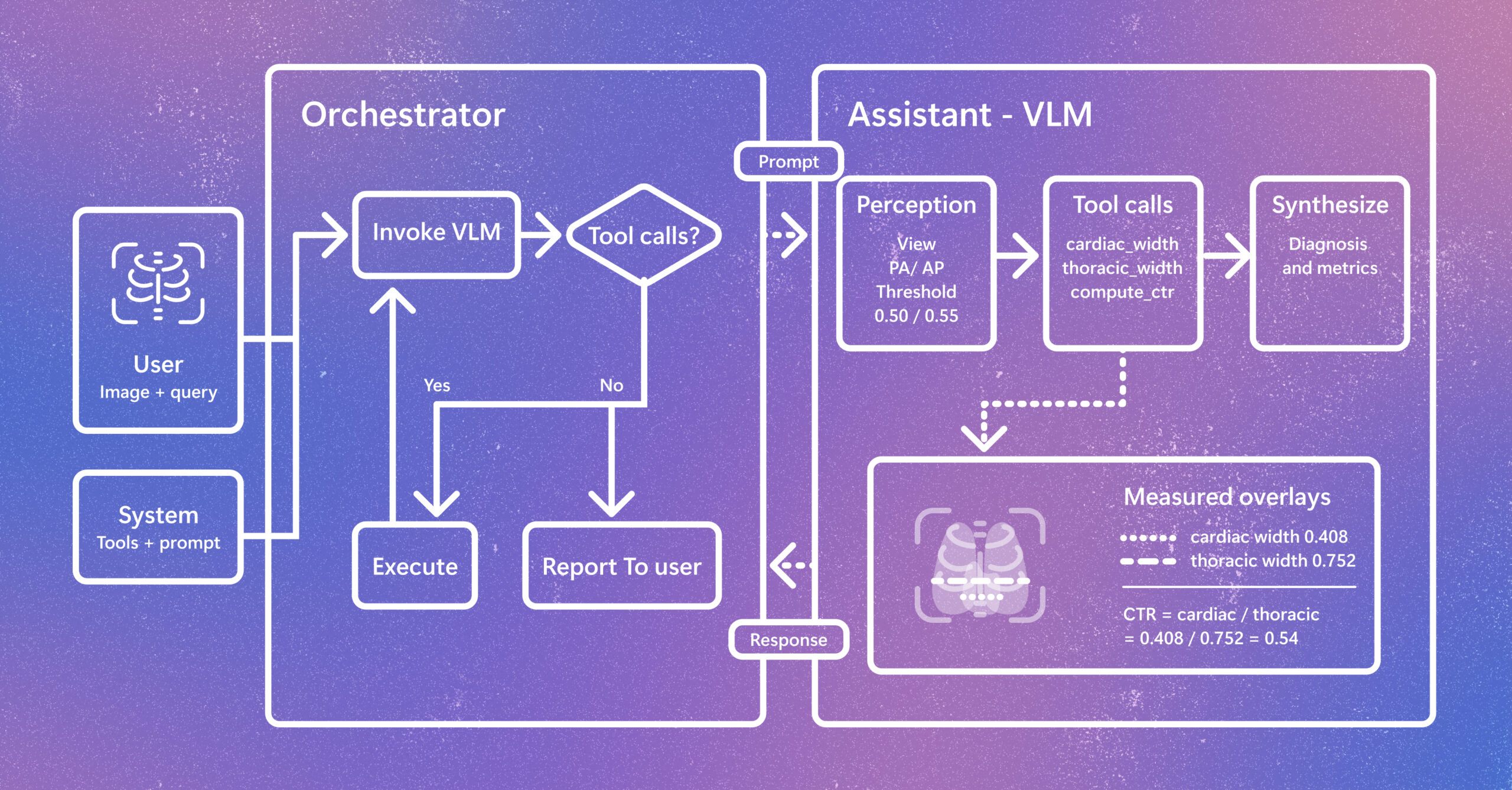
Radiology AI is evolving beyond report generation. CARE-X explores a unified approach that combines flexible reasoning, calibrated predictions, and measurement-based tools for chest X-ray interpretation. The post Introducing CARE-X: Towards Clinically Useful Radiology VLMs with Auxiliary Supervision, Reward-Aligned Learning, and Tool-Augmented Measurement appeared first on Microsoft Research.