This work introduces Generative Translation Priors--a Bayesian framework that transforms diffusion-based image-to-image translation models into cross-modality image priors for ill-posed imaging inverse problems, and derives two discretized GTP algorithms based on gradient and proximal likelihood guidance.
Abstract
The ability to leverage images from co-available modalities to inform target-domain reconstruction is highly desirable in imaging algorithms. In this work, we introduce Generative Translation Priors (GTP)--a Bayesian framework that transforms diffusion-based image-to-image translation models into cross-modality image priors for ill-posed imaging inverse problems. GTP incorporates target-domain measurements through likelihood guidance, steering the translation process toward the desired posterior distribution. The framework is grounded in a theoretical analysis of the resulting posterior dynamics, which reveals an intrinsic bias introduced by likelihood guidance. We further characterize this bias and derive a ground-truth-free formulation for its estimation, enabling it to serve as a practical metric for assessing posterior sampling quality. Building on this analysis, we derive two discretized GTP algorithms based on gradient and proximal likelihood guidance, respectively. We validate GTP on computed tomography reconstruction with magnetic resonance side information, and on positron emission tomography reconstruction with computed tomography side information. Experiments demonstrate that GTP effectively incorporates complementary cross-modality information and achieves high-fidelity reconstruction even under severely undersampled measurements.

This work defines an explicit surrogate posterior path and derives the Posterior-Dynamics Implicit--Explicit sampler (PD-IMEX), a stable method using one score evaluation per diffusion scale and an implicit data-consistency update, and derives continuous posterior dynamics.
Zhao-Qiang Liu, T. Pang, Ruibing Wang et al.· 1 citation
This work introduces an unsupervised, optimization-based reconstruction framework that employs a flow-matching generative model as a learned manifold prior, yielding a differentiable generator of anatomically plausible images.
Heng-Jia Ran, Jie Luo, Yu-Tao Zhu et al.· 0 citations
Experimental results across several CT inverse problem settings show that Flow Matching-based approaches consistently outperform diffusion-based methods in terms of PSNR, SSIM, and perceptual quality, while requiring fewer sampling steps.
This work investigates whether a single diffusion model trained across several imaging domains can instead serve as a prior for many CT problems simultaneously, and proposes a frozen model that out-performs analytic reconstructions in all three cases.
Haley Duba-Sullivan, Patxi Fernandez-Zelaia, Obaidullah Rahman et al.· 0 citations
I2SB-Inversion is proposed, a multi-contrast guided reconstruction framework based on the Schrödinger Bridge that achieves a a high acceleration factor of R=11.38 and consistently outperforms existing methods in both quantitative and qualitative evaluations.
Yue Wang, Yuan-Biao Yang, Zhuo-xu Cui et al.· IEEE Transactions on Medical...· 0 citations
A novel dual-domain self-supervised learning (Dual-SSL) framework that rigorously enforces physical consistency in both image and k-space domains is proposed, effectively bridging the gap between self-supervised and supervised MRI reconstruction.
Xin-Zhen Li, Jin-Hong Huang, Gen-Jiao Zhou et al.· Biomedical engineering and p...· 0 citations
Exploring how generative AI could make machine vision more accessible to businesses. The post GenEye in a Box: Making Machine Vision Something You Can Just Ask For appeared first on GPT-Lab.
Microsoft Research Blog· microsoft.comAug 11, 2026
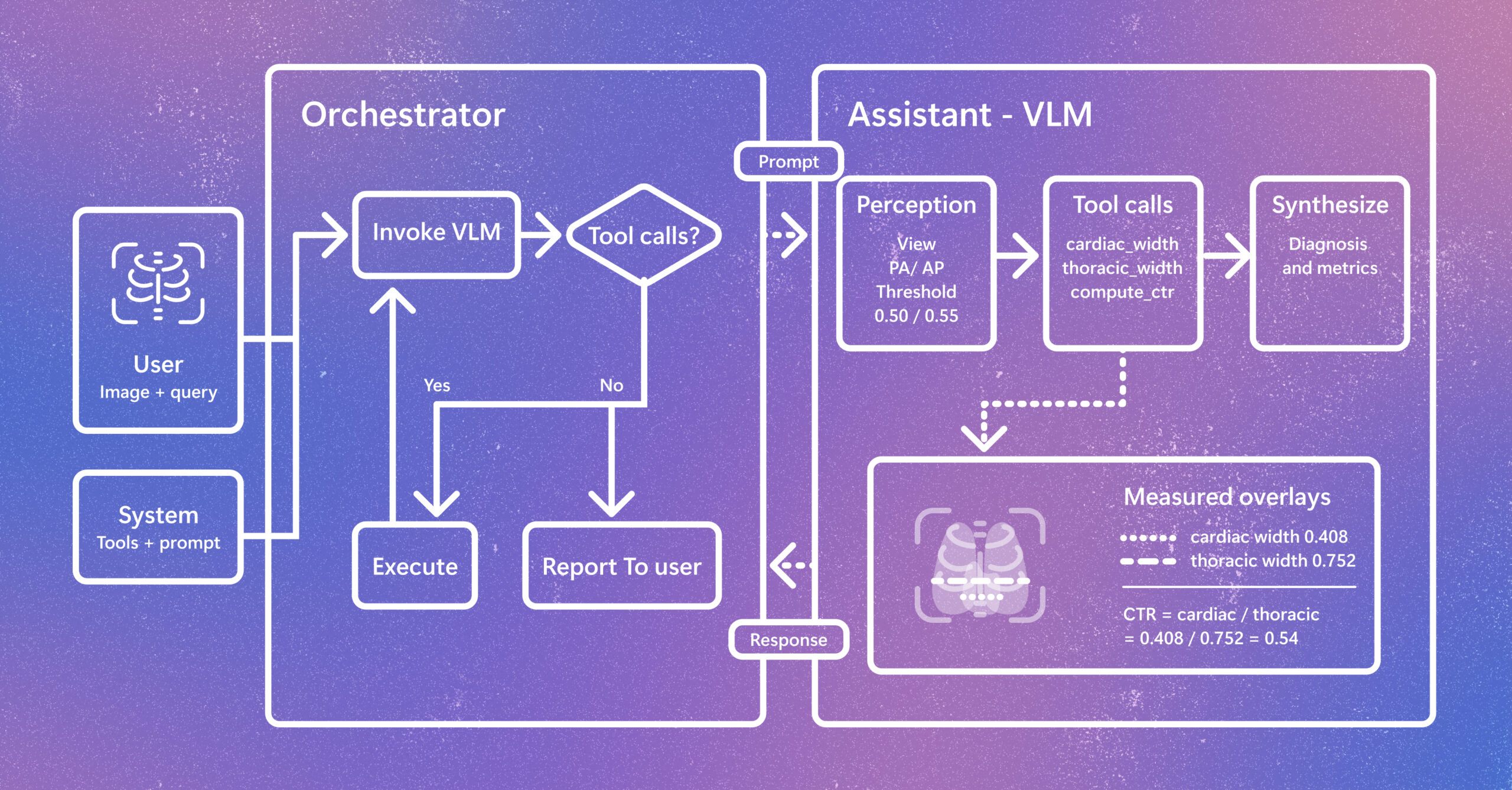
Radiology AI is evolving beyond report generation. CARE-X explores a unified approach that combines flexible reasoning, calibrated predictions, and measurement-based tools for chest X-ray interpretation. The post Introducing CARE-X: Towards Clinically Useful Radiology VLMs with Auxiliary Supervision, Reward-Aligned Learning, and Tool-Augmented Measurement appeared first on Microsoft Research.