Diversify, Anchor, and Filter (DAF), a stabilization framework that augments entropy-based adaptation with a marginal diversity loss that resists collapse, a cross-modal anchor consistency loss that constrains feature drift relative to a frozen source model, and feature salience filtering that skips low-value backward passes to offset part of the source-anchor overhead is proposed.
Abstract
Open-vocabulary semantic segmentation (OVSS) relies on vision-language alignment to recognize arbitrary text-defined categories, yet this alignment is fragile under continual test-time distribution shift. Our diagnostic analysis reveals that entropy minimization drives patch-level class collapse, continual updates erode vision-language alignment, and redundant gradients from low-shift samples waste computation. We propose Diversify, Anchor, and Filter (DAF), a stabilization framework that augments entropy-based adaptation with a marginal diversity loss that resists collapse, a cross-modal anchor consistency loss that constrains feature drift relative to a frozen source model, and feature salience filtering that skips low-value backward passes to offset part of the source-anchor overhead. We evaluate on five datasets spanning natural scenes, autonomous driving, underwater imagery, and remote sensing with their corrupted variants. Across the evaluated continual shifts, DAF remains stable where entropy minimization collapses, improving mIoU by over 8 points on Pascal VOC20-C, over 9 points on LoveDA, and over 3 points on Foggy Cityscapes compared to the source model, and is robust to aggressive adaptation and learning rate choices.

A continual test-time adaptation framework that updates only a small subset of model parameters that consistently outperforms existing TTA and OVSS adaptation baselines across multiple datasets and corruptions, while maintaining stable performance over extended and cross-corruption continual streams without introducing...
Fen Luo, Sen Li, Zhanqiang Huo· Journal of King Saud Univers...· 0 citations
This work proposes Test-time Prototype Adaptation (TPA), a training-free plug-in that operates at the output level, leaving the host's forward pass and weights unmodified.
Haozhe Wang, Jintao Cheng, Weibin Li et al.· 1 citation
This work proposes a principled VLM TTA method called \algname, and theoretically reveals that the InfoNCE loss can be neatly reformulated as a Wasserstein OT formulation, thereby unifying the objectives of the inference and adaptation of VLMs to achieve their mutual benefits.
Qi Yu, Zhichen Zeng, Katherine Tieu et al.· 0 citations
Robust and reliable perception is essential for autonomous robots operating in real-world environments, particularly in long-term missions where environmental conditions may change significantly over time. Although recent advances in Visual Foundation Models (VFMs) have improved open-vocabulary semantic segmentation, t...
Michele Antonazzi, A. C. Hernández, José Araújo et al.· 0 citations
Vision-language models show promise in zero-shot semantic segmentation, but a key challenge is the disconnect between text and visual features. While text embeddings can roughly localize unseen objects, they often lack the fine-grained detail necessary for accurate segmentation, leading to oversegmentation or undersegm...
Jia-Xiang Fang, Shi-Qiang Ma, Jing Wang et al.· Neural Networks· 0 citations
Exploring how generative AI could make machine vision more accessible to businesses. The post GenEye in a Box: Making Machine Vision Something You Can Just Ask For appeared first on GPT-Lab.
Microsoft Research Blog· microsoft.comAug 11, 2026
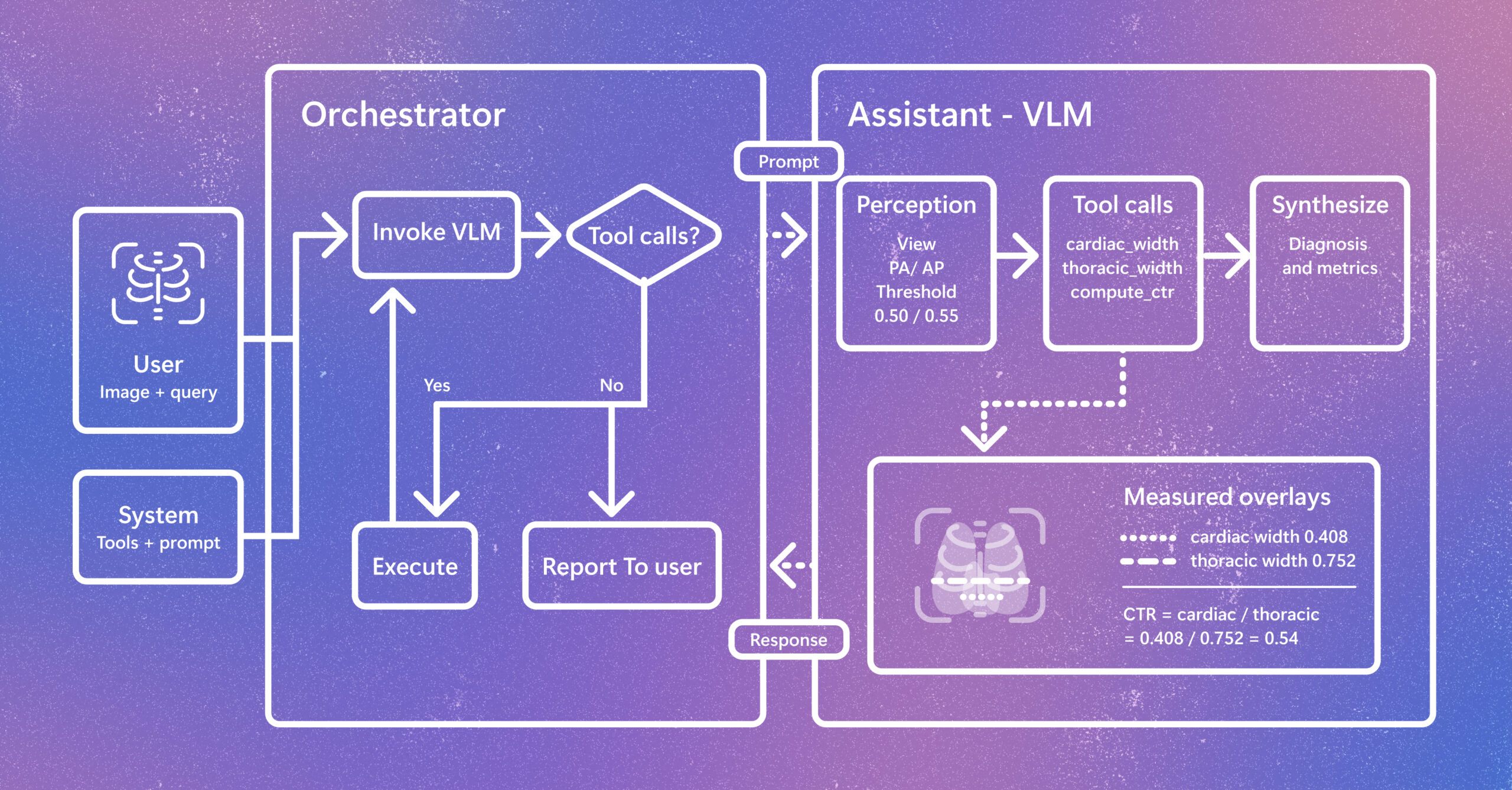
Radiology AI is evolving beyond report generation. CARE-X explores a unified approach that combines flexible reasoning, calibrated predictions, and measurement-based tools for chest X-ray interpretation. The post Introducing CARE-X: Towards Clinically Useful Radiology VLMs with Auxiliary Supervision, Reward-Aligned Learning, and Tool-Augmented Measurement appeared first on Microsoft Research.
Assistant Professor Benjamin Lindquist studies how engineers deliberately injected randomness into early AI, giving rise to deep-learning models that sometimes hallucinate.
We use cookies to run the site and, with your consent, for analytics and to show ads.
See our Cookie Policy.