The results suggest that explicitly regulating representation geometry is an effective complement to optimization balancing, and provide evidence that geometry-aware regularization can improve multimodal learning across diverse architectures and domains.

Abstract
Multimodal fusion is often treated as an optimization-balancing problem, where training signals are adjusted to prevent one modality from dominating the others. However, balanced optimization does not fully determine the geometry of intermediate representations. Supervised multimodal models may still learn low-diversity modality-specific embeddings or allow paired cross-modal observations to drift excessively apart, weakening both unimodal robustness and multimodal fusion. We introduce \regName, a lightweight plug-and-play geometric regularization framework for multimodal representation learning. Rather than enforcing rigid cross-modal alignment, \regName follows a bounded-agreement principle: preserve modality-specific diversity while softly constraining only the portion of paired cross-modal drift that exceeds an admissible agreement band. Operationally, \regName combines a dispersion term that mitigates spectral concentration with an agreement-band anchoring term that controls excessive paired drift, requiring no architectural modification or inference-time overhead. Experiments across audio-visual, image-text, and RF-based benchmarks show that \regName consistently improves multimodal performance and often strengthens unimodal representations. These results suggest that explicitly regulating representation geometry is an effective complement to optimization balancing, and provide evidence that geometry-aware regularization can improve multimodal learning across diverse architectures and domains.
Geodesic Unlearning (GU), a lightweight parameter-editing method that leverages Grassmannian subspace geometry for structured subspace correction to improve missing-modality robustness, is proposed and suggested as a practical route for robustness correction.
Song-Yuan Sui, Zhen Tan, Mohan Zhang et al.· 0 citations
Across a unified 16-task classification-retrieval stream with three hyperbolic backbones, HMCL improves final performance and backward transfer over sequential fine-tuning and four continual-learning baselines; HMCL-CA gives the highest Overall score on every backbone.
Jia-Hong Liu, Ming Shen, Xiao-Hao Liu et al.· 0 citations
Multimodal classifiers can converge to modality-dominant solutions in which one modality dominates the joint prediction, suppressing the learning of others. Existing balancing methods mainly adjust losses, gradients, or modality contributions, largely treating modality imbalance as an optimization problem while implici...
Ze-Chang Xiong, Da Li, Rong Yin et al.· 0 citations
This paper proposes multimodal Max Confidence Regularization (MaxCR) to dynamically intervene in modality semantic confidence, and reveals that this flaw stems from unimodal characteristics rather than multimodal learning, and this confidence discrepancy can be corrected by positive cross-modal intervention.
Long-Fei Huang, Xiang-Yu Wu, Yang Yang· 0 citations
This work introduces a framework that applies contrastive or masked objectives at intermediate layers, coupled with source-wise invertible normalizing flows and a supervised, low-rank latent variable model, offering a practical latent-variable lens for characterizing continuous multimodal interactions.
Multi-modal image fusion (MMIF) aims to form a single image by integrating shared information, preserving complementary cues, and coordinating cross-modal conflicts across modalities. However, due to the absence of ground-truth fused images, existing MMIF supervision commonly uses spatial-domain sources or gradient var...
Ze-Yu Wang, Ming-Yu Ge, Hai-Yu Song et al.· 0 citations
Exploring how generative AI could make machine vision more accessible to businesses. The post GenEye in a Box: Making Machine Vision Something You Can Just Ask For appeared first on GPT-Lab.
Microsoft Research Blog· microsoft.comAug 11, 2026
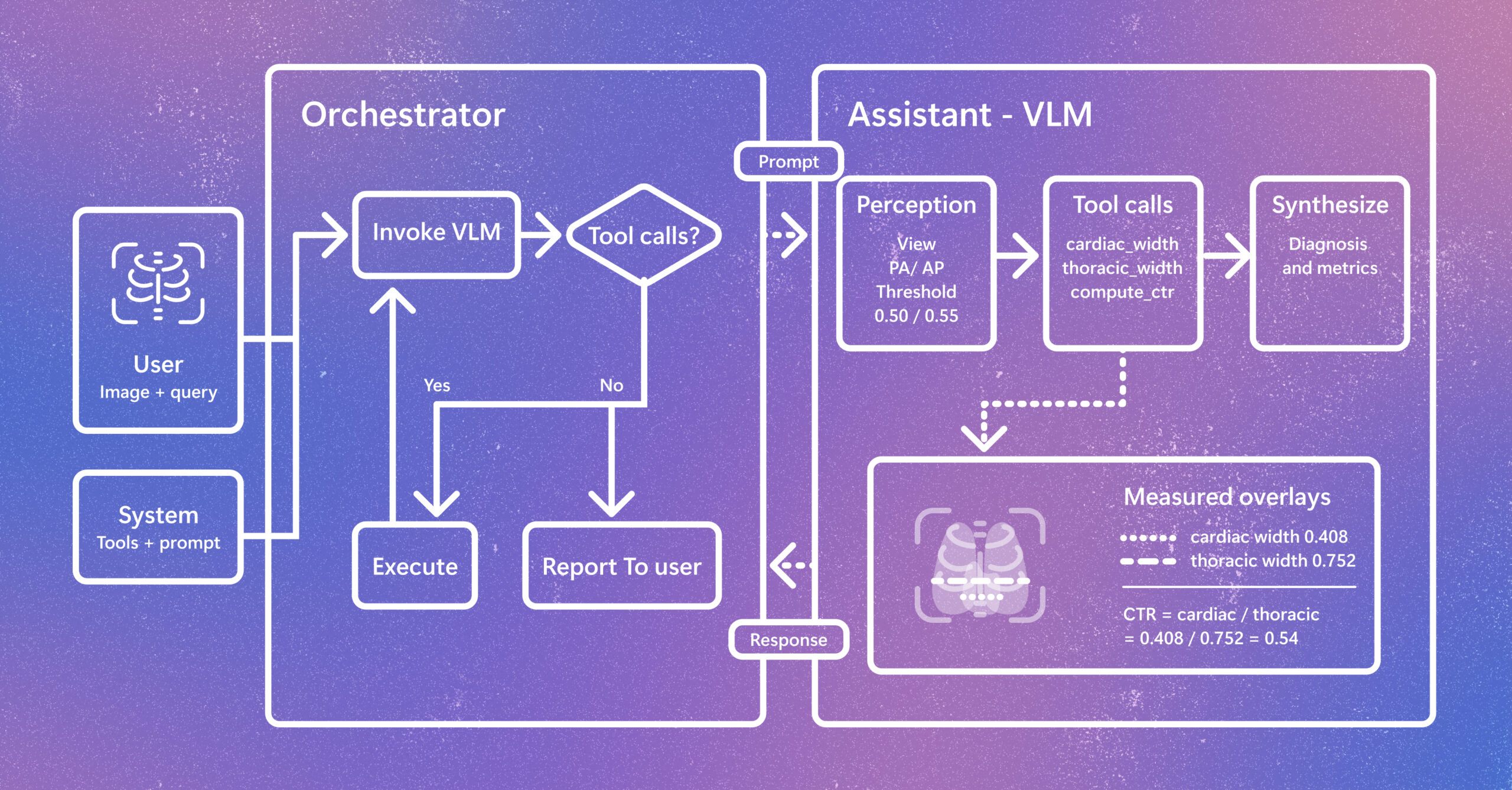
Radiology AI is evolving beyond report generation. CARE-X explores a unified approach that combines flexible reasoning, calibrated predictions, and measurement-based tools for chest X-ray interpretation. The post Introducing CARE-X: Towards Clinically Useful Radiology VLMs with Auxiliary Supervision, Reward-Aligned Learning, and Tool-Augmented Measurement appeared first on Microsoft Research.