This work develops a scalable online entropic OT approximation that enables substantially larger source-target couplings while preserving the benefits of OT, and proves strict reductions in full stochastic-gradient variance and integration error relative to independent pairing.
Abstract
A central challenge in scaling flow models is maintaining stability in training and integration. In flow matching, this stability depends critically on how source samples are paired with data. Independent random pairing introduces substantial stochasticity, motivating minibatch optimal transport (OT) to construct online source-target couplings that reduce this randomness (Tong et al., 2024). However, as applications extend to larger and higher-dimensional datasets, small minibatches can limit these benefits, while scaling the coupling to substantially larger minibatches at every iteration is computationally prohibitive. Moreover, how OT coupling affects the full stochastic gradient and integration remains theoretically unresolved. In this work, we develop a scalable online entropic OT approximation that enables substantially larger source-target couplings while preserving the benefits of OT. We close the theoretical gap for both unregularized and entropic OT by proving strict reductions in full stochastic-gradient variance and integration error relative to independent pairing, and further characterize how these improvements strengthen as the online coupling minibatch grows. Experiments on single-cell gene interpolation-flow and image-flow training validate these predictions, showing that larger online couplings consistently improve training stability and final generation performance.

Drifting models enable one-step generation by amortizing distribution transport into training, but this efficiency places greater demands on the transport field estimated at each update. In large-scale training, the field is computed from finite mini-batches of generated and real samples, which provide only imperfect a...
Yi-Rong Shen, Mengfei Xia, Jun-Peng Jing et al.· 0 citations
Training large language models (LLMs) across geographically distributed and poorly interconnected compute pools or data centers has become a topic of significant interest. This has led to increased study of local optimization methods such as DiLoco for LLMs, especially those that use local (or inner) adaptive or precon...
Eugene Belilovsky, Stefan Horoi, Edouard Oyallon et al.· 0 citations
This work introduces FlowCPO, an offline forward-KL objective that uses both preferred and dispreferred samples without online rollouts and shows under explicit regularity conditions that the forward-KL objective is bounded by a contrastive flow matching loss, yielding a tractable surrogate on fixed data.
Yan-Sen Han, Shengyi Liao, Peng Sun et al.· 1 citation
Post-training a large language model (LLM) often requires exploring trade-offs between multiple rewards, but retraining for each trade-off is expensive. Decoding-time policy composition allows these trade-offs to be adjusted by combining reward-specific policies at inference time. This composition targets a weighted pr...
A. Kurennoy, R. Yarullin, Fergal Reid· 0 citations
Teacher-free one-step generative models such as W-Flow learn directly from distributional objectives, with the Sinkhorn divergence providing the strongest empirical performance among the energies studied in W-Flow. However, Sinkhorn divergence is based on balanced optimal transport, whose exact marginal constraints can...
Jongwook Jeon, Mingue Park, Jiwon Choi et al.· 0 citations
Recent bidirectional encoders have been modernized with innovations from causal large language models (LLMs). However, the pretraining recipe itself remains inherited from small-scale conventions, leaving encoders underoptimized, with no single model performing competitively across both classification and retrieval tas...
Jungwoo Park, Taewhoo Lee, Jaewoo Kang· 0 citations
Exploring how generative AI could make machine vision more accessible to businesses. The post GenEye in a Box: Making Machine Vision Something You Can Just Ask For appeared first on GPT-Lab.
Microsoft Research Blog· microsoft.comAug 11, 2026
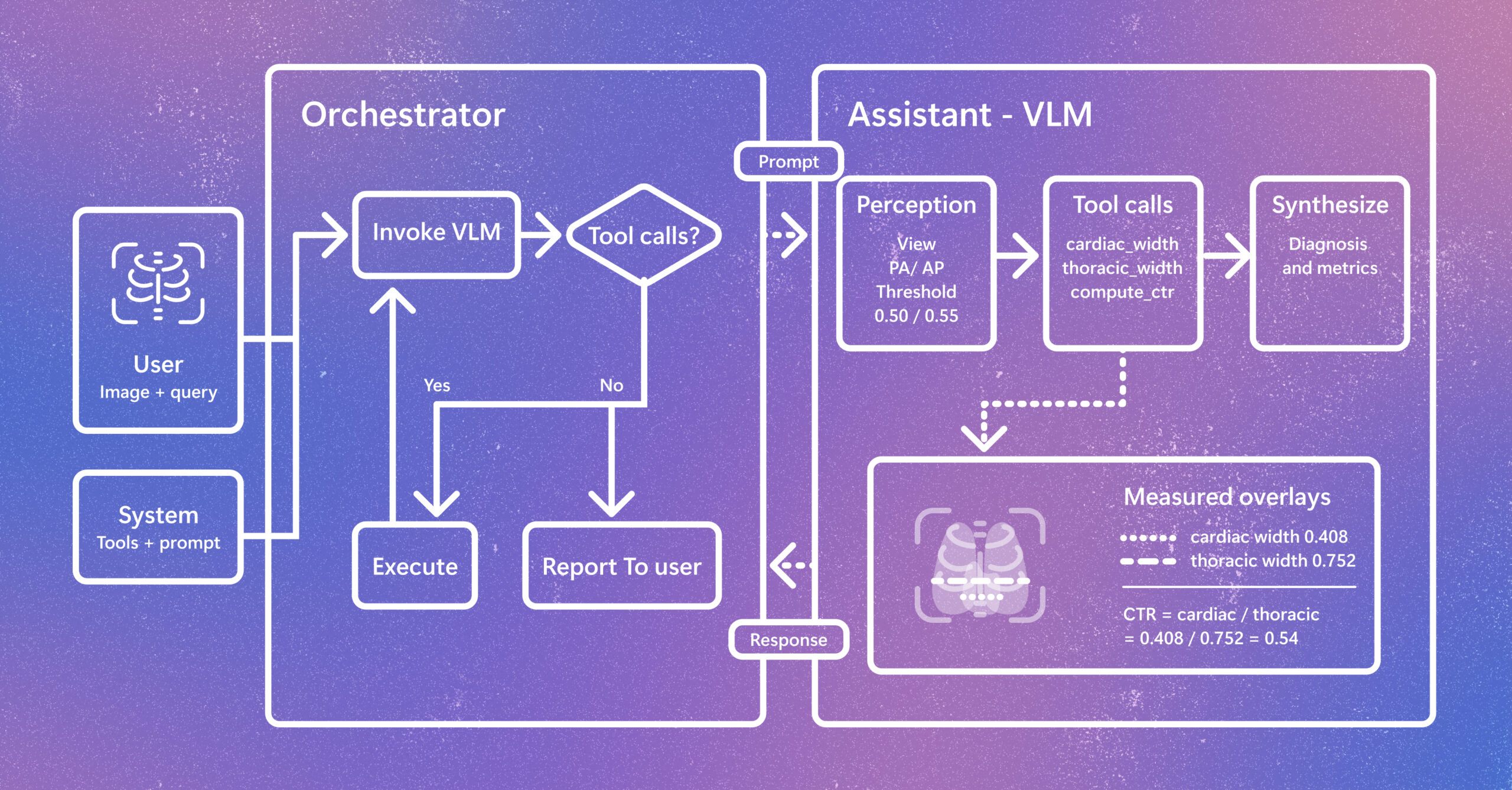
Radiology AI is evolving beyond report generation. CARE-X explores a unified approach that combines flexible reasoning, calibrated predictions, and measurement-based tools for chest X-ray interpretation. The post Introducing CARE-X: Towards Clinically Useful Radiology VLMs with Auxiliary Supervision, Reward-Aligned Learning, and Tool-Augmented Measurement appeared first on Microsoft Research.
Assistant Professor Benjamin Lindquist studies how engineers deliberately injected randomness into early AI, giving rise to deep-learning models that sometimes hallucinate.
We use cookies to run the site and, with your consent, for analytics and to show ads.
See our Cookie Policy.