Skip to content

Variational Filtering for Bayesian Last Layers with an Independent Binary Probit Surrogate

Oct 2026 · 0 citations · 36 references
Mathematics Computer Science

Abstract

Modern deep classifiers trained by gradient descent need many passes over the data to become accurate, and even then are not always well calibrated; post-hoc temperature scaling corrects calibration after training but cannot influence training-time accuracy or convergence. We propose a variational filtering algorithm for the last layer of deep classifiers, whose parameters are treated as the latent state of a linear-Gaussian state-space model. Each mini-batch is assimilated by an exact prediction step followed by a closed-form variational update, made conjugate by an independent binary probit (IBProbit) surrogate for the categorical likelihood. The filter's process noise stabilises the updates under feature drift and keeps the predictive distribution from collapsing to a point estimate, allowing the same procedure to be used for linear probing on a frozen backbone and for full-network fine-tuning. We evaluate on DINOv3 backbones against two baselines tuned under an identical protocol: AdamW with cross-entropy and post-hoc temperature scaling, and Variational Bayesian Last Layers (VBLL). As a linear probe on frozen features, IBProbit attains the best accuracy and negative log-likelihood on all five downstream tasks at the largest backbone, and on two of the five at the smallest. In out-of-distribution detection with CIFAR probes on the largest backbone, IBProbit reduces the false-positive rate at 95\% true-positive rate by a factor of 1.4 to 3.2 relative to the better of the two baselines, on all three dataset pairs. When the whole network is fine-tuned on ImageNet-1k, IBProbit reaches the final performance of the cross-entropy baseline in half the wall-clock time.


View source

Similar papers

#computer vision Review Sep 2017

Agile Software Development Methods: Review and Analysis

This publication proposes a definition and a classification of agile software development approaches and analyses ten software development methods that can be characterized as being "agile" against the defined criterion.

P. Abrahamsson, O. Salo, Jussi Ronkainen et al. · 727 citations · ⚡54
#computer vision Jun 2008

The impact of agile practices on communication in software development

The study shows that agile practices improve both informal and formal communication, but indicates that, in larger development situations involving multiple external stakeholders, a mismatch of adequate communication mechanisms can sometimes even hinder the communication.

M. Pikkarainen, Jukka Haikara, O. Salo et al. · 401 citations · ⚡48
#machine learning Review Open access Oct 2014

Software development in startup companies: A systematic mapping study

The results indicate that software engineering work practices are chosen opportunistically, adapted and configured to provide value under the constrains imposed by the startup context.

Nicolò Paternoster, Carmine Giardino, M. Unterkalmsteiner et al. · 394 citations · ⚡54

Diffusion models as plug-and-play priors

The possibility of inferring high-dimensional data inference in a model that consists of a prior and an auxiliary differentiable constraint given some additional information is considered, thereby allowing a range of potential applications in adapting models to new domains and tasks.

Alexandros Graikos, Esmeralda S. Whitammer, N. Jojic et al. · 316 citations · ⚡15

Trajectory Balance: Improved Credit Assignment in GFlowNets

It is proved that any global minimizer of the trajectory balance objective can define a policy that samples exactly from the target distribution, and empirically demonstrate the benefits of the trajectories balance objective for GFlowNet convergence, diversity of generated samples, and robustness to long action sequenc...

Esmeralda S. Whitammer, Moksh Jain, Emmanuel Bengio et al. · 302 citations · ⚡60

Related blog posts

Microsoft Research Blog Oct 6, 2026

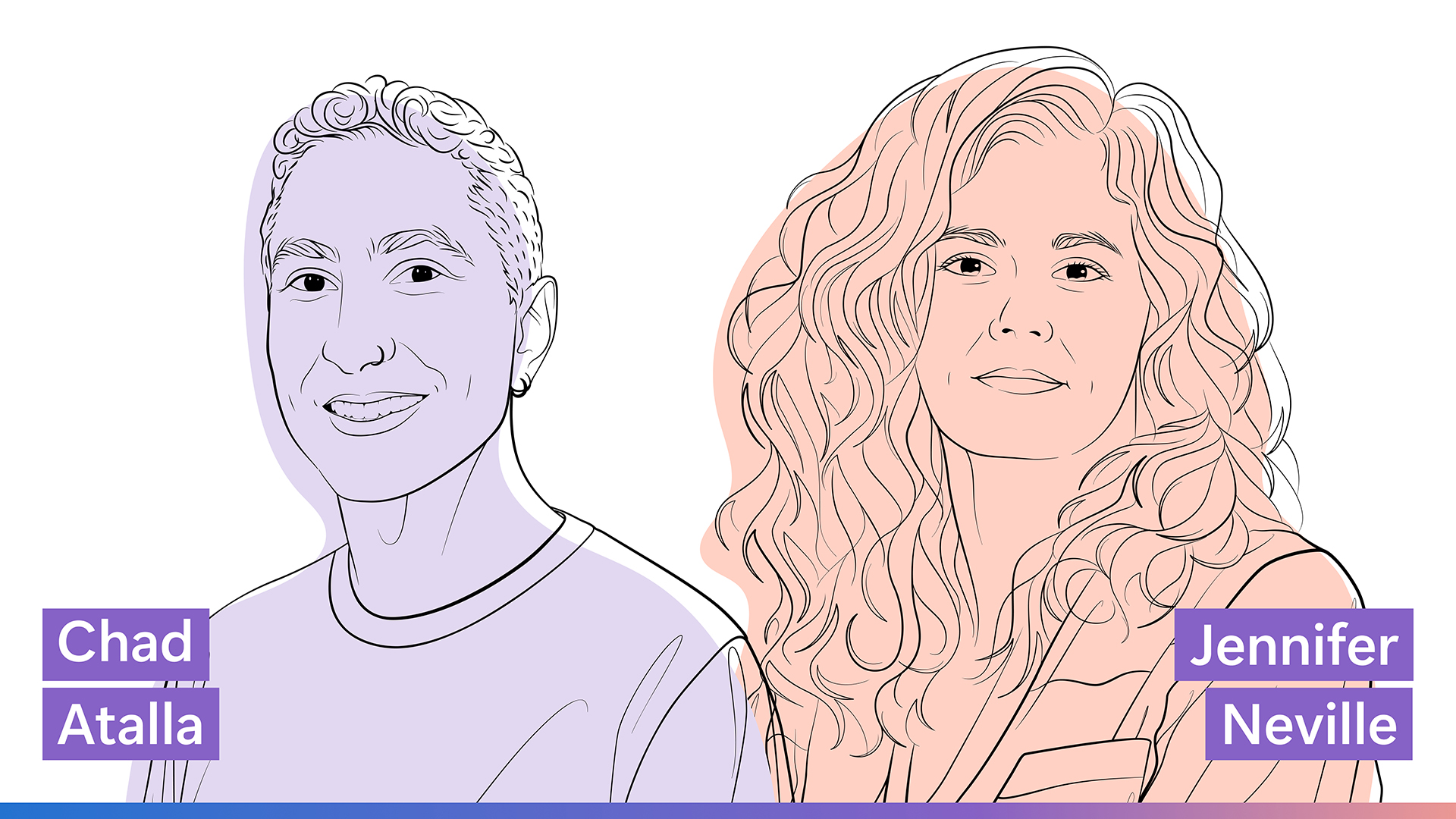
What AI gets wrong and what failure teaches us

Jennifer Neville did not want to go into computer science—but that’s exactly where she landed. Neville discusses the starts and stops that led to her professional sweet spot and her work identifying “surprising failures” making it hard for AI to handle complexity.  The post What AI gets wrong and what failure teaches us appeared first on Microsoft Research.

We use cookies to run the site and, with your consent, for analytics and to show ads. See our Cookie Policy.