Boundary delineation of anatomical structures in prostate MRI is often compromised by regional ambiguity. Automated segmentation methods relying on global overlap loss functions tend to be insensitive to surface deviations, leading to significant errors in ambiguous regions. Most existing uncertainty-aware methods treat uncertainty as a post-hoc quality indicator or prediction filter. We propose Contrastive Uncertainty Learning (CUL), a supervised framework that uses predictive uncertainty to directly guide representation learning. Using Monte Carlo Dropout, CUL identifies voxel-wise uncertainty and structures the embedding geometry accordingly: low-uncertainty, correctly predicted features form stable voxels while high-uncertainty or misclassified features are actively repelled, preventing feature collapse at difficult boundaries. We evaluate CUL on a 589-scan 3D prostate MRI multi-structure segmentation task (8 anatomical structures) using a ViT with UperNet decoder architecture. Average Dice ($83.38\%$) remains comparable to the baseline ($83.35\%$), while surface distance decreases significantly ($p<0.001$) across 6 of 8 anatomical structures. A hard-case analysis reveals a $22{\times}$ asymmetry between significantly improved and degraded cases ($18.8\%$ vs $0.9\%$). Ablation studies show that removing uncertainty-guided sample selection eliminates improvements for the transition zone, while replacing the contrastive objective with a boundary loss additionally removes bladder improvements, demonstrating that both uncertainty-guided sampling and the contrastive objective are essential for the observed gains. These findings demonstrate that the proposed uncertainty-guided representation learning is a useful mechanism for reducing the risk of extreme errors in safety-critical medical segmentation

This paper investigates developing real-world perception for active agents, proposes Gibson Environment for this purpose, and showcases a set of perceptual tasks learned therein.
F. Xia, Amir Zamir, Zhi-Yang He et al.· 2018 IEEE/CVF Conference on...· 1,069 citations· ⚡112
This publication proposes a definition and a classification of agile software development approaches and analyses ten software development methods that can be characterized as being "agile" against the defined criterion.
P. Abrahamsson, O. Salo, Jussi Ronkainen et al.· arXiv.org· 727 citations· ⚡54
The study shows that agile practices improve both informal and formal communication, but indicates that, in larger development situations involving multiple external stakeholders, a mismatch of adequate communication mechanisms can sometimes even hinder the communication.
M. Pikkarainen, Jukka Haikara, O. Salo et al.· Empirical Software Engineeri...· 401 citations· ⚡48
The results indicate that software engineering work practices are chosen opportunistically, adapted and configured to provide value under the constrains imposed by the startup context.
Nicolò Paternoster, Carmine Giardino, M. Unterkalmsteiner et al.· Information and Software Tec...· 394 citations· ⚡54
The possibility of inferring high-dimensional data inference in a model that consists of a prior and an auxiliary differentiable constraint given some additional information is considered, thereby allowing a range of potential applications in adapting models to new domains and tasks.
Alexandros Graikos, Esmeralda S. Whitammer, N. Jojic et al.· Neural Information Processin...· 316 citations· ⚡15
Related blog posts
MIT News · Artificial Intelligence· news.mit.eduOct 28, 2026
Professor Paris Smaragdis develops computers with superhuman hearing for applications like speech recognition, music understanding, and environmental monitoring.
Exploring how generative AI could make machine vision more accessible to businesses. The post GenEye in a Box: Making Machine Vision Something You Can Just Ask For appeared first on GPT-Lab.
Microsoft Research Blog· microsoft.comAug 11, 2026
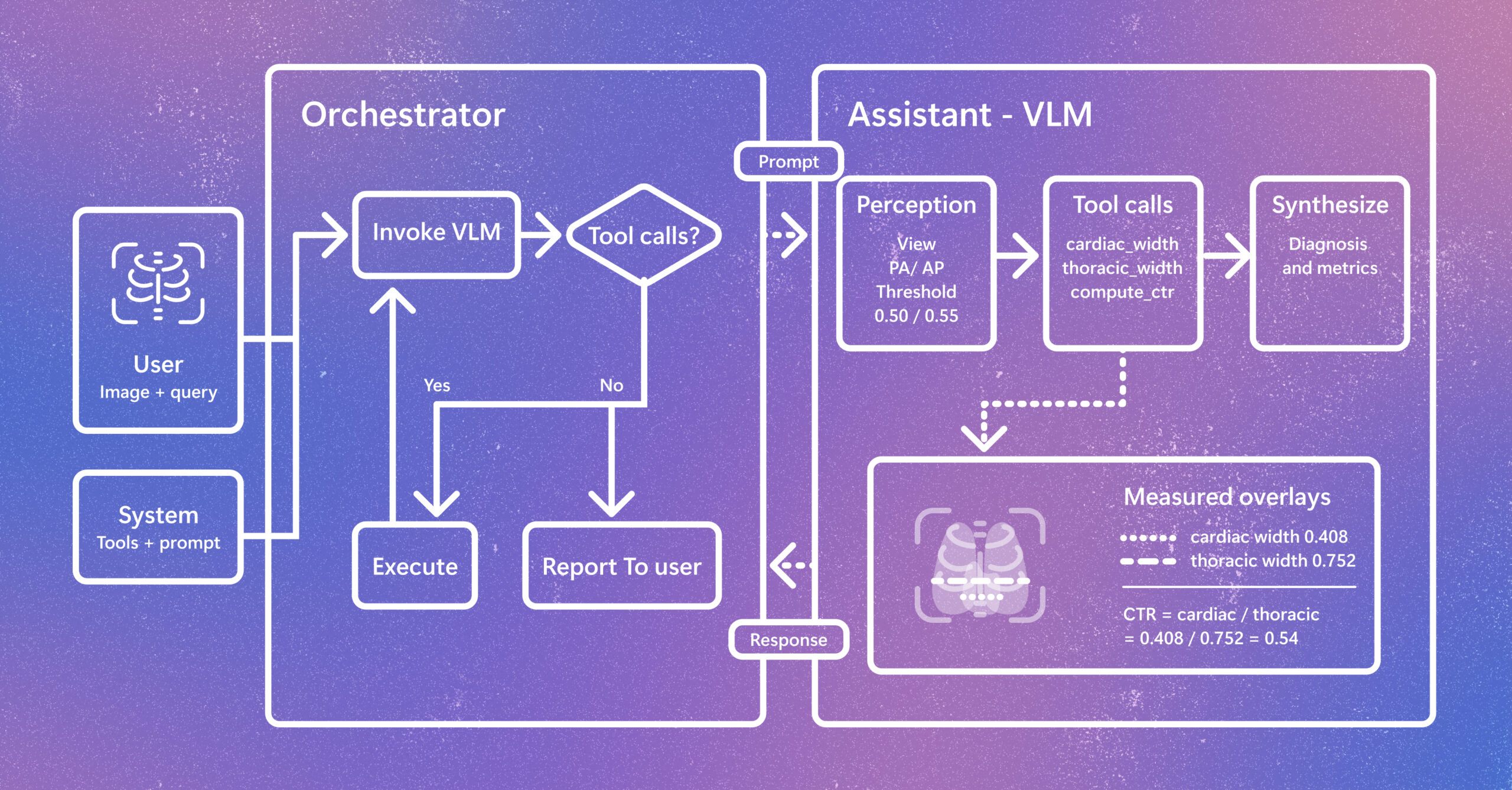
Radiology AI is evolving beyond report generation. CARE-X explores a unified approach that combines flexible reasoning, calibrated predictions, and measurement-based tools for chest X-ray interpretation. The post Introducing CARE-X: Towards Clinically Useful Radiology VLMs with Auxiliary Supervision, Reward-Aligned Learning, and Tool-Augmented Measurement appeared first on Microsoft Research.