Rule-based and reinforcement-learning policies for resource allocation in a pediatric echo lab: a simulation study
Bozhi SunSeda TierneyJeffrey A. FeinsteinFrederick DamenAlison L. MarsdenDaniele E. Schiavazzi
Oct 2026
Artificial IntelligenceMachine Learning
Abstract
Scheduling echocardiographic examinations in a hospital setting presents significant challenges due to non-deterministic factors such as patient no-shows, variable arrival times, and heterogeneous exam durations, as well as asymmetric resource constraints between fetal and non-fetal patient streams. Fetal cases involve specialized ultrasound examinations performed during pregnancy, whereas non-fetal cases correspond to general diagnostic echocardiography services. Using one week (184 patients) of operational data from the Echo Laboratory at Stanford University's Lucile Packard Children's Hospital, we estimate patient no-show probabilities and derive empirical distributions of arrival times and exam durations, and use them to build a discrete-event stochastic simulation model using SimPy, exposed through an open-source Gymnasium interface (https://github.com/desResLab/echo_rl). As a baseline for policy optimization, we systematically compare two scheduling paradigms: on-the-fly allocation, in which patients are served according to their arrival time without prior reservations, and reservation-based allocation, in which varying proportions of resources are preassigned. We consider a hospital with seven ultrasound rooms (one equipped for both fetal and non-fetal exams, six for non-fetal exams only) and six sonographers (four qualified for both exam types, two for non-fetal exams only). In this setting, on-the-fly allocation markedly reduces the average patient waiting time compared with every reservation-based configuration tested. Building on this foundation, we train a Dueling Double Deep Q-Network (DQN) with prioritized experience replay to approximate an optimal dynamic on-the-fly allocation policy. The learned RL policy is comparable to, but does not outperform, the best on-the-fly rule-based policy.

This paper investigates developing real-world perception for active agents, proposes Gibson Environment for this purpose, and showcases a set of perceptual tasks learned therein.
F. Xia, Amir Zamir, Zhi-Yang He et al.· 2018 IEEE/CVF Conference on...· 1,069 citations· ⚡112
The results indicate that software engineering work practices are chosen opportunistically, adapted and configured to provide value under the constrains imposed by the startup context.
Nicolò Paternoster, Carmine Giardino, M. Unterkalmsteiner et al.· Information and Software Tec...· 394 citations· ⚡54
The possibility of inferring high-dimensional data inference in a model that consists of a prior and an auxiliary differentiable constraint given some additional information is considered, thereby allowing a range of potential applications in adapting models to new domains and tasks.
Alexandros Graikos, Esmeralda S. Whitammer, N. Jojic et al.· Neural Information Processin...· 316 citations· ⚡15
It is proved that any global minimizer of the trajectory balance objective can define a policy that samples exactly from the target distribution, and empirically demonstrate the benefits of the trajectories balance objective for GFlowNet convergence, diversity of generated samples, and robustness to long action sequenc...
Esmeralda S. Whitammer, Moksh Jain, Emmanuel Bengio et al.· Neural Information Processin...· 302 citations· ⚡60
GAOKAO-Bench is introduced, an intuitive benchmark that employs questions from the Chinese GAOKAO examination as test samples, including both subjective and objective questions that contribute a robust evaluation benchmark for future large language models and offers valuable insights into the advantages and limitations...
Xiaotian Zhang, Chun-yan Li, Yi Zong et al.· arXiv.org· 216 citations· ⚡17
An algorithm is proposed which leverages disentangled semantic factors to generate adversarial perturbation by altering controlled semantic attributes to fool the learner towards various "adversarial" targets.
Haonan Qiu, Chaowei Xiao, Lei Yang et al.· arXiv.org· 208 citations· ⚡17
Related blog posts
MIT News · Artificial Intelligence· news.mit.eduOct 13, 2026
Machine-learning networks can learn without detailed instructions from a designer. Those that do may offer insight into how the brain reorganizes itself during learning.
MIT News · Artificial Intelligence· news.mit.eduSep 29, 2026
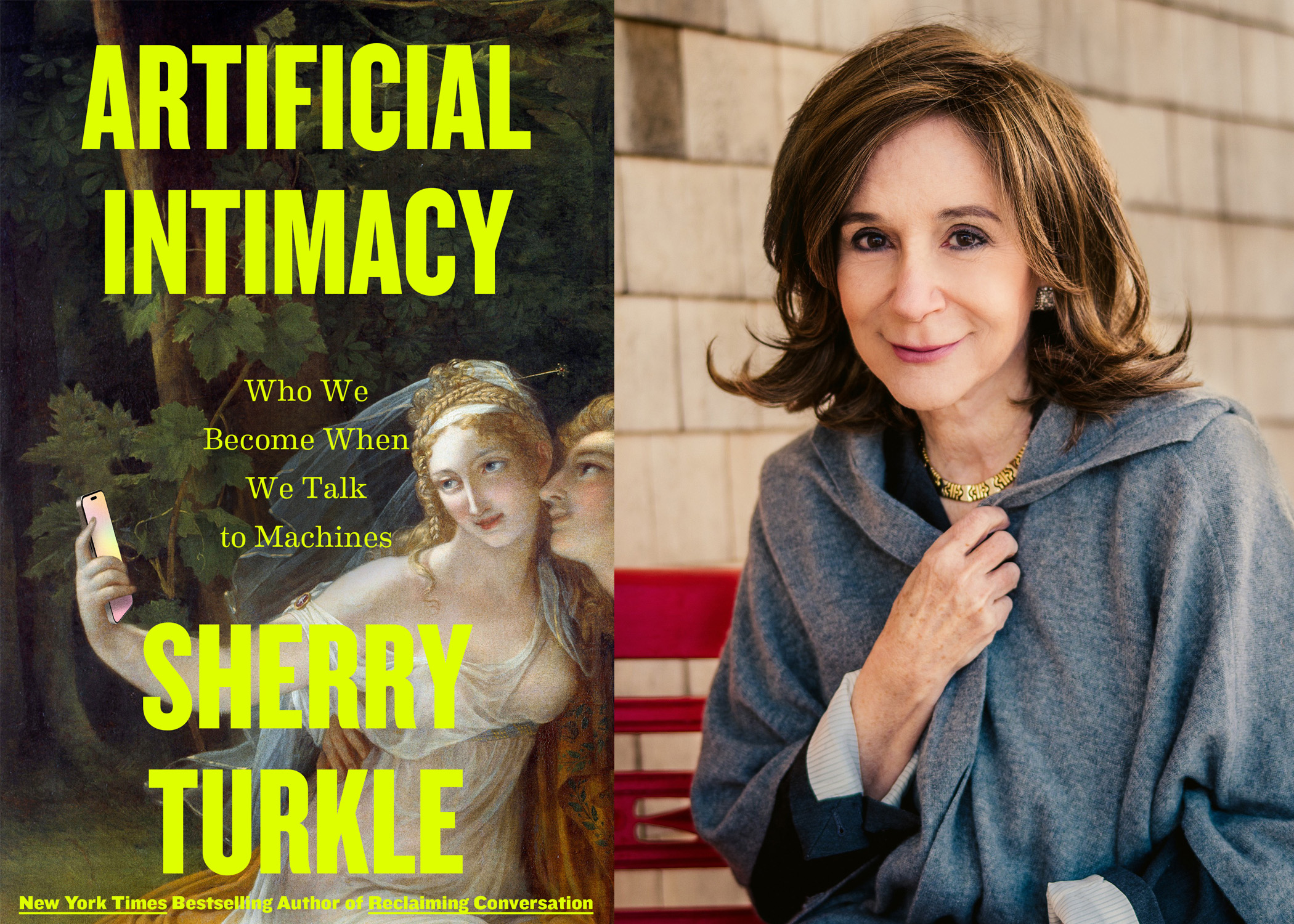
Professor Sherry Turkle’s new book, “Artificial Intimacy,” offers a withering critique of chatbots and the antisocial dynamics she believes they encourage.