May 2026· arXiv.org· Vol abs/2605.07191· 3 citations· 60 references
Computer Science
TL;DR
A comprehensive benchmark of 20 teachers from 11 well-known ViT families reveals that Attention Transfer is not universally effective, and identifies architectural mismatch between the pre-trained teacher and the standard student as the primary mechanism.
Abstract
A recent work shows that Attention Transfer, which transfers only the attention patterns from a pre-trained teacher Vision Transformer (ViT) to a randomly initialized standard student ViT, is sufficient to recover the full benefit of the teacher's pre-trained weights. We revisit this finding on a comprehensive benchmark of 20 teachers from 11 well-known ViT families and reveal that Attention Transfer is not universally effective. While 7 families transfer successfully, 4 consistently fail, falling up to 5.1\% below the from-scratch no-transfer baseline. Further results demonstrate that this failure is family-consistent across model sizes, and persists under extended training durations, different transfer datasets, and out-of-distribution evaluations. Controlled analyses then consistently localize the problem to the attention-routing channel, indicating that the key issue is not whether the student can match the teacher's attention patterns, but whether the matched patterns remain functional for the student. Crucially, we identify architectural mismatch between the pre-trained teacher and the standard student as the primary mechanism. By adding only the teacher's native architectural components to the student in a randomly initialized state, we completely reverse the failure for all 4 families. Notably, these components alone do not improve from-scratch training, confirming that they specifically unlock the usability of the teacher's attention. We further show that this failure is not explained by the inadequate choice of transfer loss, differences in pre-training recipes, or the intrinsic quality of attention maps. Our findings refine the prevailing understanding of attention in ViT representations: attention is sufficient \textit{only} when the student architecture matches the teacher.

This publication proposes a definition and a classification of agile software development approaches and analyses ten software development methods that can be characterized as being "agile" against the defined criterion.
P. Abrahamsson, O. Salo, Jussi Ronkainen et al.· arXiv.org· 727 citations· ⚡54
The study shows that agile practices improve both informal and formal communication, but indicates that, in larger development situations involving multiple external stakeholders, a mismatch of adequate communication mechanisms can sometimes even hinder the communication.
M. Pikkarainen, Jukka Haikara, O. Salo et al.· Empirical Software Engineeri...· 401 citations· ⚡48
The results indicate that software engineering work practices are chosen opportunistically, adapted and configured to provide value under the constrains imposed by the startup context.
Nicolò Paternoster, Carmine Giardino, M. Unterkalmsteiner et al.· Information and Software Tec...· 394 citations· ⚡54
The possibility of inferring high-dimensional data inference in a model that consists of a prior and an auxiliary differentiable constraint given some additional information is considered, thereby allowing a range of potential applications in adapting models to new domains and tasks.
Alexandros Graikos, Esmeralda S. Whitammer, N. Jojic et al.· Neural Information Processin...· 316 citations· ⚡15
Exploring how generative AI could make machine vision more accessible to businesses. The post GenEye in a Box: Making Machine Vision Something You Can Just Ask For appeared first on GPT-Lab.
Microsoft Research Blog· microsoft.comAug 11, 2026
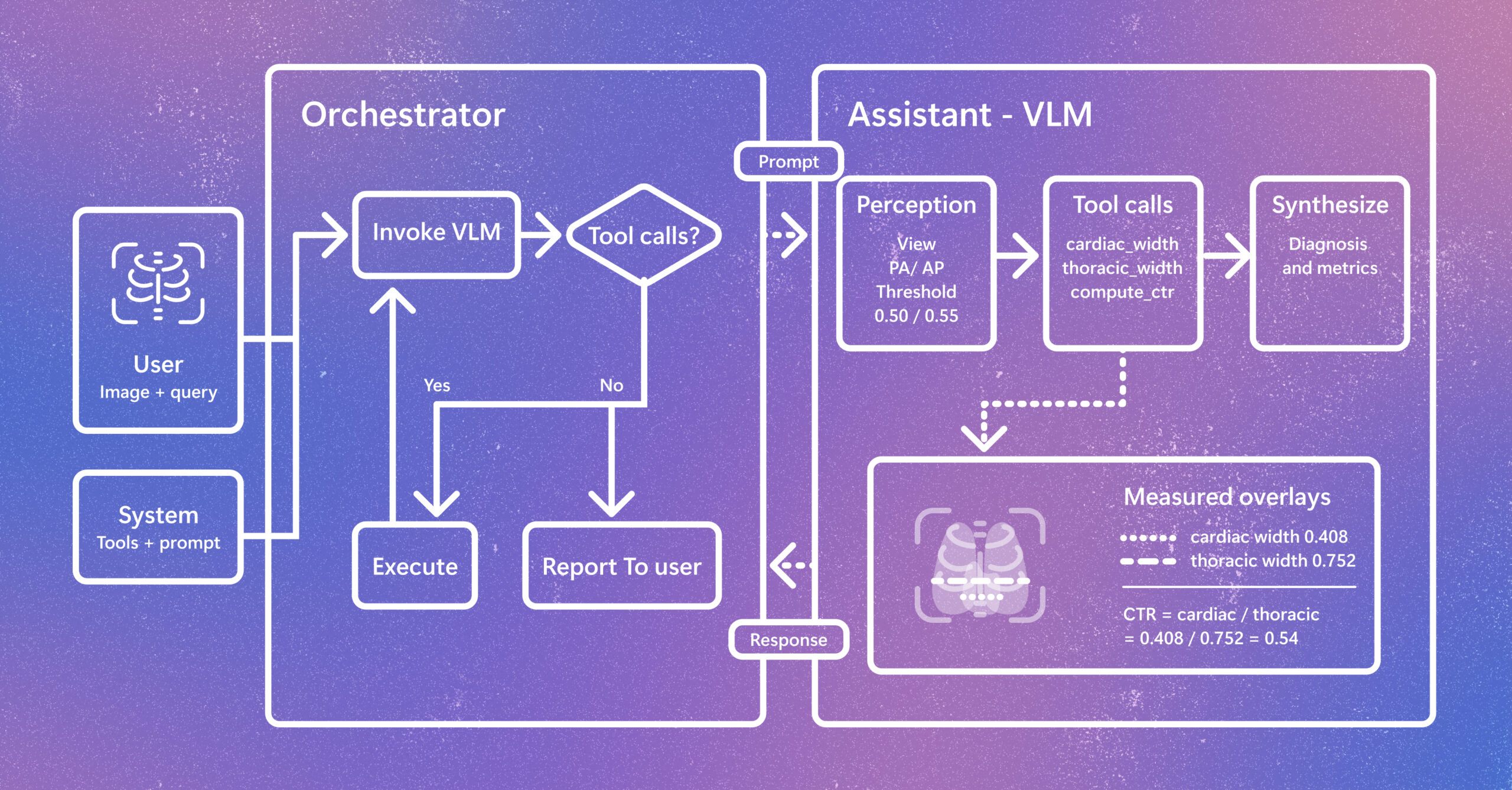
Radiology AI is evolving beyond report generation. CARE-X explores a unified approach that combines flexible reasoning, calibrated predictions, and measurement-based tools for chest X-ray interpretation. The post Introducing CARE-X: Towards Clinically Useful Radiology VLMs with Auxiliary Supervision, Reward-Aligned Learning, and Tool-Augmented Measurement appeared first on Microsoft Research.
Assistant Professor Benjamin Lindquist studies how engineers deliberately injected randomness into early AI, giving rise to deep-learning models that sometimes hallucinate.
We use cookies to run the site and, with your consent, for analytics and to show ads.
See our Cookie Policy.