Can the Parts Fool the Test? Counterfactual Pairing Cycles for Relational OOD
Yibo ZhouYirong Xiang
Oct 2026
Machine LearningComputer Vision
Abstract
Relational out-of-distribution errors are easy to describe and hard to evaluate cleanly. An image may be natural, a caption may be fluent, and all mentioned objects may be common, yet the caption may describe the wrong relation in the image. Many evaluations intended to test this behavior can be solved without checking the pairing at all, because negatives differ in caption style, template, length, object frequency, or image statistics. We propose counterfactual pairing cycles, a blocked evaluation primitive that reuses the same two images and the same two captions on both sides of the comparison, changing only which image is paired with which caption. This makes image-only, text-only, and additive component shortcuts cancel exactly in finite samples. The same contrast also gives a training loss for relational outlier exposure and a diagnostic for bilinear vision-language scores. Across synthetic controls, GQA, and COCO, cycles separate coarse image-caption matching from directional role-binding failures, while also identifying geometric size relations that remain strongly visible in global features. In a shortcut-contaminated COCO outlier-exposure stress test, a model selected by a near-perfect shortcut validation AUROC retains substantial relational signal but remains below cycle training on exact cycles; cycle training improves CycleAcc from 0.882 to 0.927. The main lesson is simple: to test whether a model understands a pairing, the benchmark should keep the parts fixed, change the pairing, and ask only about coupling. The official implementation is available online.

This publication proposes a definition and a classification of agile software development approaches and analyses ten software development methods that can be characterized as being "agile" against the defined criterion.
P. Abrahamsson, O. Salo, Jussi Ronkainen et al.· arXiv.org· 727 citations· ⚡54
The study shows that agile practices improve both informal and formal communication, but indicates that, in larger development situations involving multiple external stakeholders, a mismatch of adequate communication mechanisms can sometimes even hinder the communication.
M. Pikkarainen, Jukka Haikara, O. Salo et al.· Empirical Software Engineeri...· 401 citations· ⚡48
The results indicate that software engineering work practices are chosen opportunistically, adapted and configured to provide value under the constrains imposed by the startup context.
Nicolò Paternoster, Carmine Giardino, M. Unterkalmsteiner et al.· Information and Software Tec...· 394 citations· ⚡54
The possibility of inferring high-dimensional data inference in a model that consists of a prior and an auxiliary differentiable constraint given some additional information is considered, thereby allowing a range of potential applications in adapting models to new domains and tasks.
Alexandros Graikos, Esmeralda S. Whitammer, N. Jojic et al.· Neural Information Processin...· 316 citations· ⚡15
Exploring how generative AI could make machine vision more accessible to businesses. The post GenEye in a Box: Making Machine Vision Something You Can Just Ask For appeared first on GPT-Lab.
Microsoft Research Blog· microsoft.comAug 11, 2026
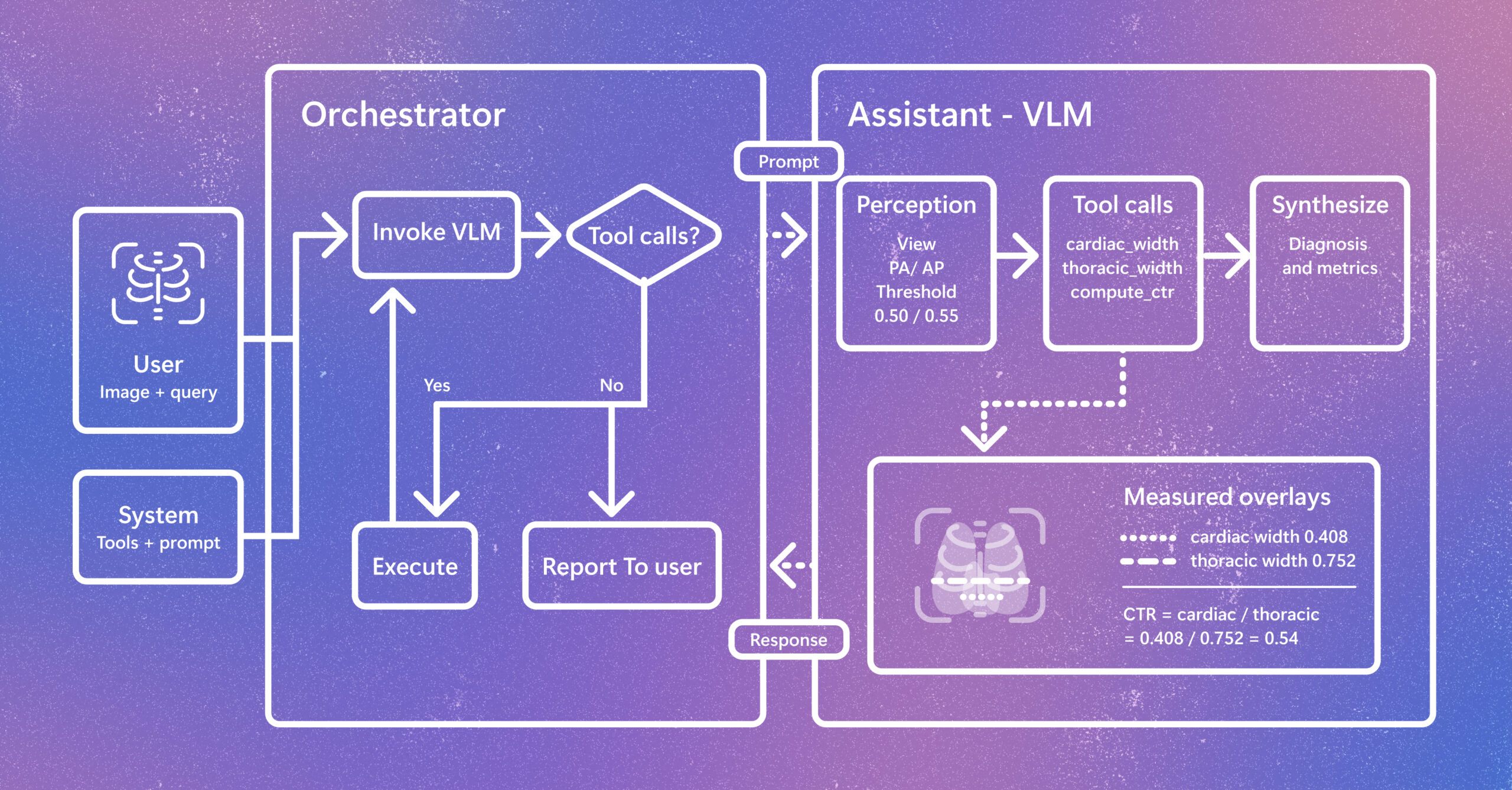
Radiology AI is evolving beyond report generation. CARE-X explores a unified approach that combines flexible reasoning, calibrated predictions, and measurement-based tools for chest X-ray interpretation. The post Introducing CARE-X: Towards Clinically Useful Radiology VLMs with Auxiliary Supervision, Reward-Aligned Learning, and Tool-Augmented Measurement appeared first on Microsoft Research.