Quality inspection of sugar beets after harvest and storage is critical to preserve sugar content and ensure optimal processing efficiency. The transfer of harvested beets to field clamps or trucks provides an opportunity to visually inspect individual beets automatically on loader conveyors. However, this is a challenging task as the large number of beets causes partial overlap and occlusion, complicating both annotation and detection. In this work, we propose an end-to-end image-based pipeline for detecting partially occluded sugar beets in loading scenarios as a first step toward automated quality inspection. We introduce a dedicated benchmark and present an automatic annotation strategy that leverages the SAM 3 foundation model to generate bounding boxes. We compare models trained on manually annotated and automatically generated labels. Additionally, we investigate deployment considerations by benchmarking multiple inference configurations, including execution on an edge device, under realistic operational constraints regarding precision, inference time and power consumption. Our results show that, despite substantial occlusion and inherent annotation ambiguity, foundation-model-based labels can substitute for a substantial share of manual annotation, trading labeling effort for data volume at a modest accuracy cost. Furthermore, we demonstrate that a Raspberry Pi 5 equipped with a Hailo accelerator enables high-performance, low-power inference, making it a practical solution for mobile outdoor deployment.

This paper investigates developing real-world perception for active agents, proposes Gibson Environment for this purpose, and showcases a set of perceptual tasks learned therein.
F. Xia, Amir Zamir, Zhi-Yang He et al.· 2018 IEEE/CVF Conference on...· 1,069 citations· ⚡112
This publication proposes a definition and a classification of agile software development approaches and analyses ten software development methods that can be characterized as being "agile" against the defined criterion.
P. Abrahamsson, O. Salo, Jussi Ronkainen et al.· arXiv.org· 727 citations· ⚡54
The study shows that agile practices improve both informal and formal communication, but indicates that, in larger development situations involving multiple external stakeholders, a mismatch of adequate communication mechanisms can sometimes even hinder the communication.
M. Pikkarainen, Jukka Haikara, O. Salo et al.· Empirical Software Engineeri...· 401 citations· ⚡48
The results indicate that software engineering work practices are chosen opportunistically, adapted and configured to provide value under the constrains imposed by the startup context.
Nicolò Paternoster, Carmine Giardino, M. Unterkalmsteiner et al.· Information and Software Tec...· 394 citations· ⚡54
The possibility of inferring high-dimensional data inference in a model that consists of a prior and an auxiliary differentiable constraint given some additional information is considered, thereby allowing a range of potential applications in adapting models to new domains and tasks.
Alexandros Graikos, Esmeralda S. Whitammer, N. Jojic et al.· Neural Information Processin...· 316 citations· ⚡15
Related blog posts
MIT News · Artificial Intelligence· news.mit.eduOct 28, 2026
Professor Paris Smaragdis develops computers with superhuman hearing for applications like speech recognition, music understanding, and environmental monitoring.
Exploring how generative AI could make machine vision more accessible to businesses. The post GenEye in a Box: Making Machine Vision Something You Can Just Ask For appeared first on GPT-Lab.
Microsoft Research Blog· microsoft.comAug 11, 2026
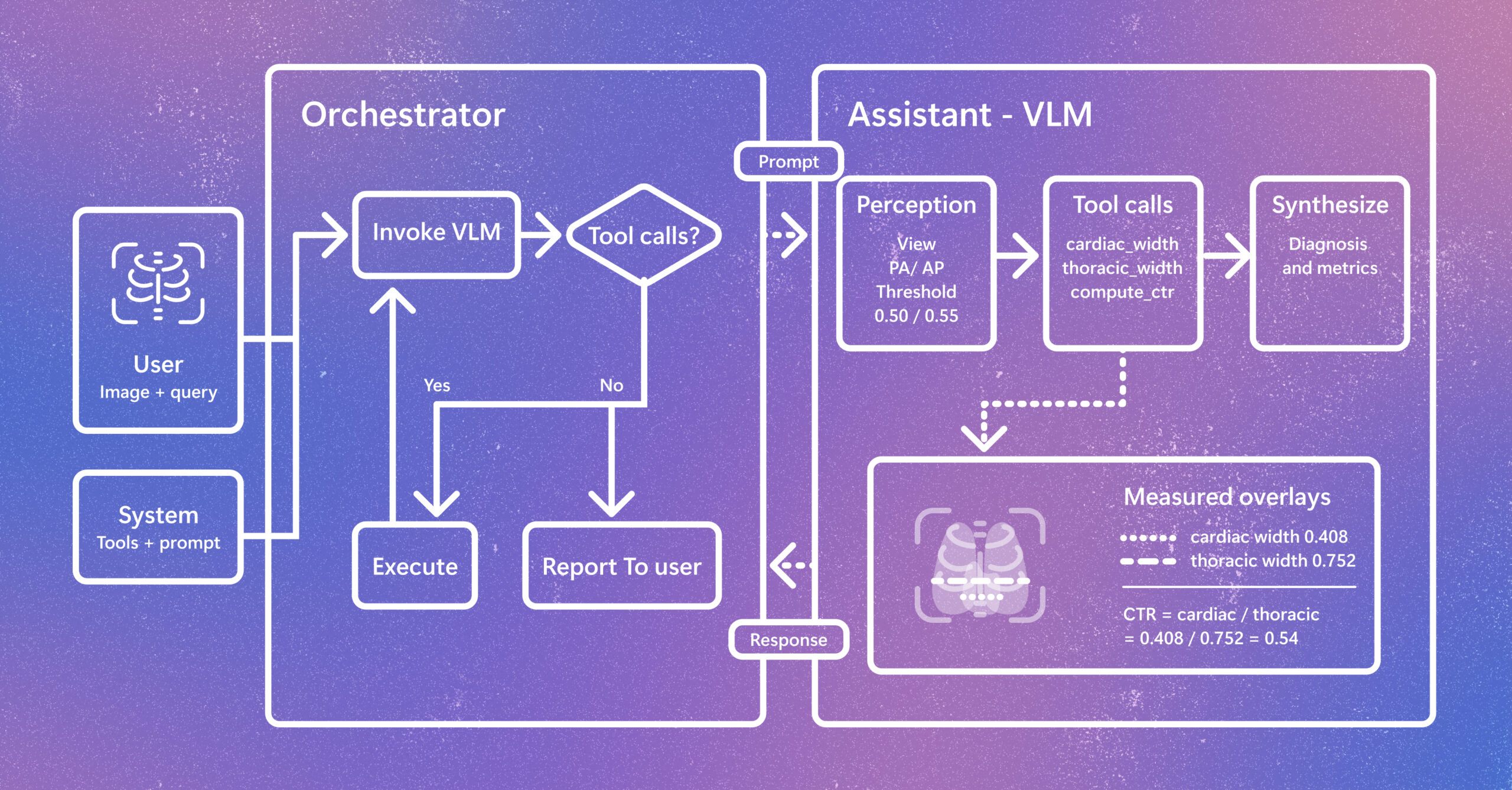
Radiology AI is evolving beyond report generation. CARE-X explores a unified approach that combines flexible reasoning, calibrated predictions, and measurement-based tools for chest X-ray interpretation. The post Introducing CARE-X: Towards Clinically Useful Radiology VLMs with Auxiliary Supervision, Reward-Aligned Learning, and Tool-Augmented Measurement appeared first on Microsoft Research.