Skip to content
#explainable ai Book Open access

rCamInspector: Building Reliability and Trust on IoT (Spy) Camera Detection using XAI

Nov 2026 · Proceedings of the 3rd Workshop on Trusted Computing and Artificial Intelligence applied to Cybersecurity · 0 citations · 7 references

Abstract

The classification of network traffic using machine learning (ML) models has become popular to address the security issues in IoT networks and/or IoT devices. However, the classifiers often act as black-boxes which hinders its adoption in critical decision making. To address this problem, we design and develop a system, called rCamInspector, that employs Explainable AI (XAI) to generate reliable and trustworthy explanations for the model outputs. It adopts two classifiers, Flow Classifier and SmartCam Classifier; both of them are IP address and transport port agnostic. rCamInspector is evaluated using a total of 38 GB network traffic collected over 72 hours. Our results show that Extreme Gradient Boosting (XGB) achieves the highest accuracy of 92% and 99% in the Flow and Smart-Cam classifiers respectively, among eight supervised ML models. We empirically show that the traditional mutual information (MI) based important features in XGB remain almost same in either classifier. Using SHAP and LIME, we show that the most important features in Flow Classifier are significantly different from those in the SmartCam Classifier for the correct prediction using XGB. To evaluate the faithfulness of SHAP and LIME on the dataset, we show that both have a consistency of more than 0.7 and a sufficiency of 1.0. Compared to the existing works, rCamInspector achieves a better accuracy (99%), precision (99%), and false negative rate (0.7%), supported by the XAI for the predictions.

Read PDF

Similar papers

Open access Sep 2026

Ensemble Shields: Optimizing DDoS Detection in IoT Networks Using Machine Learning

DDoS (Distributed Denial-of-Service) attacks are significant cyber threats that affect network infrastructures and cause massive service disruption. DDoS attacks have become even more threatening, owing to the poor security of IoT devices. This paper proposes two ensemble approaches: (1) Optimized Ensemble Stacking App...

Abdul Ghani Ansari, F. Jokhio, A. Arain · 0 citations
Open access Oct 2026

Explainable AI-driven IoT botnet detection for 6G networks

This study proposes an explainable AI-driven IoT botnet detection framework utilizing the N-BaIoT dataset to bridge the gap between high detection precision and human-interpretable reasoning, fulfilling essential trust and reliability requirements for next-generation 6G IoT security architectures.

M. Güllü, Ercan Atagün, Serdar Biroğul et al. · 0 citations
Open access Sep 2026

An Efficient IDS For Iot Security Using Ensemble Machine Learning

Internet-of-Things (IoT) is gaining popularity because of its ability to interconnect a variety of devices which can exchange data with ease. However, its pervasiveness makes it vulnerable to security threats posed by intruders. Therefore, building robust Intrusion Detection Systems (IDS) to protect IoT components from...

Samir Kumar Patro, Chinmaya Ku. Nayak, Ashalata Panigrahi · 0 citations
Open access Jun 2023

Machine Learning Based Classification of IoT Traffic

With the rapid expansion and widespread adoption of the Internet of Things (IoT), maintaining secure connections among active devices can be challenging. Since IoT devices are limited in power and storage, they cannot perform complex tasks, which makes them vulnerable to different types of attacks. Given the volume of...

B. Velichkovska, A. Cholakoska, V. Atanasovski · 8 citations
Open access Oct 2026

Implementation and Web Deployment of an Anomaly Detection System for IoT Environments Using the CRISP-ML(Q) Methodology

The expansion of the Internet of Things (IoT) has intensified cyber risk in Edge deployments with limited computational resources, where conventional intrusion detection systems are unfeasible. Aiming to reduce this gap, a lightweight anomaly detection system for IoT networks has been designed and implemented, structur...

Fernando Gutiérrez-Portela, Oscar Augusto Diaz Triana, A. Yule et al. · 0 citations

Related blog posts

Microsoft Research Blog Nov 16, 2026

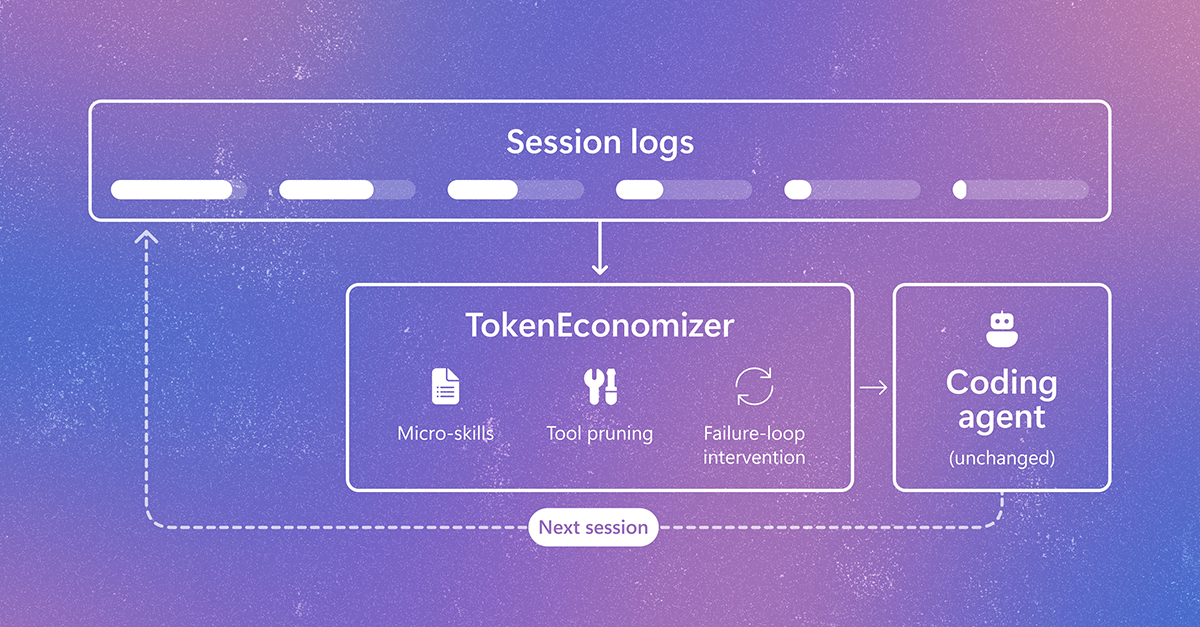
TokenEconomizer: Learning from Experience to Make AI Coding Agents More Efficient

AI coding agents are increasingly help developers fix bugs and build features largely on their own, but every interaction with their models consumes tokens. In each session, an agent sends instructions, tool descriptions, and session history to its model. Most efforts to reduce this cost focus on individual tasks. Yet developers return to the same […] The post TokenEconomizer: Learning from Experience to Make AI Coding Agents More Efficient appeared first on Microsoft Research.

GPT-Lab Nov 13, 2026

TenderIntell at ICSOB 2026: Three Days in Gothenburg

At ICSOB 2026 in Gothenburg, we presented TenderIntell, our work on multi-agent support for tendering. This post looks back at the conference, the idea behind a panel of three AI reviewers who score each proposal independently, and why evaluating agents reliably is the question we keep coming back to. The post TenderIntell at ICSOB 2026: Three Days in Gothenburg appeared first on GPT-Lab.

MIT News · Artificial Intelligence Nov 13, 2026

Helping robots fit into the human workplace

Founded by Anthony Jules ’92, SM ’92 and Professor Emeritus Rodney Brooks, Robust AI’s robots are designed to collaborate with humans in factories and warehouses.

We use cookies to run the site and, with your consent, for analytics and to show ads. See our Cookie Policy.