Federated Learning (FL) enables collaborative training of machine learning models across distributed clients while preserving data privacy. In practical deployments, FL relies on selecting a subset of clients in each communication round to reduce communication cost, mitigate stragglers, and improve training efficiency under heterogeneous data and system conditions. In heterogeneous edge computing environments, both statistical heterogeneity and system heterogeneity significantly affect convergence efficiency and model performance. However, existing client selection methods often address these factors independently, overlooking their coupled and dynamic impact across communication rounds. To address this limitation, we propose FedCSGA, a Client Selection method for Federated learning based on a Genetic Algorithm. FedCSGA encodes client subsets as chromosomes and evaluates these subsets through a non-linear fitness function that jointly integrates resource-aware metrics and history-aware participation weighting. This design captures subset-level interactions, mitigates persistent selection bias, and balances statistical utility with system efficiency. Extensive experiments on FMNIST, CIFAR-10, CIFAR- 100, and Tiny-ImageNet demonstrate that FedCSGA consistently outperforms state-of-the-art baselines across diverse heterogeneity settings, achieving accuracy improvements of up to 7.0% and faster convergence with fewer communication rounds. These results validate the effectiveness of jointly modeling statistical and system factors to achieve robust and efficient learning in heterogeneous federated environments.

This paper investigates developing real-world perception for active agents, proposes Gibson Environment for this purpose, and showcases a set of perceptual tasks learned therein.
F. Xia, Amir Zamir, Zhi-Yang He et al.· 2018 IEEE/CVF Conference on...· 1,069 citations· ⚡112
This publication proposes a definition and a classification of agile software development approaches and analyses ten software development methods that can be characterized as being "agile" against the defined criterion.
P. Abrahamsson, O. Salo, Jussi Ronkainen et al.· arXiv.org· 727 citations· ⚡54
The study shows that agile practices improve both informal and formal communication, but indicates that, in larger development situations involving multiple external stakeholders, a mismatch of adequate communication mechanisms can sometimes even hinder the communication.
M. Pikkarainen, Jukka Haikara, O. Salo et al.· Empirical Software Engineeri...· 401 citations· ⚡48
The results indicate that software engineering work practices are chosen opportunistically, adapted and configured to provide value under the constrains imposed by the startup context.
Nicolò Paternoster, Carmine Giardino, M. Unterkalmsteiner et al.· Information and Software Tec...· 394 citations· ⚡54
The possibility of inferring high-dimensional data inference in a model that consists of a prior and an auxiliary differentiable constraint given some additional information is considered, thereby allowing a range of potential applications in adapting models to new domains and tasks.
Alexandros Graikos, Esmeralda S. Whitammer, N. Jojic et al.· Neural Information Processin...· 316 citations· ⚡15
Related blog posts
MIT News · Artificial Intelligence· news.mit.eduOct 28, 2026
Professor Paris Smaragdis develops computers with superhuman hearing for applications like speech recognition, music understanding, and environmental monitoring.
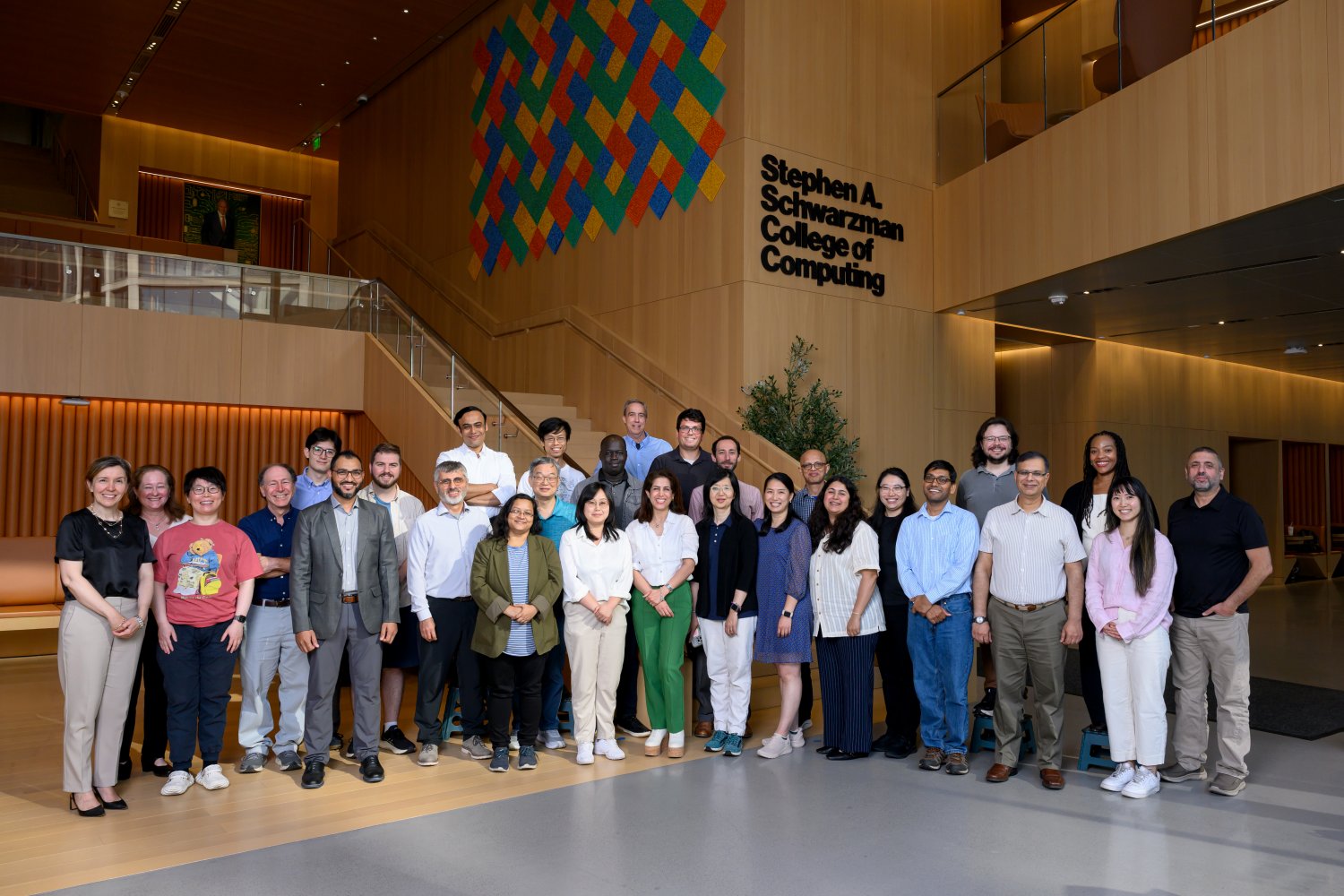
A weeklong summer workshop brought higher education faculty to campus to explore how AI and machine learning materials can be adapted for their classrooms.
We use cookies to run the site and, with your consent, for analytics and to show ads.
See our Cookie Policy.