Radial Basis Function Networks as Projection Heads in Self-Supervised Learning
Andreas SchliebitzHeiko TapkenMartin Atzmueller
Nov 2026
Machine LearningComputer Vision
Abstract
Self-supervised learning (SSL) typically relies on a backbone encoder followed by a small multilayer perceptron (MLP) projection head, which is conventionally discarded after training, while backbone quality is assessed via costly linear probing on labeled data. We argue that this approach including discarding the projector is rather computationally wasteful. Instead, we propose replacing the MLP head with a radial basis function network (RBFN), whose interpretable center and shape parameters can be exploited to judge representation quality without labels or a separate classifier. To this end, we introduce Scale-Normalized Separation (SNS), a novel label-free quality metric derived solely from the kernel centers and shapes learned during training. Across five canonical SSL architectures (MoCo, SimCLR, BYOL, SwAV and SimSiam) and four image classification datasets, we show that RBFN projection heads are competitive drop-in replacements for standard MLP projectors. We recommend constructing them with three RBF layers activated by the Gaussian radial basis function. Moreover, SNS exhibits strong to very strong positive correlation with established logistic regression metrics, demonstrating that a trained RBFN projector can act as a reliable proxy for backbone representation quality. We additionally publish a novel PyTorch compatible image classification dataset based on Google's Open Images V7 to facilitate reproducible research into representation learning.

This paper investigates developing real-world perception for active agents, proposes Gibson Environment for this purpose, and showcases a set of perceptual tasks learned therein.
F. Xia, Amir Zamir, Zhi-Yang He et al.· 2018 IEEE/CVF Conference on...· 1,069 citations· ⚡112
This publication proposes a definition and a classification of agile software development approaches and analyses ten software development methods that can be characterized as being "agile" against the defined criterion.
P. Abrahamsson, O. Salo, Jussi Ronkainen et al.· arXiv.org· 727 citations· ⚡54
The study shows that agile practices improve both informal and formal communication, but indicates that, in larger development situations involving multiple external stakeholders, a mismatch of adequate communication mechanisms can sometimes even hinder the communication.
M. Pikkarainen, Jukka Haikara, O. Salo et al.· Empirical Software Engineeri...· 401 citations· ⚡48
The results indicate that software engineering work practices are chosen opportunistically, adapted and configured to provide value under the constrains imposed by the startup context.
Nicolò Paternoster, Carmine Giardino, M. Unterkalmsteiner et al.· Information and Software Tec...· 394 citations· ⚡54
The possibility of inferring high-dimensional data inference in a model that consists of a prior and an auxiliary differentiable constraint given some additional information is considered, thereby allowing a range of potential applications in adapting models to new domains and tasks.
Alexandros Graikos, Esmeralda S. Whitammer, N. Jojic et al.· Neural Information Processin...· 316 citations· ⚡15
Related blog posts
MIT News · Artificial Intelligence· news.mit.eduOct 28, 2026
Professor Paris Smaragdis develops computers with superhuman hearing for applications like speech recognition, music understanding, and environmental monitoring.
Exploring how generative AI could make machine vision more accessible to businesses. The post GenEye in a Box: Making Machine Vision Something You Can Just Ask For appeared first on GPT-Lab.
Microsoft Research Blog· microsoft.comAug 11, 2026
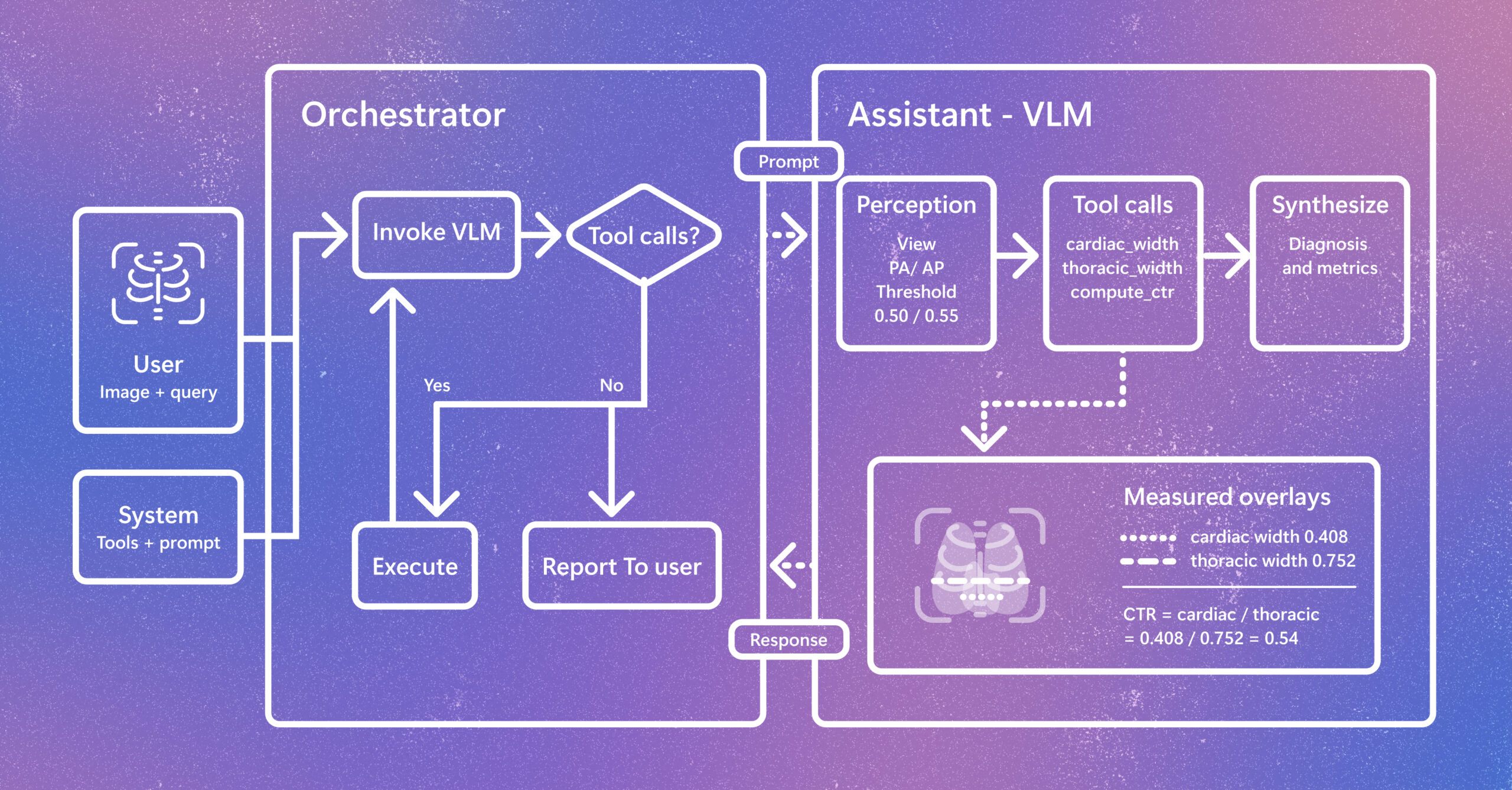
Radiology AI is evolving beyond report generation. CARE-X explores a unified approach that combines flexible reasoning, calibrated predictions, and measurement-based tools for chest X-ray interpretation. The post Introducing CARE-X: Towards Clinically Useful Radiology VLMs with Auxiliary Supervision, Reward-Aligned Learning, and Tool-Augmented Measurement appeared first on Microsoft Research.