Answer Correction with Verifiable Rewards: A Gemma-Family Study of Multi-View Driving QA
T N RickeshPranav VinodhSowmya Kamath S
Nov 2026
Machine LearningComputer Vision
Abstract
Multi-camera driving question answering provides a discrete test of vision-language models, but post-training gains can reflect changed selected answers or improved answer extraction. We investigate this distinction within the Gemma model family using archived, task-linked WaymoQA evaluations. A zero-shot diagnostic on 5,519 test questions spans effective-small, mixture-of-experts, unified, and dense checkpoints, with serving differences disclosed rather than interpreted as architecture effects. The strongest controlled evidence is a matched-harness Gemma-4-12B base/GRPO pair: accuracy rises from 73.78% to 75.43%, a gain of 1.65 percentage points with a scene-cluster bootstrap interval of [+0.84, +2.41]. There are 215 improvements and 124 regressions; 213 improvements start from an extractable but incorrect base answer, and only two recover previously unextractable responses. Crossing correctness with extraction state shows why correct noncompliant outputs cannot be counted as prediction errors. Category counts reveal a critical safety asymmetry: routine perception gains (+5.93 pp) mask a regression in safety-critical hazard prediction (-1.82 pp), demonstrating that unweighted outcome rewards can trade off rare edge cases for aggregate accuracy. Reward saturation describes sampled training dynamics rather than an architectural ceiling. A separate archived Gemma-31B thinking comparison yields no detected average improvement, with uncertainty that does not establish equivalence. These results support a modest answer-selection gain for the recorded tuning configuration and a reproducible diagnostic accounting, without attributing corrected labels to specific grounding mechanisms or claiming superiority over matched supervised tuning.

This paper investigates developing real-world perception for active agents, proposes Gibson Environment for this purpose, and showcases a set of perceptual tasks learned therein.
F. Xia, Amir Zamir, Zhi-Yang He et al.· 2018 IEEE/CVF Conference on...· 1,069 citations· ⚡112
This publication proposes a definition and a classification of agile software development approaches and analyses ten software development methods that can be characterized as being "agile" against the defined criterion.
P. Abrahamsson, O. Salo, Jussi Ronkainen et al.· arXiv.org· 727 citations· ⚡54
The study shows that agile practices improve both informal and formal communication, but indicates that, in larger development situations involving multiple external stakeholders, a mismatch of adequate communication mechanisms can sometimes even hinder the communication.
M. Pikkarainen, Jukka Haikara, O. Salo et al.· Empirical Software Engineeri...· 401 citations· ⚡48
The results indicate that software engineering work practices are chosen opportunistically, adapted and configured to provide value under the constrains imposed by the startup context.
Nicolò Paternoster, Carmine Giardino, M. Unterkalmsteiner et al.· Information and Software Tec...· 394 citations· ⚡54
The possibility of inferring high-dimensional data inference in a model that consists of a prior and an auxiliary differentiable constraint given some additional information is considered, thereby allowing a range of potential applications in adapting models to new domains and tasks.
Alexandros Graikos, Esmeralda S. Whitammer, N. Jojic et al.· Neural Information Processin...· 316 citations· ⚡15
Related blog posts
MIT News · Artificial Intelligence· news.mit.eduOct 28, 2026
Professor Paris Smaragdis develops computers with superhuman hearing for applications like speech recognition, music understanding, and environmental monitoring.
Exploring how generative AI could make machine vision more accessible to businesses. The post GenEye in a Box: Making Machine Vision Something You Can Just Ask For appeared first on GPT-Lab.
Microsoft Research Blog· microsoft.comAug 11, 2026
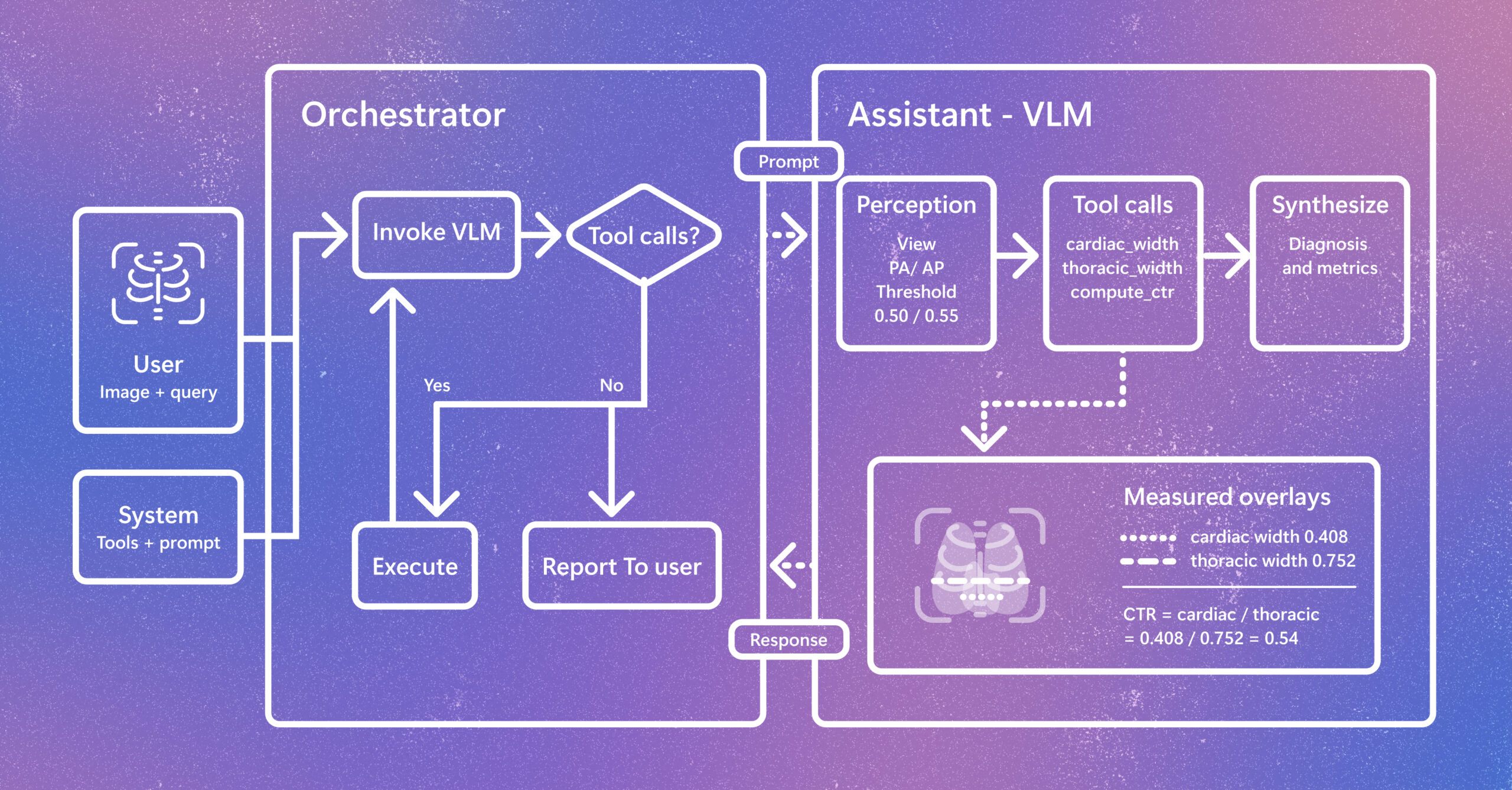
Radiology AI is evolving beyond report generation. CARE-X explores a unified approach that combines flexible reasoning, calibrated predictions, and measurement-based tools for chest X-ray interpretation. The post Introducing CARE-X: Towards Clinically Useful Radiology VLMs with Auxiliary Supervision, Reward-Aligned Learning, and Tool-Augmented Measurement appeared first on Microsoft Research.