Skip to content
#diffusion models Book Open access

SGeture: Self-Guided Generative Reranking via Picturing the Permutation

Nov 2026 · Proceedings of the 35th ACM International Conference on Information and Knowledge Management · 0 citations · 37 references
Natural Language Processing Techniques

Abstract

Reranking is instrumental in multi-stage recommender systems as it produces the target sequence of items exposed to users. Generative models have shown promise in this field recently, surpassing traditional discriminative paradigms. However, current methods generally follow an item-level generation manner. They either construct a sequence by irreversible autoregression, or iteratively refine a given sequence through item swapping and replacements. Such item-level decision horizons may cause the solution to be trapped in a local optimum, and also limit the ability to capture dependencies within the sequence, thus failing to pursue a global optimal objective. Furthermore, these methods mainly rely on historical contexts for modeling. We argue that in addition to such ''past descriptors'', the generation of a target sequence also requires directional guidance related to the future. In this paper, we propose SGeture (Self-Guided Generative Reranking via Picturing the Permutation), a sequence generation framework to address the above limitations. First, a self-guidance mechanism is designed to shape a future ''guidance'': (i) we enable the model to learn the correspondence between an exposed sequence and its own resulting future; (ii) at inference, the model is then equipped to self-control the future to be a desired one, therefore self-guiding the generation of a target sequence. Second, we present a holistic sequence generator for reranking. Specifically, a diffusion module is employed to progressively ''picture'' the permutation over candidate items in a sequence-level manner instructed by the above guidance, thereby avoiding local decision traps. Extensive offline experiments on public datasets and online A/B tests across different platforms of a real-world video application justify that our framework consistently outperforms existing generative approaches in reranking.

Read PDF

Similar papers

#computer vision Open access Jun 2016

Software Development in Startup Companies: The Greenfield Startup Model

The results are packaged in the Greenfield Startup Model (GSM), which explains the priority of startups to release the product as quickly as possible, and the need to shorten time-to-market, by speeding up the development through low-precision engineering activities.

Carmine Giardino, Nicolò Paternoster, M. Unterkalmsteiner et al. · 178 citations · ⚡14
#computer vision Open access Oct 2016

Software Startups - A Research Agenda

Software startup companies develop innovative, software-intensive products within limited timeframes and with few resources, searching for sustainable and scalable business models.

M. Unterkalmsteiner, P. Abrahamsson, Xiaofeng Wang et al. · 157 citations · ⚡17
#machine learning Review Open access Oct 2016

“Failures” to be celebrated: an analysis of major pivots of software startups

This study conducts a case survey study based on the secondary data of the major pivots happened in 49 software startups, and demonstrates that customer need pivot is the most common among all pivot types.

Sohaib Shahid Bajwa, Xiaofeng Wang, Anh Nguyen-Duc et al. · 127 citations · ⚡15
#computer vision Review Open access May 2015

A survey study on major technical barriers affecting the decision to adopt cloud services

The comparison of adopter and non-adopter sample reveals three potential adoption inhibitor, security, data privacy, and portability, which underlines the importance of the technical and security perspectives for research investigating the adoption of technology.

Nattakarn Phaphoom, Xiaofeng Wang, S. Samuel et al. · 111 citations · ⚡8
#large language models Review Open access Nov 2020

Status of the WHO recommended timing and frequency of antenatal care visits in Northern Bangladesh

Objective There is dearth of information on the timeliness of antenatal care (ANC) uptake. This study aimed to determine the timely ANC uptake by a medically trained provider (MTP) as per the World Health Organization (WHO) recommendations and the country guideline. Methods Cross-sectional survey was done with 2,731 wo...

B. Sarker, Musfikur Rahman, T. Rahman et al. · 89 citations · ⚡7
#computer vision Open access Feb 2018

Lean Internal Startups for Software Product Innovation in Large Companies: Enablers and Inhibitors

This study investigates how Lean internal startup facilitates software product innovation in large companies and identifies its enablers and inhibitors, and shows the potential of the method-in-action framework to investigate the Lean startup approach in non-startup context.

Henry Edison, Nina M. Smørsgård, Xiaofeng Wang et al. · 78 citations · ⚡6

Related blog posts

Microsoft Research Blog Nov 16, 2026

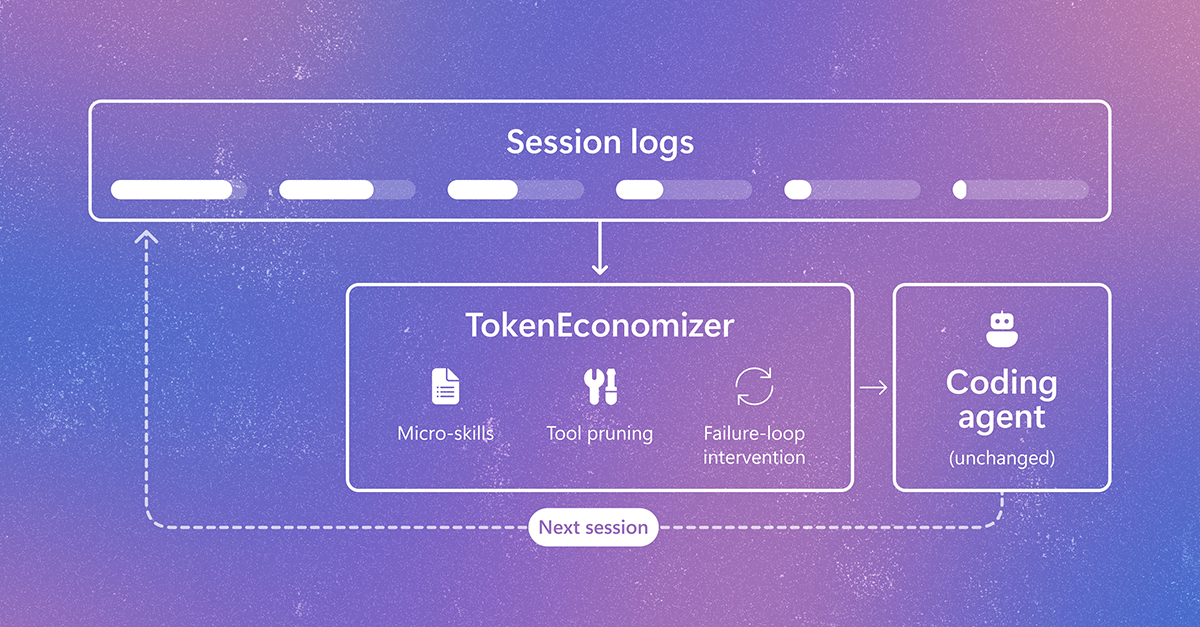
TokenEconomizer: Learning from Experience to Make AI Coding Agents More Efficient

AI coding agents are increasingly help developers fix bugs and build features largely on their own, but every interaction with their models consumes tokens. In each session, an agent sends instructions, tool descriptions, and session history to its model. Most efforts to reduce this cost focus on individual tasks. Yet developers return to the same […] The post TokenEconomizer: Learning from Experience to Make AI Coding Agents More Efficient appeared first on Microsoft Research.

We use cookies to run the site and, with your consent, for analytics and to show ads. See our Cookie Policy.