Decision-based sparse attacks must reduce perturbation support using only the victim's predicted label. The best restoration strategy varies as support contracts: coarse removal works early, while tail states need finer, history-aware tests. We propose RLGPA, an online reinforcement learning method that schedules support-reduction executors and their granularity under a hard query budget. A masked Dueling Double DQN selects among seven stable policy--scale actions; each action produces support-relative restoration groups that are rebuilt after every macro decision. A feasibility-preserving executor commits only adversarial restorations and feeds support gain and query cost back to the planner. Under the matched top-1-label oracle, RLGPA reaches 61\% targeted ASR at sparsity 0.01 on CIFAR-10 (vs. 25\% SparseEvo, 0\% Pointwise), and 75.5\%/73.0\% on ResNet50/ViT at sparsity 0.005 (vs. 29.0\%/15.5\%). A fixed-probe test reduces median \(L_0\) from 165 to 23 after 40 images without any update. State-blind and state-shuffled controls degrade significantly, confirming that the learned policy uses attack state; the main gains come from state-conditioned executor scheduling and dynamic repartition. The source code is publicly available at https://github.com/Acui001/RLGPA.git.

This paper investigates developing real-world perception for active agents, proposes Gibson Environment for this purpose, and showcases a set of perceptual tasks learned therein.
F. Xia, Amir Zamir, Zhi-Yang He et al.· 2018 IEEE/CVF Conference on...· 1,069 citations· ⚡112
This publication proposes a definition and a classification of agile software development approaches and analyses ten software development methods that can be characterized as being "agile" against the defined criterion.
P. Abrahamsson, O. Salo, Jussi Ronkainen et al.· arXiv.org· 727 citations· ⚡54
The study shows that agile practices improve both informal and formal communication, but indicates that, in larger development situations involving multiple external stakeholders, a mismatch of adequate communication mechanisms can sometimes even hinder the communication.
M. Pikkarainen, Jukka Haikara, O. Salo et al.· Empirical Software Engineeri...· 401 citations· ⚡48
The results indicate that software engineering work practices are chosen opportunistically, adapted and configured to provide value under the constrains imposed by the startup context.
Nicolò Paternoster, Carmine Giardino, M. Unterkalmsteiner et al.· Information and Software Tec...· 394 citations· ⚡54
The possibility of inferring high-dimensional data inference in a model that consists of a prior and an auxiliary differentiable constraint given some additional information is considered, thereby allowing a range of potential applications in adapting models to new domains and tasks.
Alexandros Graikos, Esmeralda S. Whitammer, N. Jojic et al.· Neural Information Processin...· 316 citations· ⚡15
Related blog posts
MIT News · Artificial Intelligence· news.mit.eduOct 28, 2026
Professor Paris Smaragdis develops computers with superhuman hearing for applications like speech recognition, music understanding, and environmental monitoring.
Exploring how generative AI could make machine vision more accessible to businesses. The post GenEye in a Box: Making Machine Vision Something You Can Just Ask For appeared first on GPT-Lab.
Microsoft Research Blog· microsoft.comAug 11, 2026
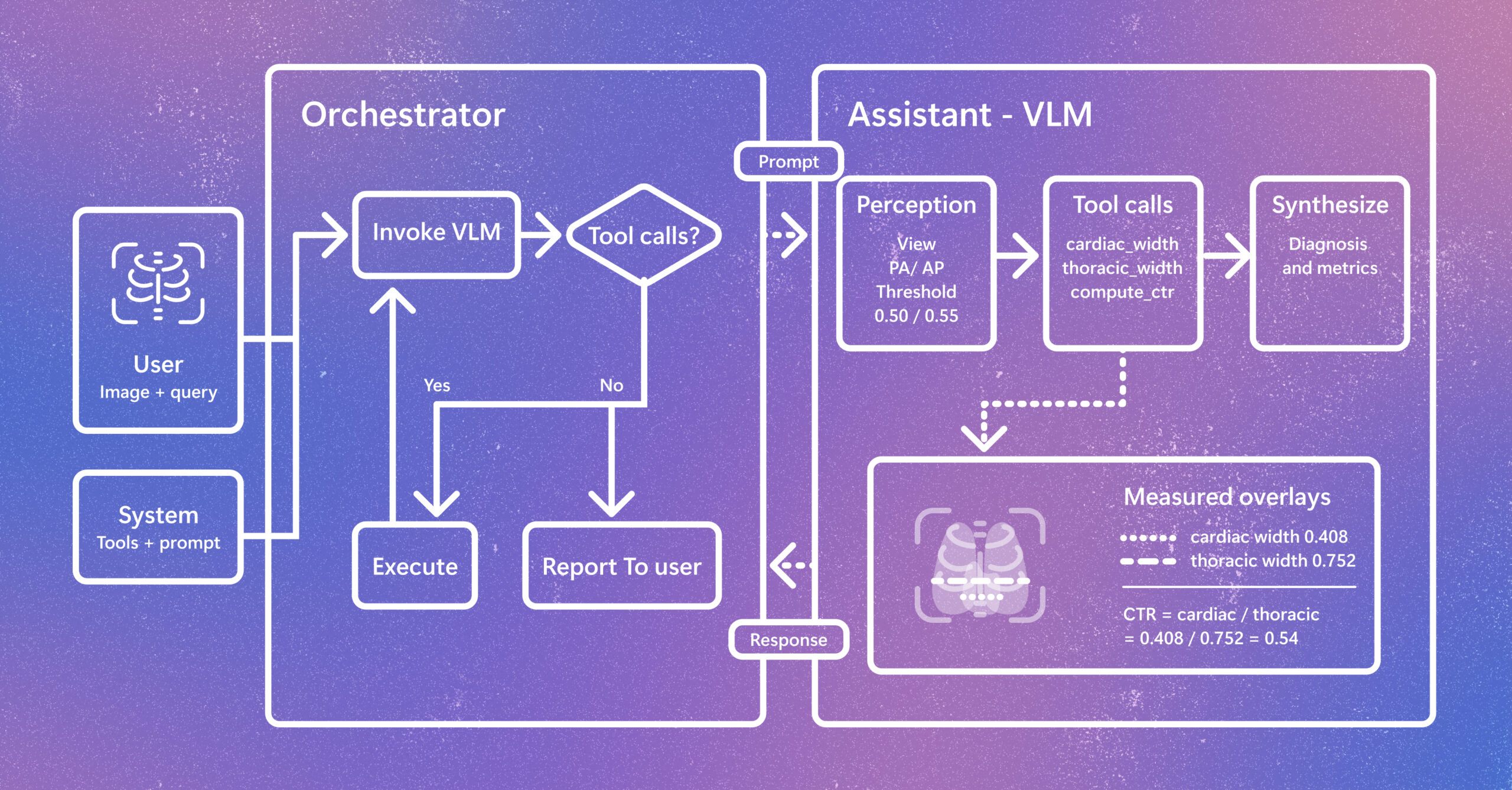
Radiology AI is evolving beyond report generation. CARE-X explores a unified approach that combines flexible reasoning, calibrated predictions, and measurement-based tools for chest X-ray interpretation. The post Introducing CARE-X: Towards Clinically Useful Radiology VLMs with Auxiliary Supervision, Reward-Aligned Learning, and Tool-Augmented Measurement appeared first on Microsoft Research.