Classification and feature learning are two closely interrelated fundamental tasks. Feature learning in supervised settings is typically achieved by training classification models, under the common assumption that higher classification accuracy implies better feature quality. In this paper, we first point out that classification accuracy reflects the sample-wise local properties of a model on a dataset, whereas feature learning aims to learn features with good dataset-level global properties, such as intra-class compactness and inter-class separability. From the first principle of feature learning, we redesign the binary cross-entropy (BCE) loss, a counterpart of the cross-entropy (CE) loss used in classification. Then, in normalized feature space, we analyze the minima of the BCE and CE losses and show that both can lead to neural collapse, where sample features from different classes become maximally compact and maximally separated. More importantly, by investigating the convergence behaviors of the two losses as the scale factor $\gamma$ varies in the normalized space, we reveal how classification accuracy and feature quality change differently across spaces of different sizes. Under a fixed training strategy, a very large $\gamma$ achieves perfect classification accuracy but slows convergence toward the ideal feature geometry, whereas a very small $\gamma$ makes classification highly sensitive to small perturbations. A moderate $\gamma$ is therefore necessary for simultaneously achieving reliable classification and well-structured features. Extensive experiments validate these findings and demonstrate that BCE loss exhibits advantages in long-tail and open-set recognitions, as it better aligns with the global requirements of feature learning.

This paper investigates developing real-world perception for active agents, proposes Gibson Environment for this purpose, and showcases a set of perceptual tasks learned therein.
F. Xia, Amir Zamir, Zhi-Yang He et al.· 2018 IEEE/CVF Conference on...· 1,069 citations· ⚡112
This publication proposes a definition and a classification of agile software development approaches and analyses ten software development methods that can be characterized as being "agile" against the defined criterion.
P. Abrahamsson, O. Salo, Jussi Ronkainen et al.· arXiv.org· 727 citations· ⚡54
The study shows that agile practices improve both informal and formal communication, but indicates that, in larger development situations involving multiple external stakeholders, a mismatch of adequate communication mechanisms can sometimes even hinder the communication.
M. Pikkarainen, Jukka Haikara, O. Salo et al.· Empirical Software Engineeri...· 401 citations· ⚡48
The results indicate that software engineering work practices are chosen opportunistically, adapted and configured to provide value under the constrains imposed by the startup context.
Nicolò Paternoster, Carmine Giardino, M. Unterkalmsteiner et al.· Information and Software Tec...· 394 citations· ⚡54
The possibility of inferring high-dimensional data inference in a model that consists of a prior and an auxiliary differentiable constraint given some additional information is considered, thereby allowing a range of potential applications in adapting models to new domains and tasks.
Alexandros Graikos, Esmeralda S. Whitammer, N. Jojic et al.· Neural Information Processin...· 316 citations· ⚡15
Related blog posts
MIT News · Artificial Intelligence· news.mit.eduOct 28, 2026
Professor Paris Smaragdis develops computers with superhuman hearing for applications like speech recognition, music understanding, and environmental monitoring.
Exploring how generative AI could make machine vision more accessible to businesses. The post GenEye in a Box: Making Machine Vision Something You Can Just Ask For appeared first on GPT-Lab.
Microsoft Research Blog· microsoft.comAug 11, 2026
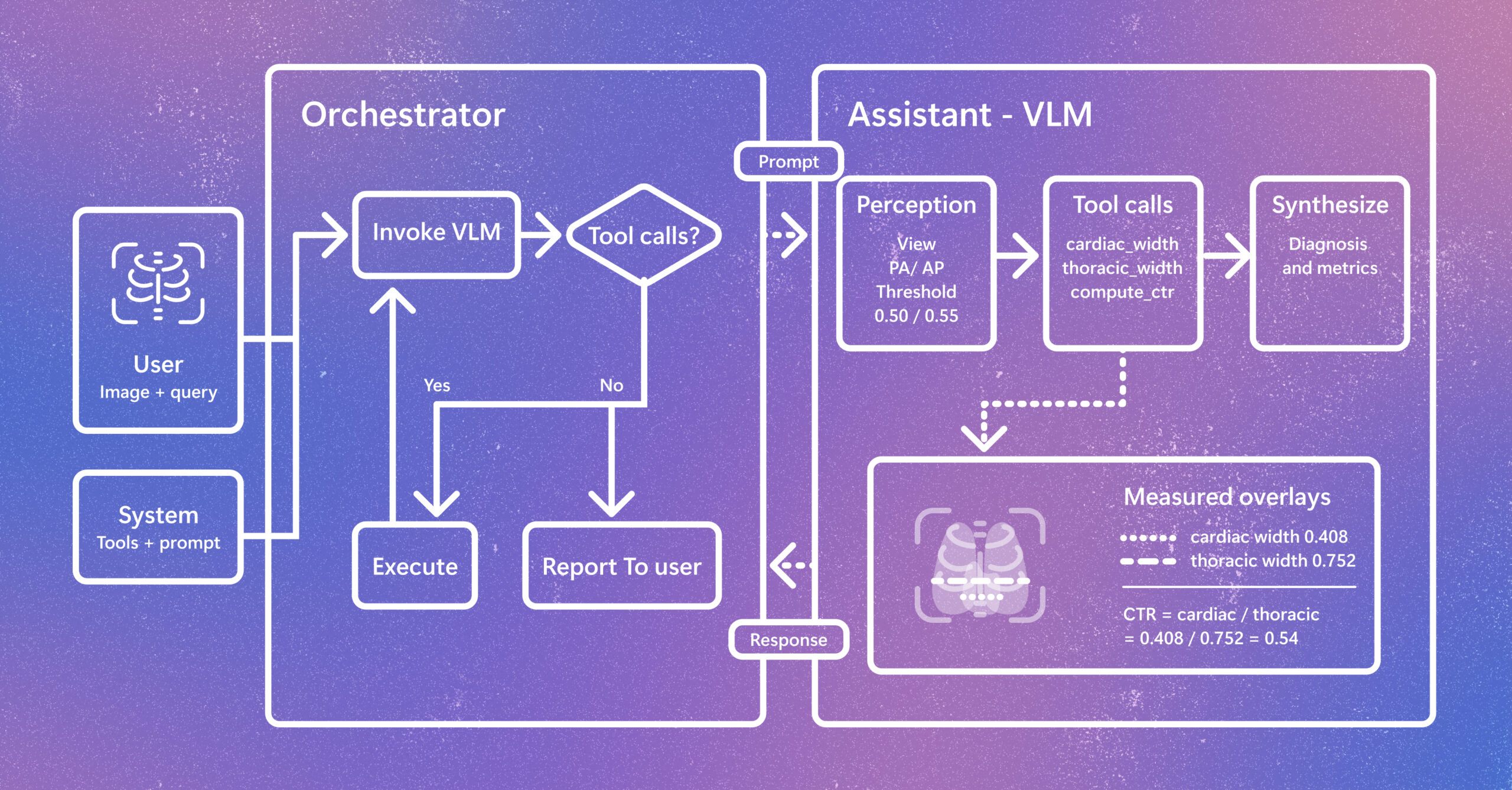
Radiology AI is evolving beyond report generation. CARE-X explores a unified approach that combines flexible reasoning, calibrated predictions, and measurement-based tools for chest X-ray interpretation. The post Introducing CARE-X: Towards Clinically Useful Radiology VLMs with Auxiliary Supervision, Reward-Aligned Learning, and Tool-Augmented Measurement appeared first on Microsoft Research.