Performance metrics can yield different conclusions from the same predictions. This methodological tutorial explains the effects of class prevalence, decision thresholds, aggregation rules and software conventions through controlled scenarios. Twenty-two confusion-matrix metrics are organized in a prevalence-coded map. Fifteen scenarios cover binary and multi-class classification, score discrimination, probability calibration, regression, uncertainty and consistency checks. Inputs are fixed in released files, and one factor is varied in each scenario. All 205 verification checks passed; 202 were independent and 3 were internal. An always-negative rule achieved an accuracy of 0.990 at a prevalence of 0.010, with balanced accuracy of 0.500. At fixed sensitivity and specificity, precision fell from 0.889 to 0.008 as prevalence fell from 0.5 to 0.001. Three probability variants shared a ROC-AUC of 0.825 but had calibration slopes of 2.08, 1.04 and 0.52. With 10 participants, participant-majority accuracy of 0.700 had a 95% interval of 0.348-0.933. Fold-averaged scores were falsely flagged as inconsistent under an inappropriate pooled-test-set model. A goal-based metric table and a reporting checklist are provided. The scenarios illustrate mechanisms and do not estimate their frequency in published studies. A literature audit and a real-data demonstration are specified as future protocols and were not executed.
This paper investigates developing real-world perception for active agents, proposes Gibson Environment for this purpose, and showcases a set of perceptual tasks learned therein.
F. Xia, Amir Zamir, Zhi-Yang He et al.· 2018 IEEE/CVF Conference on...· 1,069 citations· ⚡112
This publication proposes a definition and a classification of agile software development approaches and analyses ten software development methods that can be characterized as being "agile" against the defined criterion.
P. Abrahamsson, O. Salo, Jussi Ronkainen et al.· arXiv.org· 727 citations· ⚡54
The study shows that agile practices improve both informal and formal communication, but indicates that, in larger development situations involving multiple external stakeholders, a mismatch of adequate communication mechanisms can sometimes even hinder the communication.
M. Pikkarainen, Jukka Haikara, O. Salo et al.· Empirical Software Engineeri...· 401 citations· ⚡48
The results indicate that software engineering work practices are chosen opportunistically, adapted and configured to provide value under the constrains imposed by the startup context.
Nicolò Paternoster, Carmine Giardino, M. Unterkalmsteiner et al.· Information and Software Tec...· 394 citations· ⚡54
The possibility of inferring high-dimensional data inference in a model that consists of a prior and an auxiliary differentiable constraint given some additional information is considered, thereby allowing a range of potential applications in adapting models to new domains and tasks.
Alexandros Graikos, Esmeralda S. Whitammer, N. Jojic et al.· Neural Information Processin...· 316 citations· ⚡15
It is proved that any global minimizer of the trajectory balance objective can define a policy that samples exactly from the target distribution, and empirically demonstrate the benefits of the trajectories balance objective for GFlowNet convergence, diversity of generated samples, and robustness to long action sequenc...
Esmeralda S. Whitammer, Moksh Jain, Emmanuel Bengio et al.· Neural Information Processin...· 302 citations· ⚡60
Related blog posts
Microsoft Research Blog· microsoft.comOct 12, 2026
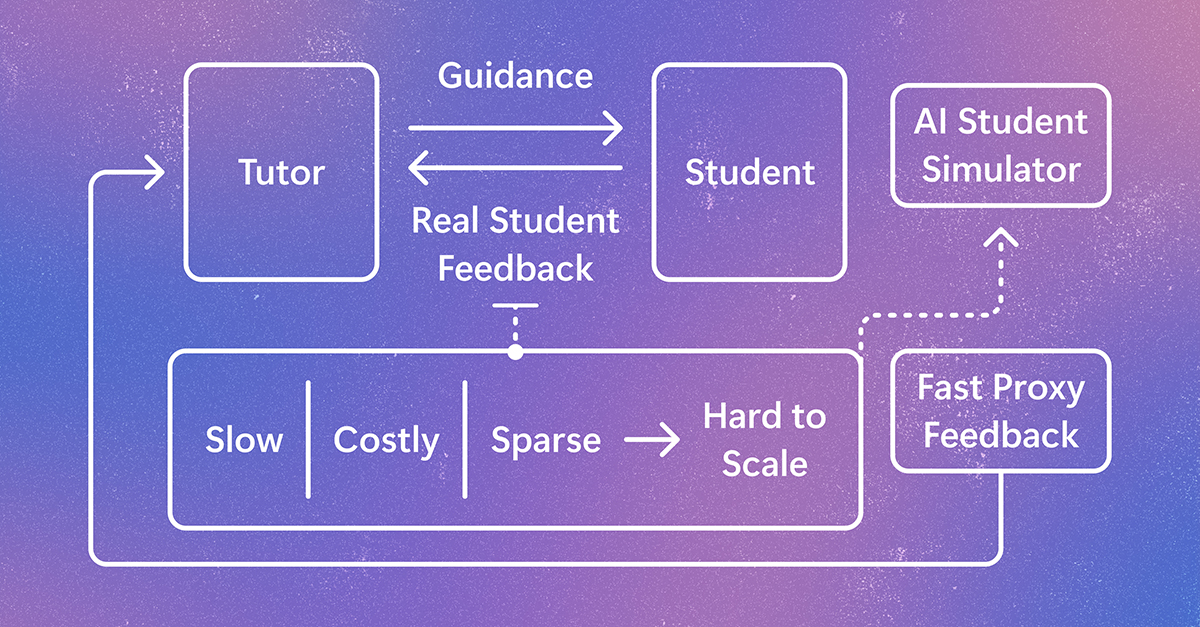
StudentSim is a research system for evaluating and improving AI tutoring tools before they are tested with learners. It models how individuals may engage with tutors, giving feedback to improve tutor performance across subjects like chess, writing, and mathematics. The post Simulating student learning for better AI tutoring appeared first on Microsoft Research.
AI agents can generate code at a scale that’s hard for humans to review line-by-line. PDD Kit helps ensure the code is doing what the developer intended by creating formal specifications and testing against them. It converts developer intent into a Verus specification, proves AI-generated code meets it for every input, and uses tests where proofs aren't practical. Developers review intent, not every line. The post Formally verifying agent-written full-stack web apps with PDD Kit appeared first o…


